










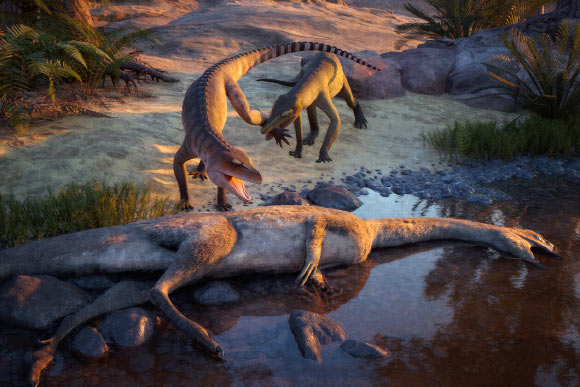
CT scans of a decades-old specimen from the Yale Peabody Museum of Natural History show a new species of short-snouted crocodylomorph with unusually strong jaws, offering a rare snapshot of ecological specialization in the Late Triassic epoch.
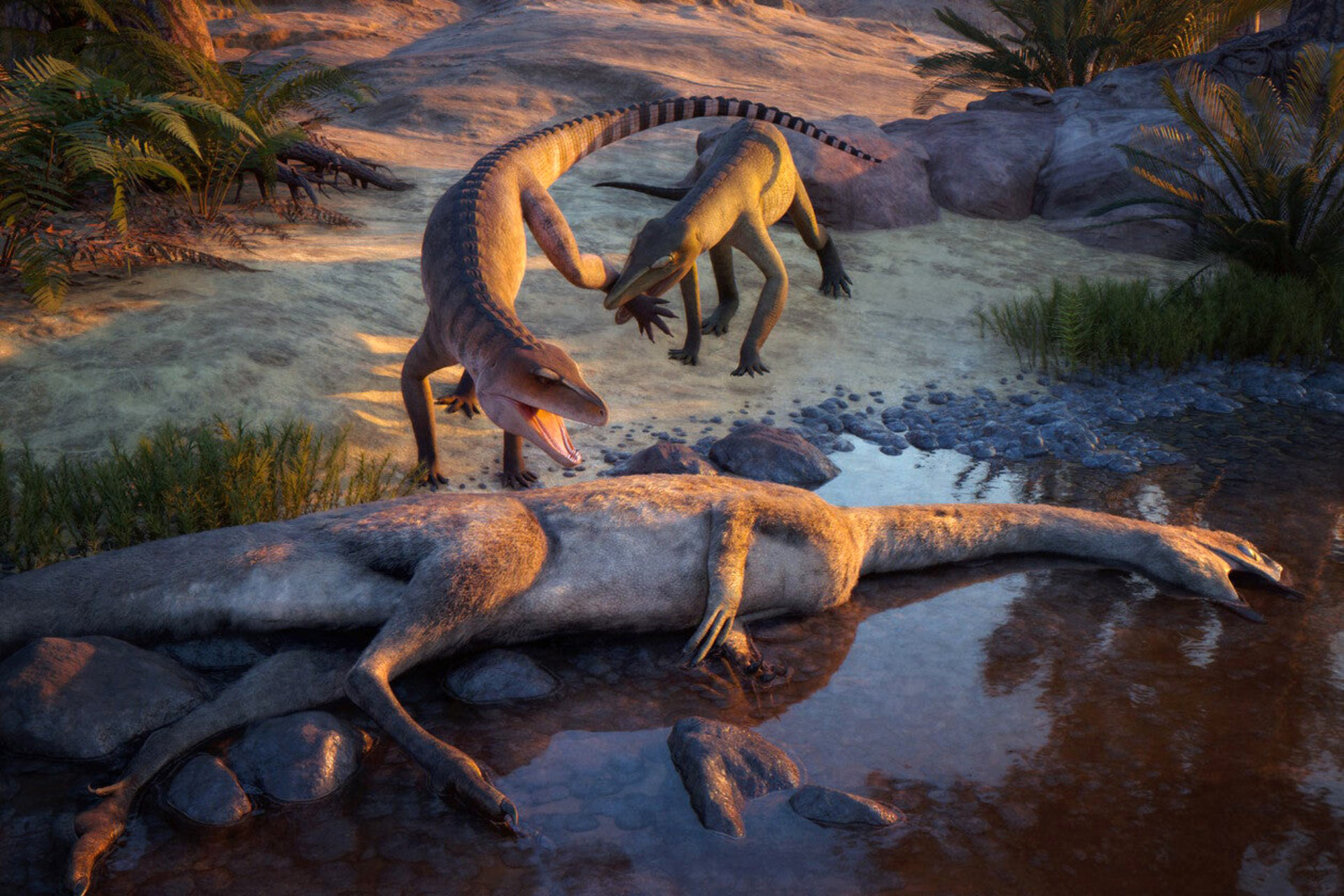
Eosphorosuchus lacrimosa (left) is disturbed by Hesperosuchus agilis (right) near a Coelophysis carcass at what will become modern-day Ghost Ranch, New Mexico, the United States. Image credit: Julio Lacerda.
Eosphorosuchus lacrimosa lived 210 million years ago near rivers and lakes in what is now New Mexico, the United States.
This reptile was a fast-running predator with large back legs and smaller, thinner arms.
It also had a short snout, a heavily reinforced skull, and well-developed jaw muscles perfect for snapping shut on large prey.
“This speaks to the diversification of proto-crocs toward the beginning of the Age of Reptiles,” said Dr. Bhart-Anjan Bhullar, a paleontologist at Yale University and the Yale Peabody Museum of Natural History.
“During this period, the Late Triassic, there were two reptile dynasties vying for dominance: the line that would produce crocodiles and alligators on one side, and that which would produce birds, which of course are dinosaurs, on the other.”
“The dinosaurs at this time were slim, delicate animals that walked on two slender legs almost like herons, and the crocodiles were fast-running, four-legged predators, low-slung and more heavily built — analogous to a jackal, a big fox, or a dog.”
The holotype specimen of Eosphorosuchus lacrimosa includes parts of the skull, lower jaw, vertebrae, limbs, and armor elements.
Excavated in 1948 at Ghost Ranch in New Mexico, the fossil has been known to science for three-quarters of a century, but it was never fully examined or identified.
The team’s phylogenetic analysis places Eosphorosuchus lacrimosa near the base of Crocodylomorpha, outside a clade that includes another small crocodylomorph called Hesperosuchus agilis.
This indicates that its distinctive features evolved early in crocodylomorph history.
Importantly, the fossilized remains of Eosphorosuchus lacrimosa were found in the same assemblage as Hesperosuchus agilis.
The coexistence of these two forms suggests that early crocodylomorphs were already partitioning ecological niches, even among similarly sized terrestrial predators.
“Eosphorosuchus lacrimosa is one of only a handful of well-preserved early crocodile relatives, and its coexistence with Hesperosuchus agilis represents the ‘dawn’ of functional diversification in the lineage that would give rise to modern crocodiles,” said Miranda Margulis-Ohnuma, a Ph.D. student at Yale University.
“In addition to its unique anatomy and preservational history, the specimen demonstrates the potential of existing museum collections to continue revealing novel insights into the history of life.”
“What makes the discovery particularly compelling, researchers say, is the fact that it provides a snapshot of a long-ago ecosystem whose biodiversity was sufficiently rich that close relatives partitioned their ecological roles by specializing their feeding anatomy.”
The team’s paper was published this month in the Proceedings of the Royal Society B.
_____
Miranda Margulis-Ohnuma et al. 2026. A short-snouted ‘sphenosuchian’ with unusual feeding anatomy demonstrates that ecological specialization occurred early in crocodylomorph evolution. Proc Biol Sci 293 (2069): 20260130; doi: 10.1098/rspb.2026.0130
Source: Read Full Article