










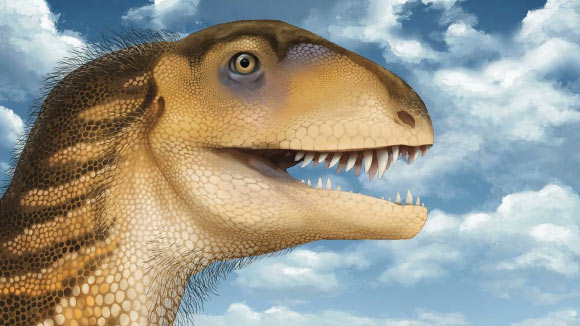
A new genus and species of carnivorous herrerasaurian dinosaur has been described from an incomplete but well-preserved skull found in northern New Mexico, the United States.
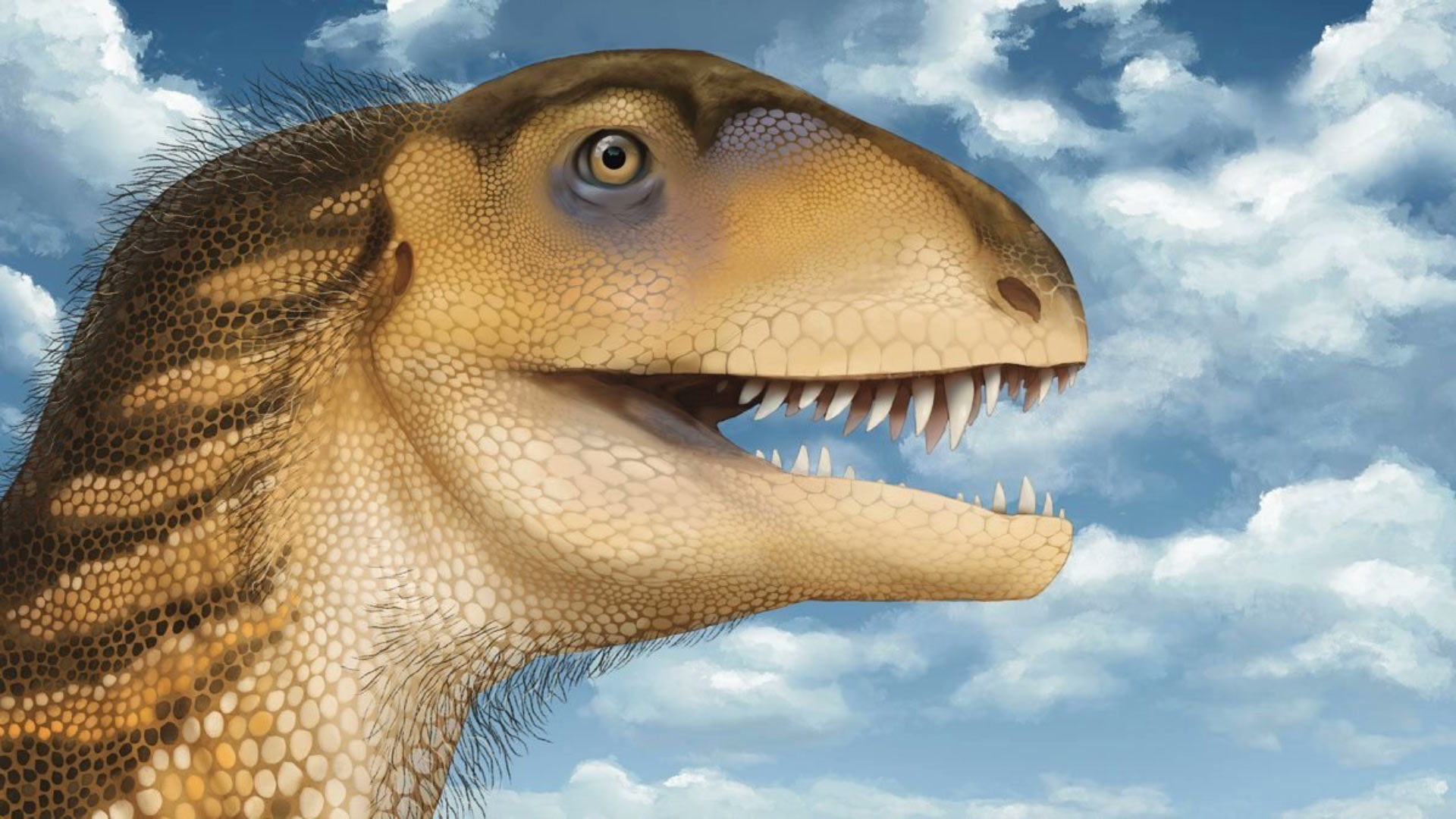
An artistic rendition of Ptychotherates bucculentus. Image credit: Megan Sodano / Virginia Tech.
The new dinosaur species roamed our planet around 201 million years ago during the Rhaetian stage of the latest Triassic.
Named Ptychotherates bucculentus, it offers rare insight into a poorly understood moment in dinosaur history.
“Dinosaurs originated in the Carnian stage (237 to 227 million years ago), the earliest part of the Late Triassic, and subsequently diverged into three Jurassic-surviving lineages: Ornithischia, Theropoda and Sauropodomorpha,” said Virginia Tech paleontologists Simba Srivastava and Sterling Nesbitt.
“Nearly all of the earliest dinosaur remains come from the high-latitude southern part of Pangea (i.e. present-day Brazil, Argentina, Zimbabwe, India, whereas the lower latitudes (i.e. Late Triassic deposits of the American Southwest, Morocco) have few, if any, diagnostic dinosaur remains from the equivalent age.”
The fossilized remains of Ptychotherates bucculentus — a mostly complete skull with a complete braincase and much of the skull roof — were found in 1982 in the Coelophysis Quarry in northern New Mexico.
The skull itself measures about 22 cm (9 inches) in length and suggests a dinosaur with a relatively tall, narrow head.
“The skull shows that the species had massive cheekbones, a wide braincase, and probably a short, deep snout,” the paleontologists said.
“It was the first time these characteristics had been seen in early dinosaurs, indicating that they were constantly evolving.”
Ptychotherates bucculentus belongs to one of the earliest-evolving families of carnivorous dinosaurs called Herrerasauria.
The species is closely related to two Triassic dinosaurs: Tawa hallae and Chindesaurus bryansmalli.
These animals form part of a newly-defined clade, Morphoraptora, which displays a mix of anatomical features seen in both more primitive dinosaurs and later theropods.
“Through anatomical comparison with other Triassic archosaurs and inclusion in phylogenetic analyses, we support Ptychotherates bucculentus as a new taxon of saurischian dinosaur closely related to Tawa hallae,” the researchers said.
“More broadly, we recover Ptychotherates bucculentus as a member of Morphoraptora, a clade known exclusively from the Upper Triassic deposits of southwestern United States.”
Previously, scientists believed that by the latest Triassic, the earliest carnivorous dinosaur lineages had already disappeared, replaced by more advanced theropods.
However, the presence of Ptychotherates bucculentus suggests that some of these groups persisted much longer than expected, at least in low-latitude regions of the ancient supercontinent Pangea.
“Ptychotherates bucculentus was found in rocks that may date to right before the great extinction at the end of the Triassic period — and no other members of their family was ever seen again, possibly suggesting that this dinosaur group went extinct as a result of that mass extinction,” the scientists said.
“This forces us to reconsider the impact of the end-Triassic extinction as something that wiped out not just the competitors to dinosaurs, but some long-standing dinosaur lineages themselves,” Srivastava added.
“And finally, because no herrerasaurians have been found anywhere else this late in the Triassic, the area that is today the American Southwest may have been where they survived the longest and made their last stand.”
The discovery of Ptychotherates bucculentus is reported in a paper published this week in the journal Papers in Palaeontology.
_____
Simba Srivastava & Sterling J. Nesbitt. 2026. A new taxon of saurischian dinosaur from the Coelophysis Quarry of New Mexico, USA (Triassic: latest Norian or Rhaetian) highlights herrerasaurian diversity in the latest Triassic. Papers in Palaeontology 12 (2): e70069; doi: 10.1002/spp2.70069
Source: Read Full Article