










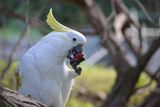
Wild cockatoos don’t rush into unfamiliar food. Faced with something new, they’re often suspicious. But after watching a few birds try it, others quickly start copying.
In a study published in PLOS Biology, researchers at the Australian National University tracked more than 700 wild sulphur-crested cockatoos in Sydney to see how they respond to new food. By introducing brightly colored almonds the birds had never seen before, the team found that once a handful of individuals learned the food was safe, that knowledge quickly spread through the group, largely through social interactions rather than trial and error.
“Our study demonstrates how social learning allows urban cockatoos to rapidly adopt new food sources — which may be part of the secret to their successful persistence in urban areas,” the authors stated in a press release.
Wild Cockatoos Copy Each Other to Decide What’s Safe to Eat
To see how this played out in the wild, researchers set up feeding stations near five cockatoo roosts across Sydney. The food was deliberately unusual: almonds still in their shells and dyed bright red or blue, something the birds were unlikely to encounter naturally.
Before placing the feeders, the team trained four cockatoos to eat the almonds. Those birds became the first to handle and crack open the unfamiliar food in front of others.
At first, most cockatoos avoided the almonds. Some backed away or picked them up only to drop them.
At the sites where trained birds were present, other cockatoos began trying the almonds soon after watching them. At a nearby site with no trained birds, the food remained untouched for several days. The first bird to try it there had previously spent time with birds from another group that already knew the almonds were safe. Within minutes, others followed.
Over 10 days, 349 birds began eating the almonds, showing how quickly a new behavior can spread through a social group.
Read More: Bruce the Parrot Has No Upper Beak Yet Is the Undefeated Alpha Male Thanks to a “Jousting” Technique
Why Some Cockatoos Follow the Crowd — and Others Don’t
Cockatoos that spent more time together were more likely to start eating the almonds around the same time, suggesting they were picking them up directly from one another. When researchers mapped those relationships, the spread of learning mirrored the birds’ social networks.
Younger cockatoos tended to stick with whichever almond color was most popular, while adults were less likely to follow the group and appeared to rely more on their own experience — a pattern also seen in humans, where young children tend to copy what others are doing.
Male birds were more influenced by other males, while adults paid closer attention to birds within their own roost group. These preferences shaped who copied whom and how the behavior moved through the population.
The birds also didn’t all handle the almonds the same way. Some chipped away at the shell bit by bit, while others split it open more directly. Birds that spent more time together tended to use similar techniques, and nearby groups showed more overlap than those farther apart.
How Copying Starts to Look Like Culture in Urban Cockatoos
For animals living in cities, new food sources show up all the time, from human leftovers to unfamiliar plants. Figuring out what’s safe to eat can be risky, especially when a bad choice carries consequences.
What stands out here isn’t just how quickly the cockatoos picked up the new food, but how that knowledge started to vary between groups. Birds in different roosts didn’t just adopt the almonds at different times; they also developed slightly different ways of opening them.
As behaviors spread through social groups and start to vary, they can turn into local traditions, even among neighboring groups.
Read More: Wild Parrots May Follow Language-Like Rules — Including Syntax
Article Sources
Our writers at Discovermagazine.com use peer-reviewed studies and high-quality sources for our articles, and our editors review for scientific accuracy and editorial standards. Review the sources used below for this article:
Source: Read Full Article