









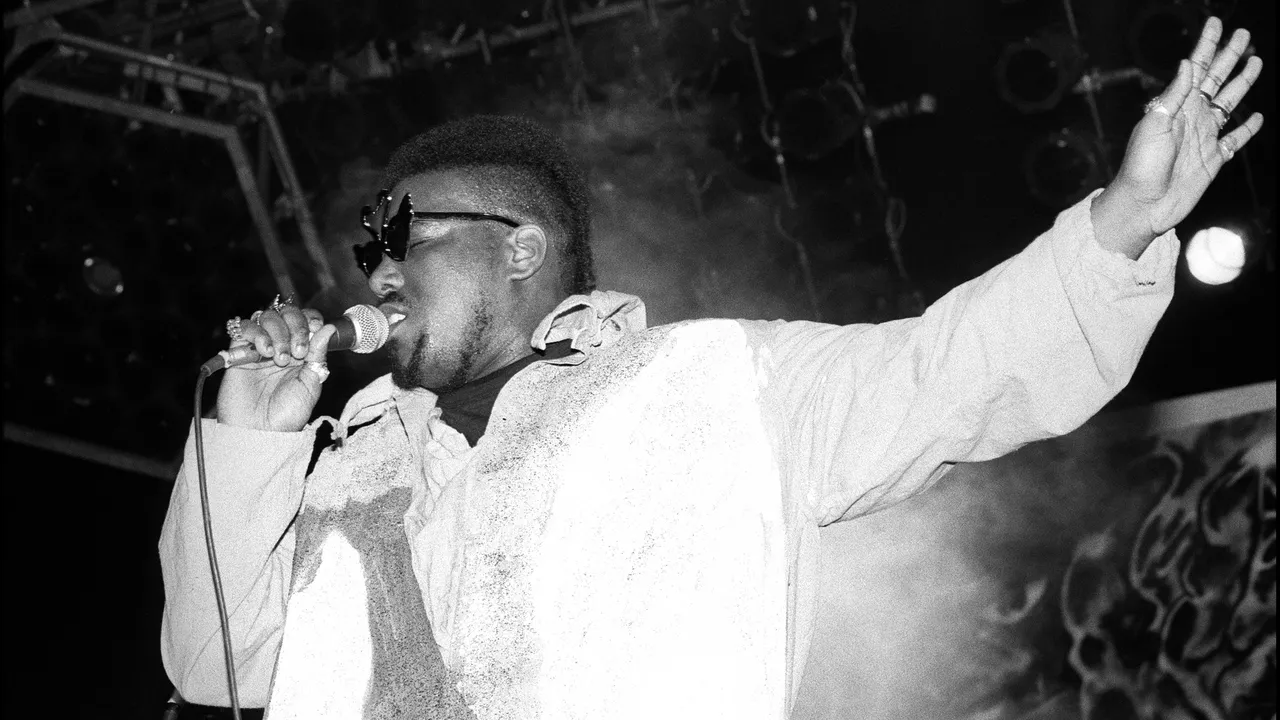
The man who was called the “godfather of hip-hop,” and who took full license from that status, is dead. Afrika Bambaataa passed away in early April, reportedly of prostate cancer, at the age of sixty-eight. His legend is a split one: that of the street griot who molded the genre of the century from the primordial soup of funk, vinyl, and youth disaffection, and that of a predator who allegedly abused more than a dozen children and teen-agers, some of whom worked as his “crate boys,” carting around his voluminous collection of records. The splitting is a form of mythology management. His is not only a case of separating the artist from the art; it is one of separating an originator from his art form.
Men begetting men is the story, a kind of immaculate cultural reproduction. Steven Hager, writing in the Village Voice, in 1982, gave the burgeoning scene in the Bronx the reportorial treatment, widely recognized as the first major newspaper acknowledgment of the turntable innovation that was happening uptown. The piece opens with Bambaataa, then twenty-four years old. It is Black History Month, and the d.j., rapper, producer—no, none of these really communicate his role; he was more akin to a macher, an operator—is holding his third annual party at the Bronx River Community Center. “I Want You Back,” by the Jackson 5, wafts through the gym until the music abruptly stops because shots have been fired outside the door. A panic ensues. Bambaataa summons his authority, the authority that is always suggested by the d.j. booth, with its elevated perch and microphone, and he addresses the audience. “ ‘No violence . . . no violence . . . no violence,’ . . . his voice having a pronounced effect on the more skittish ones in the group,” Hager wrote. Anxiety quelled, the party starts back up, with Bambaataa spinning a record by James Brown. The two would collaborate within a couple of years.
Bambaataa was born Lance Taylor in 1957. Coming up in the nineteen-sixties, his childhood coincided with a schism in Black politics. Lamarse Taylor, his mother, a nurse with Caribbean roots, leaned all the way left, exposing her son, whom she was raising in the Bronx River Houses, to the liberation movement. She also introduced him to records; she owned more than two hundred, which formed the basis of his own eventual collection. Lance Taylor was enamored with the separatism of the Black Panthers. He had a rebirth moment, as a teen-ager, visiting Ivory Coast, Nigeria, and Guinea-Bissau, and “seeing Black people controlling their own destiny, seeing them get up and go to their own work,” as he’d later recall. The romanticization of the uncorrupted mother continent took over. According to the lore—which he was canny about disseminating—it was after he watched “Zulu,” the 1964 desert-war film about British colonialism, that he changed his identity, renaming himself Afrika Bambaataa, after a Zulu warrior. He transformed the Black Spades, a Bronx gang he led, into the Universal Zulu Nation. The Spades had run the Bronx brutally; the Zulu Nation spread “Peace, Love, Unity, and Having Fun.” The Zulu Nation pushed an uplift philosophy, which hung on the promotion of five tenets: graffiti, m.c.ing, d.j.ing, b-boy, and knowledge. Music was the vessel for an elevated mode of being.
It was not clear in the mid-seventies that the city would survive. Its fiscal house was in disorder. Government workers were laid off in droves. Blackouts darkened summers. An unwell postal worker picked off lover’s-lane couples with a revolver. The block parties are remembered as oases, music as literally life-saving. Bambaataa, in the telling, branched off his own parties from that of DJ Kool Herc, the breakbeat innovator, who was like Bambaataa’s confrere, as was Grandmaster Flash. A kind of kinetic pinging between the three generated the sound and the culture of what we now call early hip-hop, always voluble, dance-floor-oriented, and drum-led. As the visionary figure, Bambaataa brought the sampling ethos to the music as well as an Afrocentric philosophy, a way of living unbounded by the earthly confines of whatever America had been or would become. It must be understood that he was a voracious musicologist. His 1982 single “Planet Rock” hits a molten ooze of futuristic funk. He looked the part, too, crowning himself with pharaoh regalia and shield sunglasses. He brought the philosophy to the Mudd Club in downtown Manhattan; he brought the philosophy global, making Kraftwerk and the Bronx talk to each other. If you were a young kid in his orbit in N.Y.C., in the late seventies and for much of the eighties, it goes without saying that Bambaataa would have been the sun to you.
Source: Read Full Article