










Google’s Gemini AI has recently become more agentic and capable inside Google Docs, Sheets, and Slides—and now Microsoft is pushing out a similar upgrade for Copilot. These features have been in testing for a while, but they’re now more widely available to individuals and companies who pay for any of the Microsoft 365 subscriptions.
Essentially, Copilot in Word, Excel, and PowerPoint can now do more on its own—not just offering advice and help, but actually taking over the business of creating and editing itself. There are a host of ways to use this, but here are just a few examples I tested to give you an idea of what’s possible.
If this kind of AI interference isn’t for you, you can hide Copilot from view inside the Microsoft Office apps. On Windows, Choose File > Options > Copilot and uncheck Enable Copilot; on macOS, open the app menu (e.g. Word), then Preferences > Copilot.
Copilot can draft and edit documents in Word
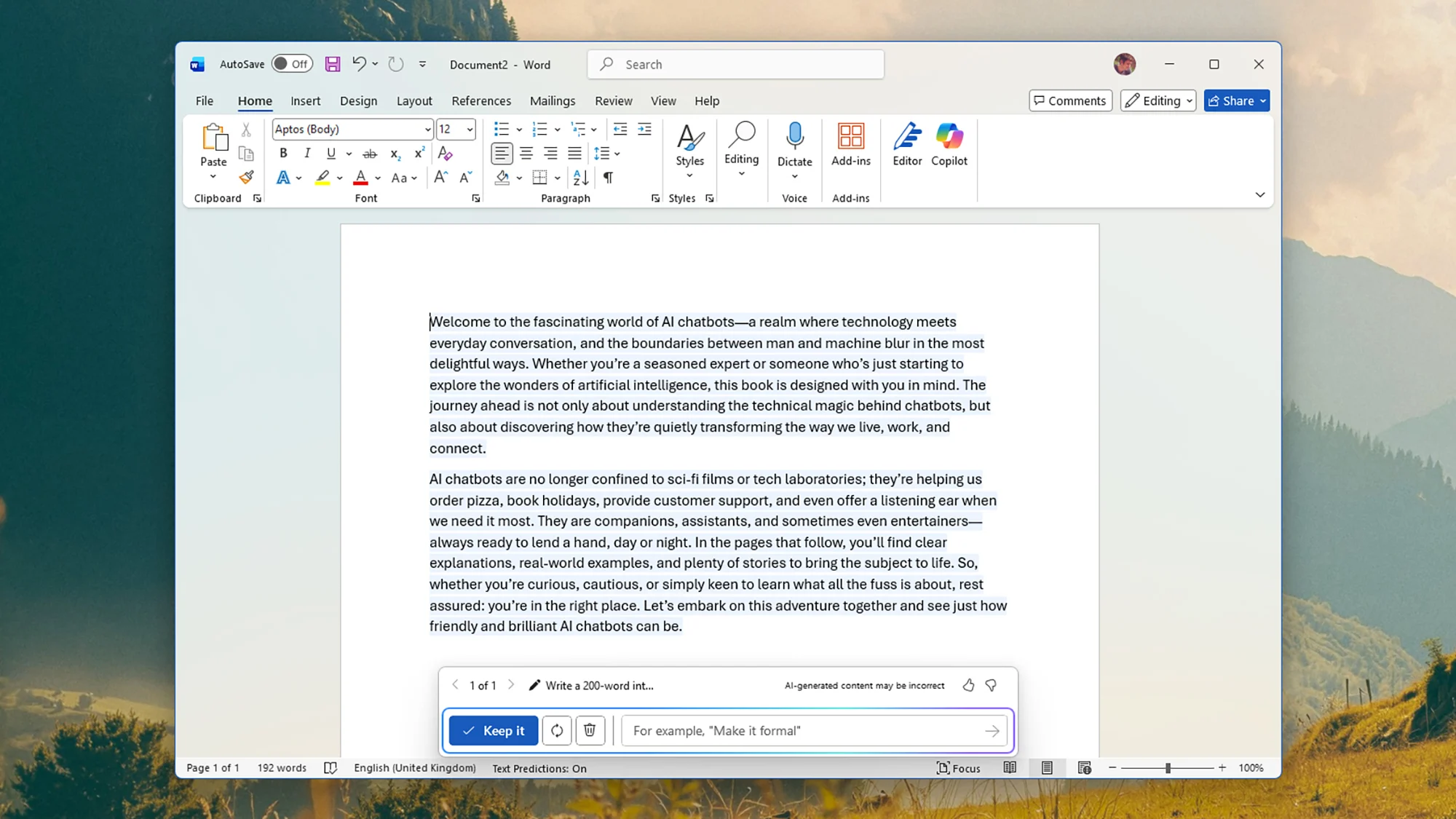
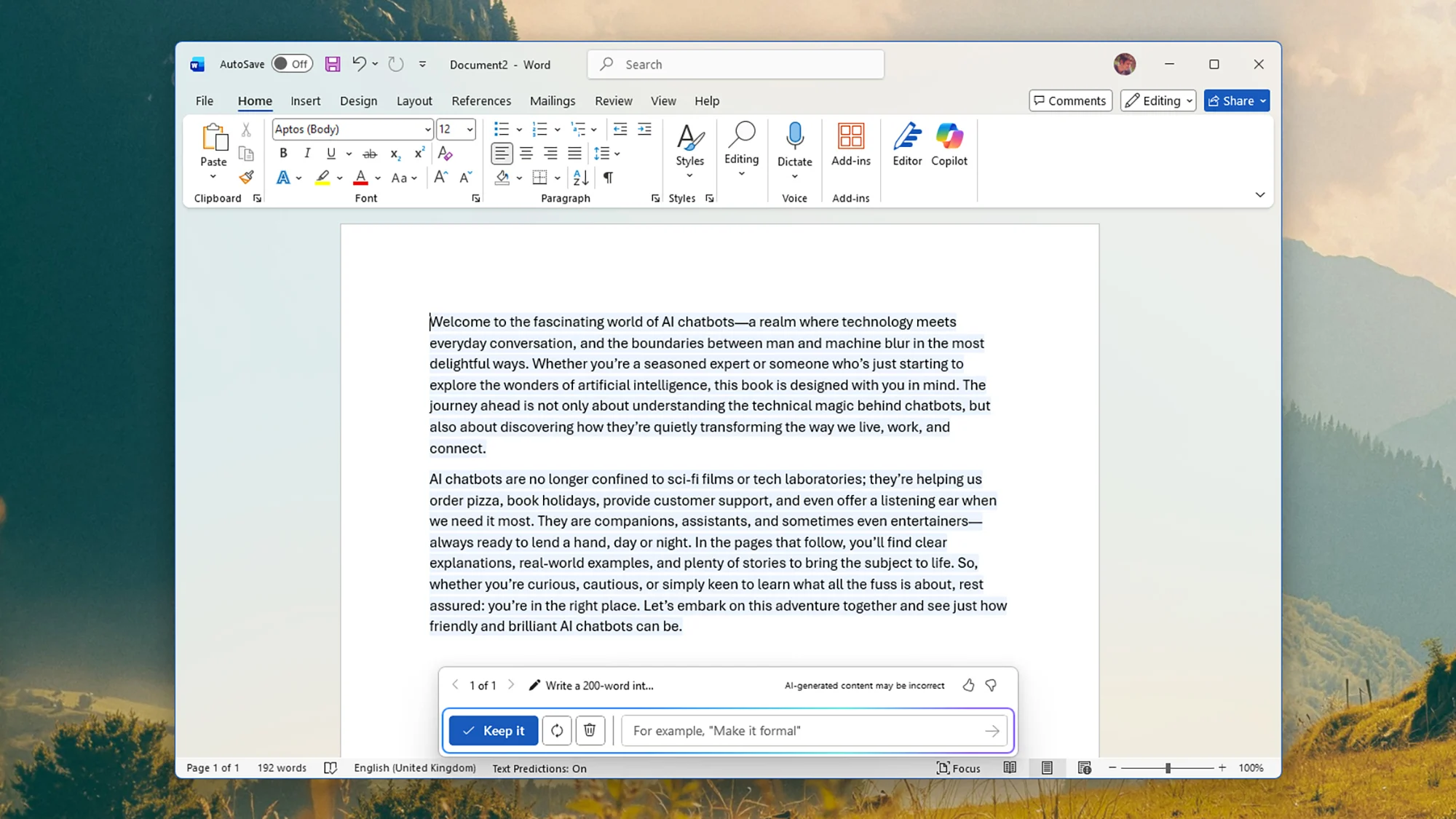
Copilot in Word will do most of the writing for you, if you let it.
Credit: Lifehacker
Create a new document in Word, and via a prompt bar at the top, Copilot asks you to “Describe what you’d like to draft with Copilot”—so I asked for a 200-word introduction suitable for the foreword of a book on AI chatbots, written in a tone that’s friendly, engaging, and accessible to anyone no matter what their technical level. You can also, via the + (plus) button, give it an existing file to work from.
In seconds, I had a generic and stilted intro, processed from the mixing together of millions of human-crafted words and sentences. I then got a second prompt box for refining the text. I asked for my intro to be made more formal and verbose, and Copilot got to work, looking up longer and fancier words in its internal thesaurus.
Click the Copilot button in the ribbon menu, and you get a side panel for requesting all kinds of edits and tweaks—whatever you can put in a prompt, Copilot can respond to. If your boss has said your report needs to be focused more on client benefits and real-world examples, Copilot can take care of it. You then get chance to review all of the edits that have been made, and accept or reject them.
It’s maybe worth saying at this point that I would never get AI to write anything for me, or even suggest edits or come up with alternative headlines or article ideas—not just because I think I can do these tasks better, but also because I’d like to engage my brain as much as possible for as long as possible. If you’re happy with your work containing machine-written text, however, Copilot is certainly capable of it (and will absolutely make fewer typos than a flesh-and-blood human).
Copilot can build and edit charts in Excel
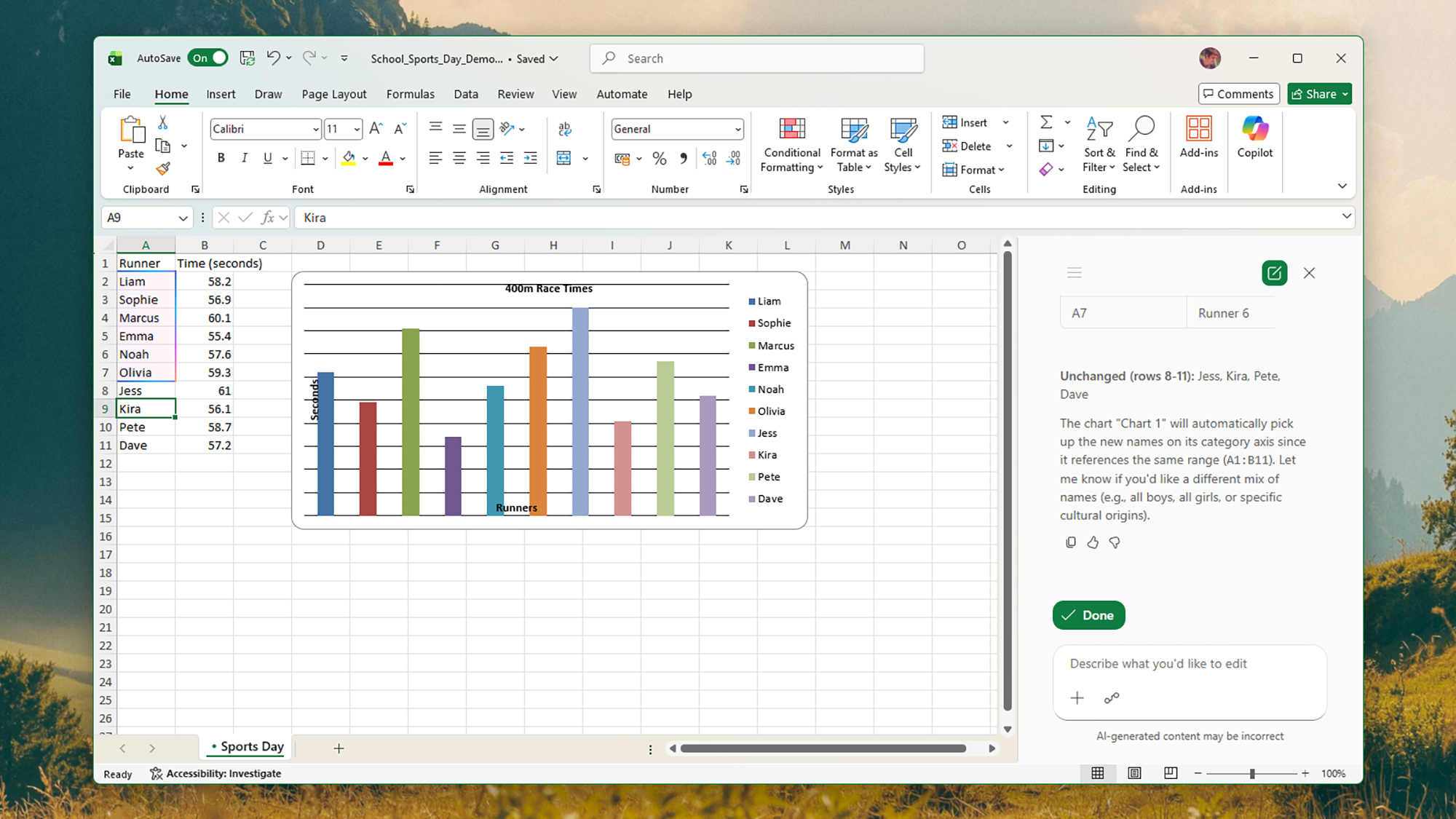
Copilot in Excel can create entire spreadsheets or make tiny edits.
Credit: Lifehacker
I’m much less familiar with spreadsheets than I am with articles, so I was interested to see how Copilot could help me out in Excel. There’s no prompt box at the top of a blank sheet, like you get with Word documents, but you can call for AI assistance by clicking the Copilot button on the ribbon toolbar.
Here I asked Copilot to create a demo spreadsheet showing 10 kids and their running times in a school sports day, putting the data in a simple table and in a chart. If you’re a more serious Excel user than I am, you can get Copilot to combine data from existing spreadsheets and reports, as well as putting together spreadsheets from scratch.
Copilot carried out my instructions with a reasonable amount of precision, though the chart was rather hit-or-miss and could’ve done with some neatening up (Copilot tried and failed to do some tidying on this). Follow-up edits were carried out well, and if you’re exact about the changes you want, Copilot takes care of them for you.
What do you think so far?
I’m not sure I’d trust Copilot with company financials, for example, but as far as spreadsheets-via-prompts goes, I was mostly impressed. Instead of manually tallying up rows and columns, tweaking formatting, or trying to figure out the exact formula you need for the job, you can get Copilot to take over.
Copilot can create slideshows in PowerPoint
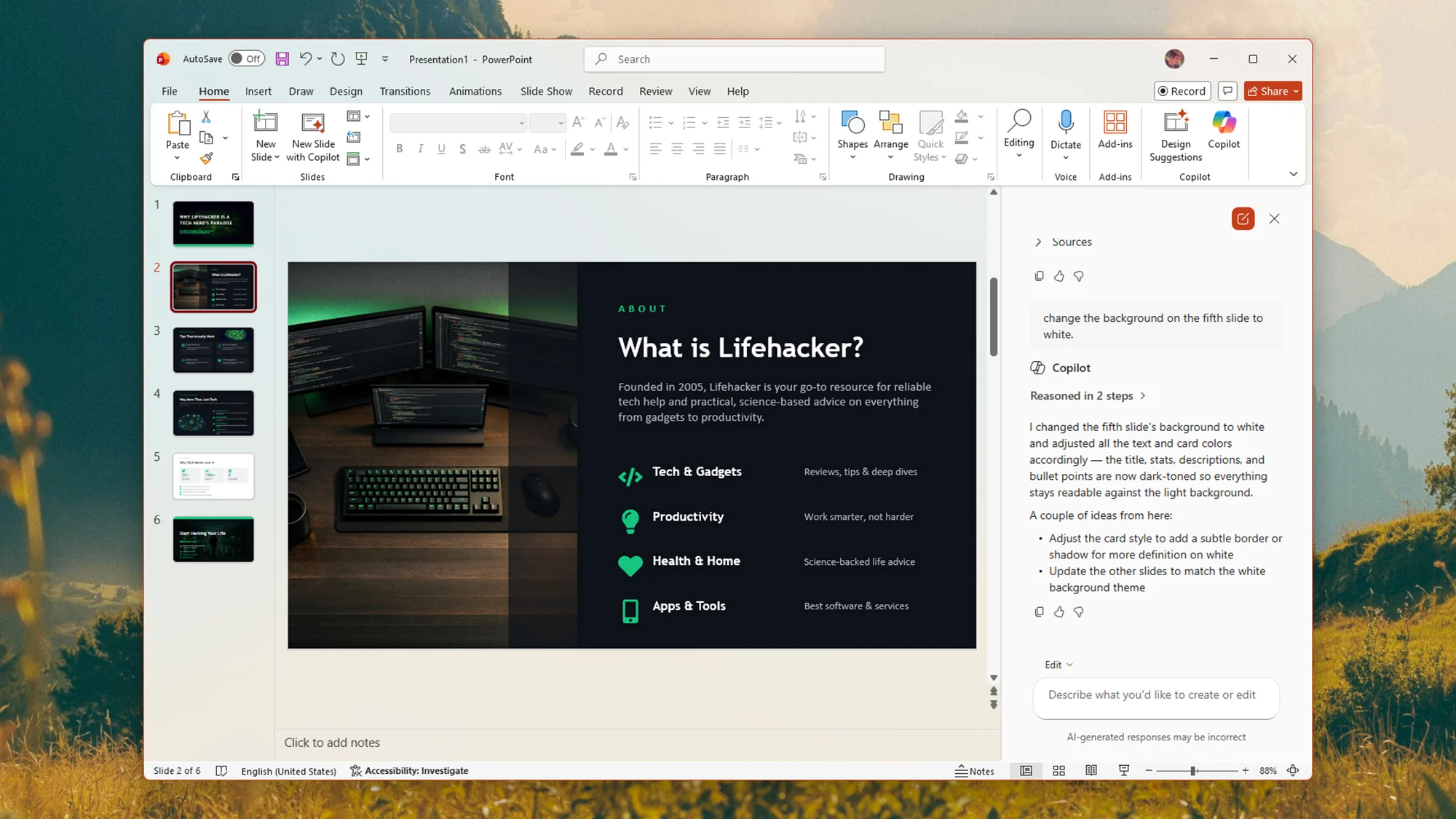
Copilot in PowerPoint creating and editing slides.
Credit: Lifehacker
Finally, I took a look at what Microsoft’s AI could do for me with a PowerPoint slideshow. Again, the Copilot button on the ribbon toolbar is the way into the AI editing capabilities, and this time I asked it to make a slide deck promoting Lifehacker. I wanted to test its ability to pull up information from the web and to put together an entire slideshow from scratch (something I’ve previously tried with Claude Design).
I answered some questions about the length and tone of my slideshow, and then Copilot got to work. Overall, the AI was up to the challenge, albeit in that generic, template-like way that we’re all now familiar with when it comes to these synthetic creations. Producing an accurate series of slides out of nothing in seconds is impressive, though, even if I think I could’ve done the job better given an hour or two.
Prompt-based edits work fine. Want to change the color of a background? Just say so—it’s quicker and easier than messing around with menus and toolbars, though perhaps not as satisfying. Whether you want to change the entire tone of a presentation or tack on an extra two slides of summaries, Copilot will do it.
I can see these tools being useful, whether to get the basics done with the minimum of fuss, or to automate advanced edits and processes that would otherwise take up a substantial amount of time. I can also imagine many users just sticking with their current workflows. For me, I think I’ll carry on doing my own Word, Excel, and PowerPoint tasks for now.
Source: Read Full Article