








Some people think we are odd for swimming in the Thames. “Isn’t it cold?” they ask with a shiver, like they are the ones who just took the plunge. Er, yes, that’s the whole point. Cold water ignites the central nervous system and reboots the mind.
“Isn’t it dirty?” they ask. Yes, sometimes, particularly when it’s rained. Then we don’t get in the Thames, we get in a rage instead, taking contamination measurements and signing petitions challenging the behaviour of the water company that spews sewage into the river.
The truth is there are plenty of days when the water acquires a yellow foam on the surface and you can no longer see your hands below the surface. Even the dogs don’t get in.
But there are lots of people who love the water and the rivers just as much as we do, even if they don’t get in for a swim. People who have been frustrated by the way the private sector has treated something we feel belongs to us. That is why the decision to make our little spot the first designated bathing site on the Thames in London feels like a rare victory for the community over the corporate, for the people over the privatisers.
A few years ago our rivers were suffering, awash with sewage and farm run-off and dying biodiversity. Although a tiny handful of swimmers and fishers were trying to raise the alarm, it was far too easy to ignore.
But in the last few years, with the help of doughty journalistic coverage and doughty campaigners who absolutely refused to let it go, there has been an explosion in awareness, and the government and the industry have begun taking steps to remedy these ills.
Setting up these bathing sites is one of those steps. Now the authorities will have to test water quality rigorously and regularly and admit when it is literally shit, increasing the pressure on Thames Water to clean up its act. It feels like the tide is turning. Even if our bit of the Thames isn’t tidal.
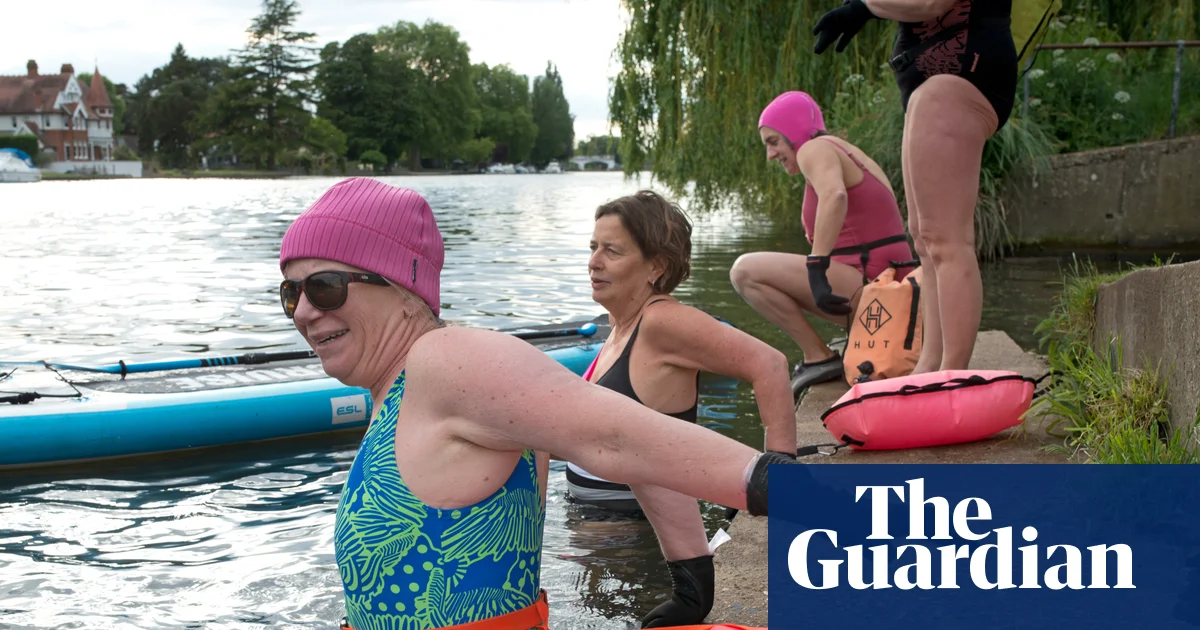
I must admit, the first time I got into the river a couple of years ago, it felt a bit awkward: removing my clothes in public while fully clad commuters marched past on the way to the station. Putting my socks in my boots and my clothes on the floor in front of dog walkers deep in winter coats. Shimmying down the jetty in my bathers while a couple of copulating geese gave me a weary look.
And then getting into river water so cold that I could feel the shape of my skeleton under my skin. My privates shrank to the size of capers and tried to get indoors. The surface was choppy, with little waves grasping at the embankment, like they too wanted to get out of the cold.
The plunge was like nothing else. I instantly stopped thinking. From 91 thoughts a minute to nothing. The effect on my tattered mental health was profound.
But if I came for the psychological boost, I stayed because of the people. During Covid, small groups began to brave these waters, in twos and threes, socially distanced. Slowly a community started to take shape – the Teddington Bluetits (pun intended) – under the tireless leadership of a local woman called Marlene Lawrence.
Marlene loves the river, and the swim. “It is like a reset for the body. You feel like you’ve conquered the world. My inflammation has gone down, my figure has changed, I’m happier in my body. My day is always better for having done a swim first thing in the morning.”
Celebrating the successful application, Marlene says: “It’s wonderful news not just for the large swim community, but for all the river users, and we are hopeful that increased testing by the Environment Agency will prompt Thames Water to decrease sewage outflows.”
Some come for the swim, the buzz you get from the cold water, the changing shades of nature through the year. Some come for the cake, or the drinks trolley that sometimes makes an appearance.
But most, I feel, are there for the company, for the laughter that cold water always engenders, for someone to talk to in this lonely city.
Recently it occurred to me: this is what we mean by community. A group of people from all walks, who self-support, listen, help each other to heal. It’s greater than the sum of the parts, something you augment by turning up, giving, helping where you can.
It’s something we’ve been steadily losing for the past 40 years as our common patrimony was hived off, fenced off, sold privately – woodland, riverbanks, parkland, urban green spaces. The great outdoors became the great out-of-bounds as we eroded the commons and the communal in favour of the private, the self.
That is why this week has been a celebration for us. The drinks trolley has been in action. The WhatsApp group has 130 updates that I haven’t read. German television filmed us undressing on Tuesday, and it’s not every day you can say that. Even Feargal Sharkey turned up.
The other morning a man walked past. “You’re mad,” he said.
“Thank you,” we replied.
Source: Read Full Article