










Experiments involving dozens of European bird species — such as great tits, house sparrows and blackbirds — suggest the birds can distinguish human sex and react differently, but the reasons remain unclear.
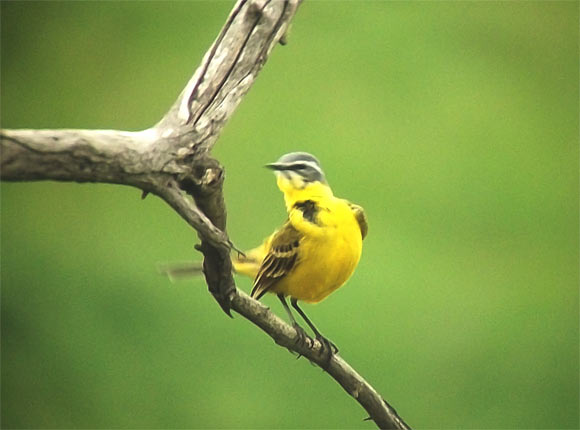
The western yellow wagtail (Motacilla flava), a small passerine bird in the family Motacillidae. Image credit: Sci.News.
“When an animal faces a potential predatory threat, the most common behavior across animals is to escape,” said University of California, Los Angeles Professor Daniel Blumstein and colleagues.
“Evaluating the costs and benefits of escape is an essential factor in managing predation risk.”
“Flight initiation distance (FID) is often used as a tool to investigate the cost-benefit trade-offs related to the risk of predation.”
“The FID is a metric of fearfulness estimated as the distance between the observer and the target animal when the targeted individual (e.g. a bird) flees.”
“Even when measured in response to approaching humans without predatory behavior, FID serves as a reliable proxy for predator-related fear in urban birds.”
Conducted across five European countries (Czechia, France, Germany, Poland and Spain), the team’s new study involved male and female participants walking in a straight line towards birds in urban parks and green spaces.
The researchers found that compared to women, men were able to get an average of one meter closer to birds before they fled.
The results were consistent across all five countries and across the 37 bird species studied, from species that typically flee early, like magpies, to species that flee late, like pigeons.
“Our study revealed that, after accounting for other variables influencing significant variation in FID, birds on average tended to escape from a distance of about one meter longer when approached by women compared to men,” the scientists said.
“Birds were less tolerant of women than of men, and this result was geographically consistent.”
From the results, the authors conclude that urban birds can recognize the sex of the humans approaching them.
But what traits the birds are picking up on or why they are more fearful of women remain a mystery.
“I fully believe our results, that urban birds react differently based on the sex of the person approaching them, but I can’t explain them right now,” Professor Blumstein said.
“We used bleeding-edge comparative analysis techniques that showed our findings were consistent across cities and species, but we simply don’t have a conclusive explanation yet.”
“As a woman in the field, I was surprised that birds reacted to us differently,” added Dr. Yanina Benedetti, a researcher at the Czech University of Life Sciences Prague.
“This study highlights how animals in cities ‘see’ humans, which has implications for urban ecology and equality in science.”
“Many behavioral studies assume that a human observer is neutral, but this wasn’t the case for urban birds in our study.”
The team has a few hypotheses for what birds are detecting, such as pheromones, body shape or gait.
“This is maybe the most interesting part of our study,” said Dr. Federico Morelli, a researcher at the University of Turin.
“We have identified a phenomenon, but we really don’t know why.”
“However, what our results do highlight is the birds’ sophisticated ability to evaluate their environment.”
“Urban birds clearly react to subtle cues that humans do not easily notice,” Dr. Benedetti said.
“Follow up studies could focus on individual factors such as movement patterns, scent cues, or physical traits, testing them separately rather than grouping them under observer sex. This approach would help identify the specific cues birds detect.”
The findings were published on the February 2026 issue of the journal People and Nature.
_____
Federico Morelli et al. 2026. Sex matters: European urban birds flee approaching women sooner than approaching men. People and Nature 8 (2): 316-326; doi: 10.1002/pan3.70226
Source: Read Full Article