









Moving to a solar-dominated grid
When it comes to supplying electrons for those alternatives, the central story is solar power. “The absolute increase of solar PV generation in 2025 is the largest ever observed for any source,” the IEA says, “excluding years marked by rebounds from global economic shocks such as COVID-19.” In other words, with nothing in particular driving the energy markets in 2025, Solar’s growth was unprecedented. On its own, its growth covered a quarter of the rising demand for all forms of energy. If you limit it to electricity, increased solar production covered over two-thirds of the increased demand.
Overall, solar generated over 2,700 terawatt-hours last year, more than double its output from three years earlier. It now accounts for over 8 percent of the world’s total electricity production. Thirty individual countries installed at least a gigawatt of solar last year, and it is now the single largest grid source by capacity (though other sources still outproduce it at the moment).
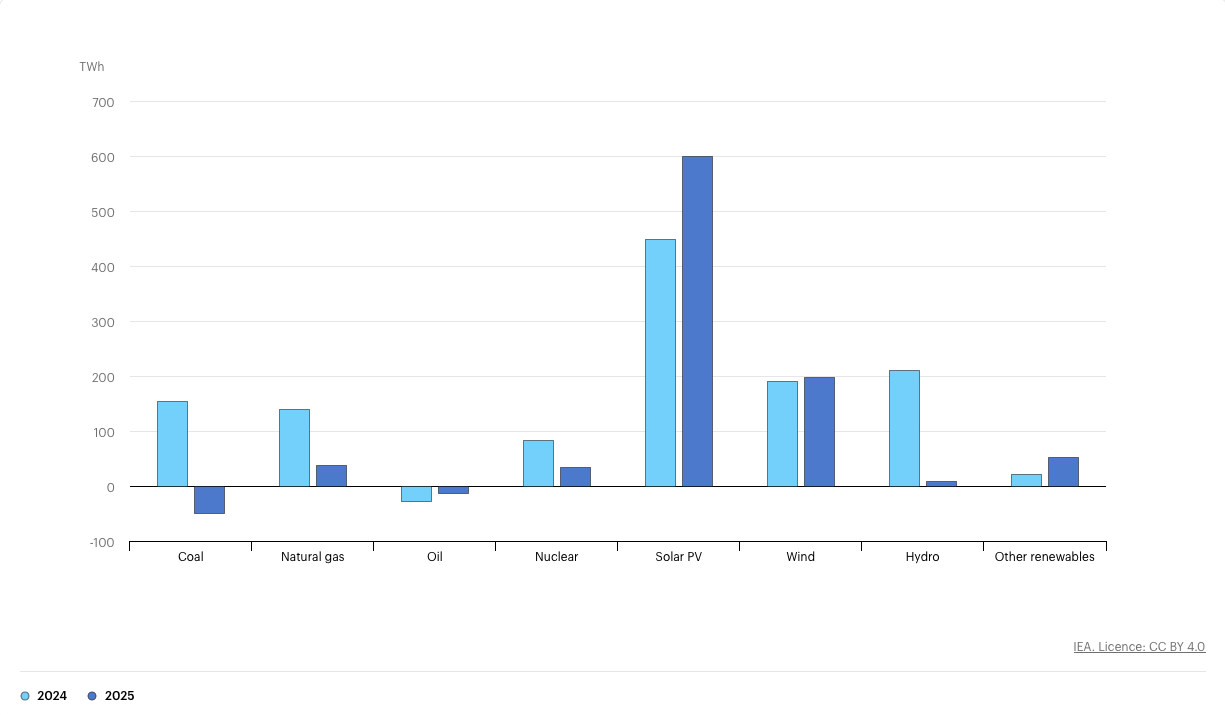
The solar boom is the primary reason that carbon-free generating sources—hydro, nuclear, solar, wind, and other renewables—were able to grow faster than demand in 2025. In other words, as electrification increases, we’re at the point where we are capable of meeting the additional demand without boosting carbon emissions. These sources covered nearly 60 percent of the overall growth in demand for energy of all types.
Solar’s growth is being accompanied by a key enabling technology: batteries. Batteries were the fastest-growing power technology, with capacity additions rising 40 percent between 2024 and 2025, reaching 110 GW of new capacity last year. That is apparently more than the highest one-year addition of natural gas capacity and leaves our total installed capacity at over 10 times what it was just five years ago. Batteries, when combined with cheap solar, can limit the need for fossil fuel-powered backups.
As noted above, natural gas use increased (by about 1 percent), but that was primarily due to weather-driven heating demand. Coal was largely flat, with use rising by just 0.4 percent. While the US saw a small increase in coal use, coal use in the EU dropped below 10 percent of electricity production last year for the first time since statistics were kept. While China commissioned a lot of coal plants in 2025, those were largely started during a prior energy shock. China actually saw its coal use for electricity drop last year due to its massive investment in renewables (China was responsible for 60 percent of renewable global growth last year).
Source: Read Full Article