








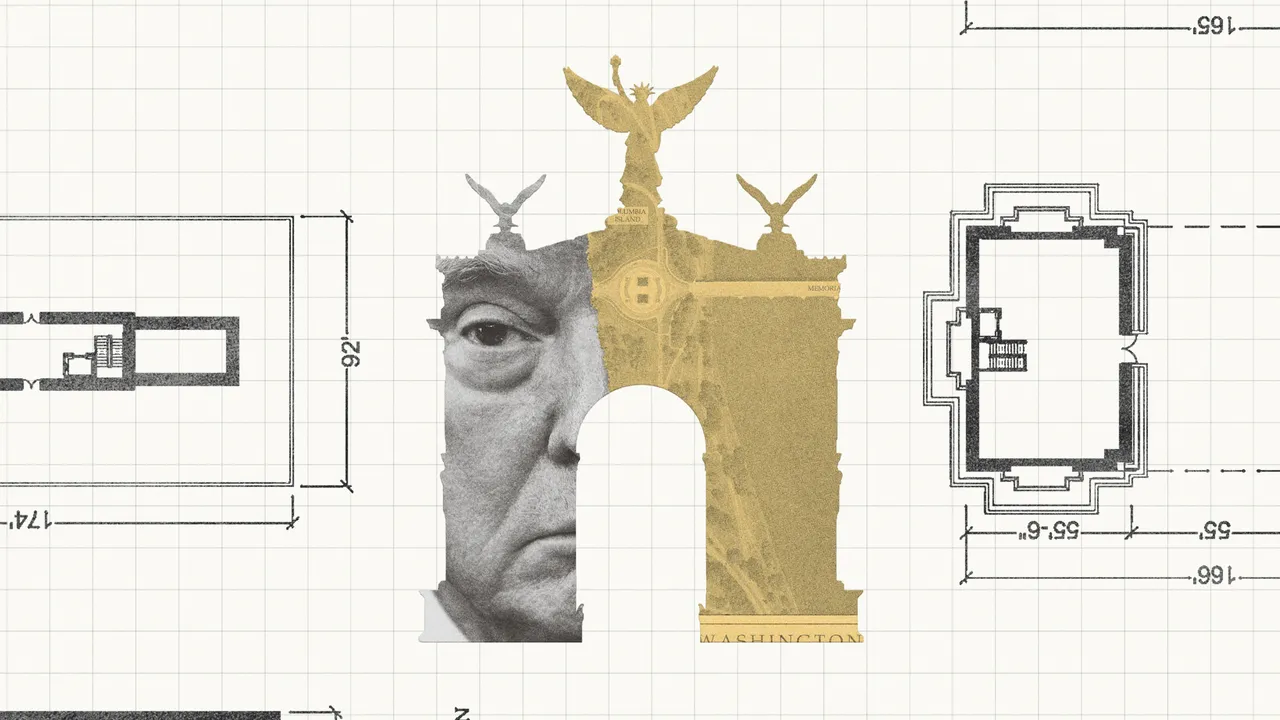
The latest in the Trumpite series of proposed oversized buildings—the previous one being a ballroom where the East Wing of the White House once stood, a project that a federal judge temporarily halted last Thursday, until an appeals court put his preliminary injunction on hold on Friday—is a so-called triumphal arch, though exactly what triumph so needs an arch is unclear. Standing at two hundred and fifty feet high, presumably for the two hundred and fiftieth anniversary of the Declaration of Independence, it would be more than twice as tall as the Lincoln Memorial, views of which it would block from its proposed site, near Arlington National Cemetery—where it would also overwhelm the simple graves of the fallen soldiers.
The plans for the arch were preliminarily approved last week by the Commission of Fine Arts, which is now completely inhabited by Donald Trump’s appointees, the previous members having stepped down or been fired for the crime of competence last year. The arch, designed by Nicolas Charbonneau, who leads Harrison Design’s Sacred Architecture Studio, in Washington, D.C., will feature a Las Vegas-style overload of gilded iconography, including a winged Lady Liberty, eagles, and, unusually for an American monument, lions. (Why not Siegfried and Roy’s tigers?)
When asked by a reporter last year whom the arch would be for, Trump said, “Me,” so, really, it might more properly be called the Arch of Trump. But there is, as always with Trump, a great deal of defiance and sheer Rodney Dangerfield-style obnoxiousness implicit in the plan. It is an act of mischief as much as of monument-making. It is a very arch arch.
Yet, bizarrely, given Trump’s recent, loud contempt for France’s military spirit and his assaults on the French for refusing to arrive, late and unconsulted, in his war on Iran, his arch is modelled on Parisian examples. The most famous of these, the Arc de Triomphe, which was originally Napoleonic in impulse but was very long-winded in execution, is only the largest. There is a better, far more handsome example of the type in the Arc de Triomphe du Carrousel, between the Tuileries and the Louvre, which is an actual Napoleonic monument, having been completed during Napoleon’s reign. The four ancient bronze horses that he stole from St. Mark’s Basilica, in Venice—which the Venetians had previously stolen from Constantinople, where they had been in residence after being taken earlier most probably from somewhere in classical Greece—once stood atop it, but they had to be returned after Napoleon’s fall, a roundelay of looting that perhaps suggests the dubious nature of all such triumphs.
The Arc de Triomphe that everyone knows sits on the Étoile, now called the Place Charles de Gaulle, and, though it was originally commissioned after the successful Napoleonic battle of Austerlitz, in 1805, construction on it was halted for a long time by the not insignificant fact that Napoleon had started losing battles about as decisively as they have ever been lost. Only decades later, when the agony of those defeats had abated a little and had been replaced by some retconned glory, which brought Napoleon’s body back to its current tomb in the Invalides, was the arch completed, as a consolation prize for disgruntled imperialists. Both these arches, along with a few others in Paris, were, of course, based on Roman examples, of which the still surviving Arch of Septimius Severus is the most imposing, celebrating now forgotten Roman victories over Parthia—an empire that was partly located, rather notably, in what is now Iran.
But what’s really wrong with Trump’s arch isn’t something that is always wrong with victory arches but, rather, something that is always wrong with all the architecture of autocracy. It lacks the modesty of intelligent self-scruple; it is not the style but the scale that is most objectionable. It would be the largest such structure in the world, and its bigness is its point. It may be noted that Hitler wanted to build an arch in his imagined new Berlin, his “Germania,” also modelled on the Arc de Triomphe, and also bigger than any other arch, and also big for the sake of bigness alone.
Source: Read Full Article