







Permian Fossil is Earliest Evidence of Rib-Powered Breathing

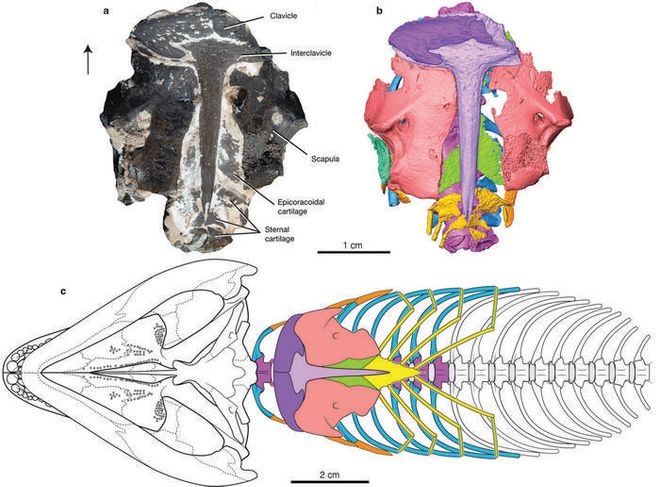
Paleontologists have examined 289-million-year-old specimens of the early reptile Captorhinus aguti that preserve a covering of three-dimensional skin, a complete shoulder girdle and ribcage with cartilages, and — most astonishingly — protein remnants that predate the previous oldest-known example by nearly 100 million years. Captorhinus aguti. Image credit: Michael DeBraga. The move from water to…

Read More

Two supermassive black holes are on a collision course

Get the Popular Science daily newsletter💡 Breakthroughs, discoveries, and DIY tips sent six days a week. Supermassive black holes literally don’t add up. Astrophysicists know it takes more time than is mathematically possible for one of them to reach its incomprehensible proportions via standard gas accretion. Despite this, they are clearly observable at the center…

Read More

‘No one knows what they are’: Researchers discover new type of cell that’s seen only during pregnancy

Scientists have unveiled a detailed “atlas” of the placenta and uterus, showing how these unique tissues grow and evolve throughout pregnancy to accommodate a developing fetus. In charting this new map, the scientists revealed a subtype of cell that had never been described before and appears to be unique to pregnancy. These cells are not…

Read More

ChatGPT’s first streaming video app helps you decide what to watch on movie night

Streaming video service recommendations still tend to be simplistic unless you’re using platform-specific tools like Google’s Gemini for TV, but that’s finally changing. Tubi has launched ChatGPT’s first-ever native streaming service app, making it easier to find movies and shows on Fox’s free-to-watch service using more natural-sounding requests. All you have to do is connect…

Read More

289‑Million‑Year‑Old Reptilian Mummy Sheds Light on How Amniotes Learned to Breathe

Mummified remains of a 289-million-year-old reptile may contain the oldest example of a breathing system in amniotes. According to new findings published in Nature, the mummy, a reptile known as Captorhinus aguti, is only a few inches long, but preserves bone, calcified cartilage, skin, and proteins that predate previously known soft-tissue evidence of amniote breathing…

Read More