










Giant predators don’t appear overnight. New fossils from Thailand show how some of the earliest ones began to develop the skull features that defined them.
In a study published in PLOS One, researchers analyzed two partial braincases from northeastern Thailand and identified them as belonging to Siamraptor suwati, a large meat-eating dinosaur that lived about 125 million years ago. The fossils preserve parts of the skull that rarely fossilize and include features that had never been described in this species before.
The findings place Siamraptor among the earliest members of the carcharodontosaur lineage, a group of apex predators that later spread across much of the world.
A Look Inside a Dinosaur Braincase From Thailand
The two fossils come from the Khok Kruat Formation in Nakhon Ratchasima, a site that has already produced more than 20 other Siamraptor specimens. But until now, none have preserved this part of the skull.
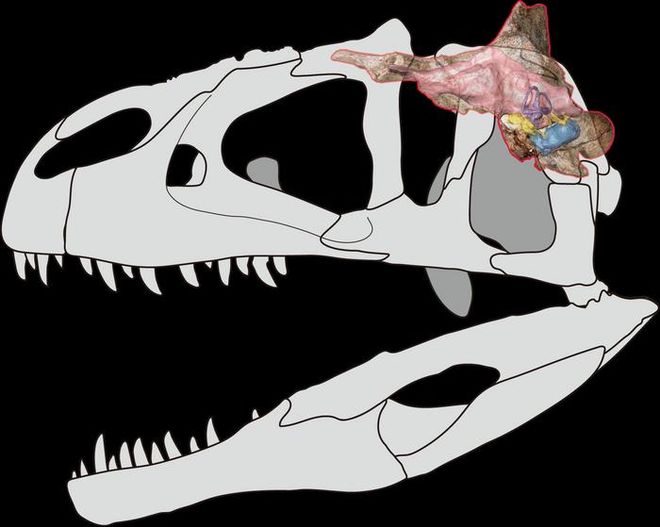
Braincase of Siamraptor suwati.
(Image Credit: Hattori et al./CC-BY 4.0)
Braincases are one of the few places where soft biology leaves a trace in bone. They hold the brain and the passageways for nerves, blood vessels, and parts of the inner ear. Even when the brain itself is long gone, the shape of the cavity can hint at how an animal balanced, moved, and sensed the world around it.
Dinosaurs in this group sat at the top of their ecosystems long before predators like Tyrannosaurus rex appeared. But their early history is still patchy, which makes fossils like this especially useful.
To study the fossils, researchers scanned them and compared the structures with those of other theropod dinosaurs. That lets them confirm the species and pick out details that would be hard to see from the surface alone.
Read More: Jurassic Predators Feasted on Baby Long-Necked Dinosaurs 150 Million Years Ago
New Features Help Identify the Species
Some of those details are what tie the fossils to Siamraptor in the first place. The bones show a tall ridge at the back of the skull and distinct features across the skull roof that match what’s already known from other remains.
But there are also a few surprises. The team found a wedge-shaped connection between parts of the skull roof, along with two deep pits along the edge of one bone. Those features haven’t been reported in other related dinosaurs, giving researchers something new to compare across the group.
The anatomy strengthens Siamraptor’s place near the base of the carcharodontosaur family tree. That position means this species sits close to the point where these predators began to branch out and diversify.
Clues to How Giant Predators Evolved
The braincase also hints at how this dinosaur may have carried itself. Its structure suggests the head was held slightly angled upward, which could have helped it track movement or scan its surroundings.
Comparisons with other theropods show that some features seen in later, more specialized predators were already beginning to appear in earlier species like Siamraptor, while others evolved later as the group grew larger and more specialized.
Later carcharodontosaurs, including giants like Giganotosaurus, would become some of the largest land predators ever, with skulls adapted for powerful feeding. Their anatomy reflects stronger muscle attachments and structural changes that supported larger bites.
What these Thai fossils capture is an earlier stage in that process. Instead of fully developed traits, they show how those features were beginning to emerge, before the group reached its largest and most specialized forms.
Because early fossils from this lineage are few and far between, especially in Asia, each new specimen adds detail to how that transition unfolded.
Read More: 160-Million-Year-Old Fossils Rewrite the Story of Dinosaur Flight
Article Sources
Our writers at Discovermagazine.com use peer-reviewed studies and high-quality sources for our articles, and our editors review for scientific accuracy and editorial standards. Review the sources used below for this article:
Source: Read Full Article