As new fossils and microscopic traces keep reshaping what we know about Neanderthals, a fresh DNA analysis from a cave in Poland adds an important piece to the puzzle, showing how these ancient humans may have moved across Europe.
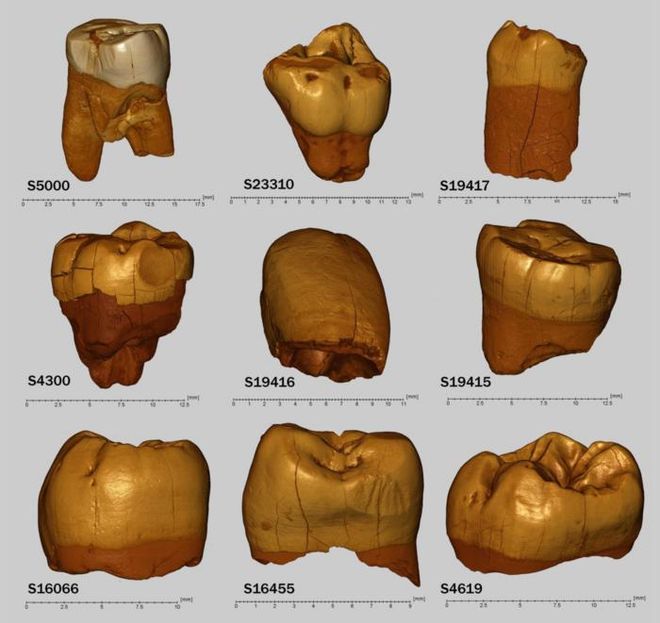
In a study published in Current Biology, an international team analyzed nine Neanderthal teeth discovered in Stajnia Cave. Instead of focusing on a single individual, the researchers reconstructed the genetic profile of an entire small group, something that has rarely been possible. That broader view helps place other scattered genetic finds across Europe into a clearer timeline.
“This is an extraordinary result because, for the first time, we are able to observe a small group of at least seven Neanderthals from Central-Eastern Europe who lived around 100,000 years ago,” said the study’s first author, Andrea Picin, professor at the University of Bologna, in a press release.
That makes the Stajnia Cave group the oldest known group of Neanderthals in Central-Eastern Europe and a key reference point for tracking how populations spread across the continent.
3D renderings of Neanderthal teeth from Stajnia Cave in Poland.
(Image Credit: Max Planck Institute for Evolutionary Anthropology/CC BY)
Genetic Profiles of a Whole Group of Neanderthals
Although Central and Eastern Europe are rich in Neanderthal archaeological sites, actual genetic data from the region have been surprisingly scarce. By combining several techniques, including radiocarbon dating, physical analysis of the teeth, and mitochondrial DNA sequencing, the team identified at least seven, possibly eight, individuals. Genetic dating suggests they likely lived between roughly 120,000 and 92,000 years ago.
“In most cases, Neanderthal genetic data come from single fossils or from remains scattered across different sites and periods,” explained Picin. “At Stajnia, by contrast, it has been possible to reconstruct a small group of individuals, providing for the first time a coherent genetic picture of Neanderthals in this part of Europe.”
One especially intriguing detail hints at family ties within the group. The researchers describe in their study how three teeth contained genetic material with a similar mitochondrial profile. “This suggests that these individuals might be closely related to each other,” said co-author Mateja Hajdinjak, researcher at the Max Planck Institute for Evolutionary Anthropology, in the release.
The findings don’t just illuminate one group but also help map a wider genetic pattern across Neanderthal populations. As explained in the press release, the mitochondrial DNA from the Stajnia individuals matches a lineage previously found in Neanderthals from regions as far apart as the Iberian Peninsula, southeastern France, and the northern Caucasus. This suggests that this maternal line was once widespread across western Eurasia before later being replaced by other, younger lineages.
The study also revisits a puzzling case of a Neanderthal known as Thorin, discovered in 2015 in southern France. Earlier research dated Thorin to about 50,000 years ago, but his DNA seemed closer to that of Neanderthals from 100,000 years ago. That mismatch led scientists to propose the existence of a mysterious, long-isolated “ghost” population, as outlined in a 2024 study in Cell Genomics. The new findings offer a different explanation.
“Our study is a reminder that the oldest chronologies must be treated with great caution,” explained study co-author Sahra Talamo, professor at the University of Bologna, in the statement. “When radiocarbon values approach the limit of calibration, it is essential not to assign more precision than the data can actually support.”
In other words, Thorin may not belong to a separate, isolated population after all, but his age may simply have been misestimated due to limitations of current analytical methods.
Central-Eastern Europe May Have Been a Crucial Hub for Neanderthal Movement
Beyond genetics, the discovery strengthens the idea that Central-Eastern Europe wasn’t just a fringe region in Neanderthal history but a crucial hub for movement, interaction, and technological exchange during the Middle Paleolithic.
“We had known for some time that Stajnia Cave preserved exceptional evidence, but these results exceeded our expectations,” said study co-authors Wioletta Nowaczewska from the University of Wrocław and Adam Nadachowski from the Polish Academy of Sciences in the release. “Being able to identify such an ancient small group of Neanderthals in such a complex site is an important achievement for Polish research and for the study of Neanderthals in Europe.”
Our writers at Discovermagazine.com use peer-reviewed studies and high-quality sources for our articles, and our editors review for scientific accuracy and editorial standards. Review the sources used below for this article: