










At first glance, it looks like any other quiet cemetery, with rows of gravestones set against freshly cut grass and the occasional visitor passing through. But just beneath the surface, it is anything but quiet. Millions of bees have built an immense underground city, where they live out their entire lives below ground, building nests, raising young, and going mostly unnoticed.
In a study published in Apidologie, researchers at East Lawn Cemetery in Ithaca, New York, uncovered one of the largest known aggregations of ground-nesting solitary bees ever recorded, estimating that an average of about 5.6 million bees emerge from a single section of lawn each spring, with totals ranging from roughly 3.1 to 8 million. Records show the species has been present at the site since the 1930s, raising the possibility that this population has remained active for decades beneath the same patch of ground.
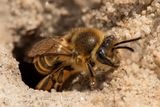
The species at the center of it is Andrena regularis, a native, ground-nesting bee known for pollinating crops like apples and blueberries.
“Our study documents one of the largest, and possibly oldest, nesting aggregations of solitary bees ever recorded,” the authors wrote in their study.
One of the Largest Ground-Nesting Solitary Bee Populations
What is especially notable about this discovery is not just the number of bees, but how concentrated they are in a space that looks completely ordinary.
To measure that density, researchers placed mesh emergence traps over sections of ground before the bees appeared in early spring, capturing insects as they surfaced and allowing the team to estimate the population below.
Each female digs a small nest underground, usually about 10 to 20 centimeters deep. Inside, she builds a few chambers, fills them with pollen, and lays a single egg in each one. Those nests sit side by side, forming a tightly packed network beneath the soil.
At peak density, researchers estimated more than 800 bees per square meter, meaning the ground itself is layered with activity.
And yet, most of that activity goes unnoticed. These bees do not form hives or swarm like honeybees. They live alone, emerging quietly in early spring, with activity surging as temperatures climb above about 68 degrees Fahrenheit (20 degrees Celsius), before disappearing just as quickly.
Read More: Bumblebee Queens Can Survive and Breathe Underwater For Over a Week By Cutting Energy Demands
How Timing Gives Parasitic Bees an Edge
Where there are this many bees, there are also opportunists. Among the millions of A. regularis, researchers found parasitic bees, primarily Nomada imbricata. These bees do not build their own nests. Instead, they enter the burrows of other bees and lay their eggs inside, leaving their offspring to consume the stored food.
Even so, the overall parasitism rate was relatively low, at about 1.4 percent, lower than what is typically seen in similar systems.
Part of that may come down to timing. The host bees tend to emerge in a short, concentrated window early in the season, while the parasites appear more gradually over time. That delay may actually be strategic.
“Delayed emergence makes sense as a way to maximize reproductive success,” the researchers stated in their study.
Why This Cemetery Has Become a Refuge for Millions of Bees
As unusual as it might seem, a cemetery can offer the kind of stability these bees need.
Places like this are often left undisturbed for decades, creating consistent conditions for ground-nesting species.
A. regularis is one of the most effective pollinators of apple trees in the region, and studies have shown that individual visits from solitary bees can deposit more pollen than those from managed honeybees. Large populations like this can rival or even exceed the pollination power of entire honeybee colonies.
“Our study highlights the importance of identifying and preserving large nesting aggregations of solitary bees for both ecosystem health and agricultural pollination,” the researchers wrote.
Read More: Ancient Bees Found Nested Inside Fossilized Bone — A Behavior Never Seen Before
Article Sources
Our writers at Discovermagazine.com use peer-reviewed studies and high-quality sources for our articles, and our editors review for scientific accuracy and editorial standards. Review the sources used below for this article:
Source: Read Full Article