










The platypus perfectly embodies the weirdness of Australia’s wildlife, carrying on this tradition from its eccentric ancestors. Ancient platypuses were much like modern platypuses, but with one notable exception: they boasted teeth that could crack sturdy animal shells with ease. Modern platypuses, which have come to lose these teeth, tend to snack on softer prey instead.
A new study published in Australian Zoologist has expanded the story of a toothed platypus named Obdurodon insignis, thanks to a rare set of 25-million-year-old fossils found in South Australia. These fossils not only show what the platypus ate and how it swam, but also provide insight into the vibrant freshwater ecosystem where it lived.
“Platypuses are extremely rare in the fossil record and are often restricted to teeth, so it’s exciting to find new material and learn more about these unique mammals,” said study author Aaron Camens, a professor of paleontology at Flinders University, in a statement.
Read More: Evolutionary Origins of the Strange Platypus and Echidna Found at Dinosaur Cove
Exposing Platypus Fossils
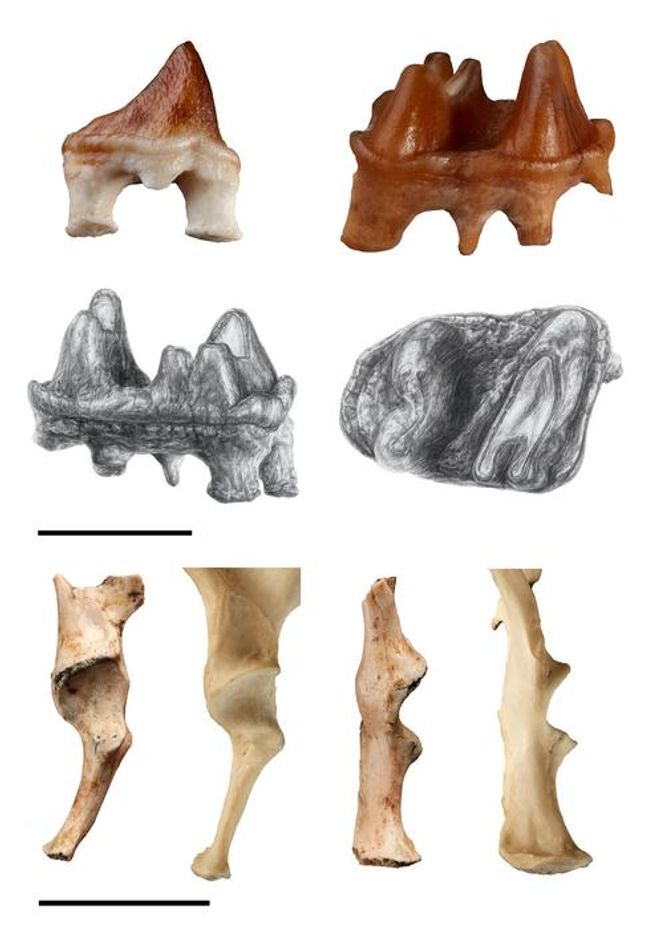
Obdurodon insignis tooth fossils
(Image Credit: Photos and drawings (G Conway, Flinders University))
Researchers unearthed three new O. insignis fossils during an expedition to an outback site east of the Flinders Ranges, where erosion has exposed millions of fish bones and more than 1,000 fossils of other vertebrates, including the toothed platypus.
The O. insignis fossils indicate that this platypus lived 25 million years ago, during the late Oligocene; at that time, it would’ve swum in vast lakes and slow-flowing rivers that were home to a diverse array of wildlife. The many species of fish that lived in the inland lakes and rivers were eaten by birds such as waterfowl, cormorants, and flamingos.
The toothed platypus also would’ve swam alongside dolphins that lived in these freshwater ecosystems — dolphin teeth and bones are among the fossils that have been found east of the Flinders Range.
Crushing Shells and Swimming Well
Two of the O. insignis fossils are teeth, a lower first molar and an upper second premolar. With its strong teeth, O. insignis was capable of eating animals with hard outer shells, like crustaceans.
“The new premolar for Obdurodon insignis shows this species also had large, pointed front teeth, which, with its large, robust molar teeth, could easily have crushed animals with shells or robust exoskeletons like yabbies,” said study co-author Trevor Worthy, a professor of paleontology at Flinders University.
Unlike ancient toothed platypuses, the modern platypus only has teeth for a very brief period of time, losing them soon after hatching. It instead eats prey by grinding them up with rough pads at the back of its jaws. According to the Australian Platypus Conservancy, the platypus diet mainly consists of bottom-dwelling aquatic insects like caddis flies, mayfly larvae, and water beetles.
The third of the three O. insignis fossils is a partial scapulocoracoid, a bone that supports the arm or front limb. This shows that the toothed platypus had a forelimb structure that would’ve allowed it to swim just as effectively as a modern platypus.
A Case of Missing Teeth
Since Obdurodon had teeth, why did modern platypuses lose them? While the answer isn’t clear, a 2016 study published in Science Advances suggests that modern platypuses may have lost their teeth as a result of a shift in foraging behavior.
It might also have something to do with the development of the electroreceptive sensory system in platypuses — this is a “sixth sense” enabled by receptor cells on the platypus bill that help them detect movements and subtle electric fields produced by prey, according to the American Museum of Natural History.
While other mammals have lost their teeth as a result of evolution, including echidnas, anteaters, and baleen whales, none of them eat their prey by masticating (grinding or crushing food). The platypus, unlike these mammals, still masticates prey with its pads, making it challenging to understand why its teeth would have lost their function over time.
Even though toothed platypuses are no longer around, platypuses living in Australia today still carry many of the same traits that their ancestors had, continuing to intrigue researchers with their odd features.
Read More: When Scientists Believed the Adorable Platypus Was a Hoax
Article Sources
Our writers at Discovermagazine.com use peer-reviewed studies and high-quality sources for our articles, and our editors review for scientific accuracy and editorial standards. Review the sources used below for this article:
Source: Read Full Article