









Researchers studying a 250-million-year-old fossil have found the first ever proof that mammal ancestors laid eggs, with the discovery also shedding light on a remarkable survival story.
The fossil, found in South Africa, belongs to a tightly curled embryo of a Lystrosaurus, a mammal ancestor famous for surviving an extinction event 252 million years ago known as the “Great Dying,” according to a study published in the journal PLOS One on Thursday.
A team of researchers scanned the fossil using high-resolution computer tomography and a synchrotron, which produces X-rays that are brighter than the sun, and found that the Lystrosaurus embryo’s jaws were not completely fused.
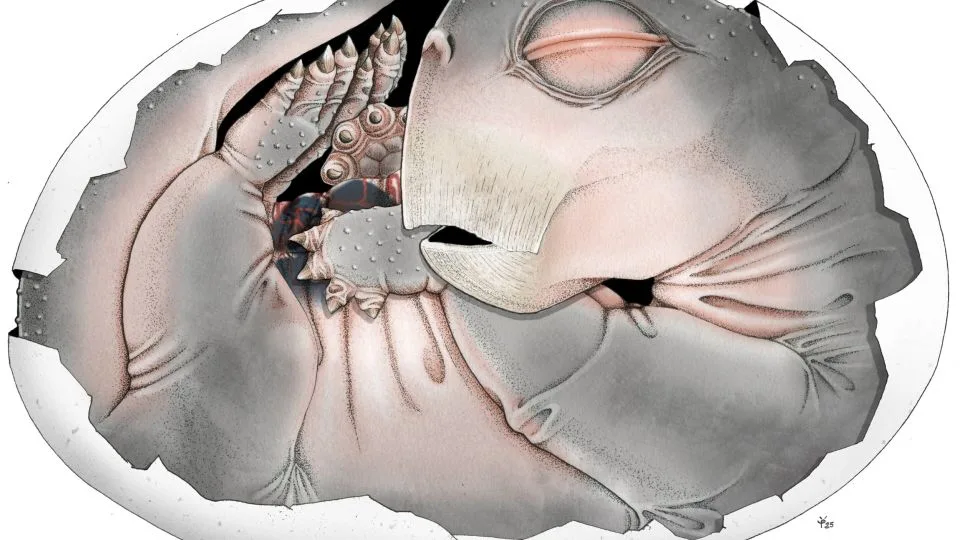
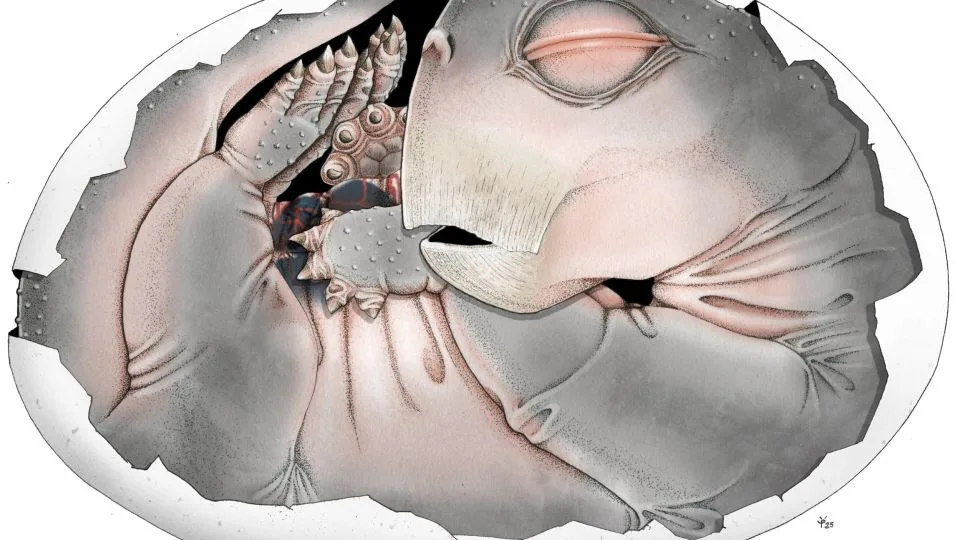
An artist’s impression of what the embryo would have looked like curled up inside the egg – Julien Benoit/Sophie Vrard
This trait, which is only found in the embryos of modern birds and turtles, proves that the Lystrosaurus embryo had been inside an egg when it died, study lead author Julien Benoit, an associate professor at the Evolutionary Studies Institute of the University of the Witwatersrand, South Africa, told CNN.
“This is the first time we can say, with confidence, that mammal ancestors like Lystrosaurus laid eggs, making it a true milestone in the field,” said Benoit.
Benoit said that these eggs would have had a soft, leathery outer shell, as hard-shelled eggs didn’t evolve for at least another 50 million years.
The fossil also provides a potential explanation for the longstanding mystery of why Lystrosaurus survived the “Great Dying,” – the mass extinction that ended the Permian geological period in which 90% of all living things on Earth died as the planet became much hotter and drier, he added.
“Lystrosaurus lived in a very dry, desert-like, environment,” said Benoit, who added that it would have foraged in dry river beds and searched for soft, muddy ground in which to burrow and survive prolonged periods of drought.
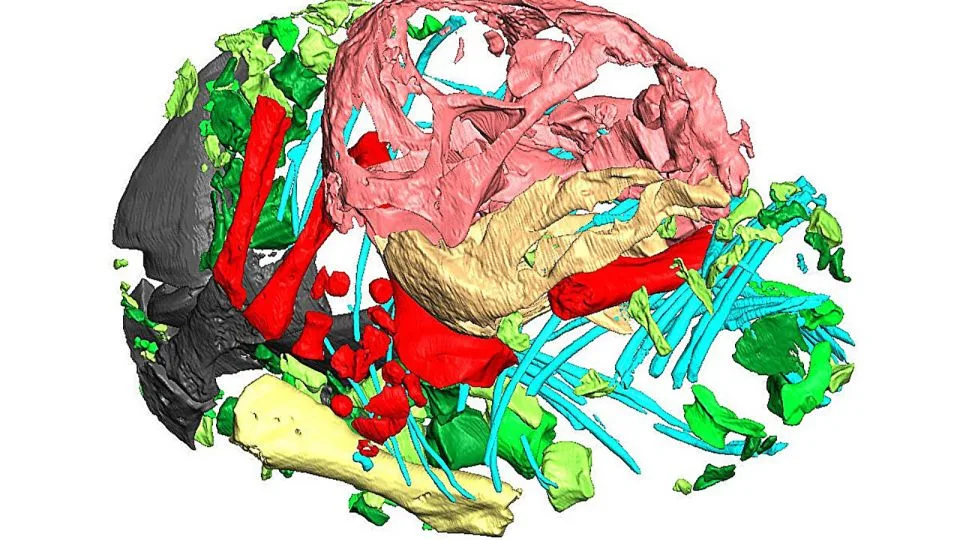
A 3D reconstruction of the Lystrosaurus embryo’s skeleton – Julien Benoit
As a result, the fact that Lystrosaurus would have laid comparatively large eggs for an animal of its size gave it an important survival advantage.
“Lystrosaurus eggs would lose less water through their leathery shell than those of other species of that time,” said Benoit.
Large eggs also imply that baby Lystrosaurus would have already been quite developed when they hatched, which constitutes another advantage.
The findings have important implications for our understanding of the origin of lactation among mammals, he added, allowing researchers to conclude the ability to secrete milk to feed young would likely have evolved between the early and late Triassic period (252 million–201 million years ago) after the mass extinction.
“Lystrosaurus hatchlings were big enough to feed by themselves and run away from predators, and would reach maturity faster so they could reproduce early,” said Benoit.
In addition, the study “provides strong support” for the hypothesis that lactation may have initially evolved not as a way to nourish offspring but to keep the leathery eggs laid by mammal ancestors moist and therefore better protected, said Benoit.
Next, he is planning further research on the evolution of lactation and viviparity, or the development of an embryo inside the mother’s body.
“These are some of the most important defining traits of our family and we still don’t know exactly when and how they evolved,” said Benoit. “Unraveling these would go a long way to help understanding the mammalian success story.”
Steve Brusatte, a professor of paleontology and evolution at the University of Edinburgh, Scotland, who was not involved in the study, told CNN that the Lyrstrosaurus embryo is “a neat fossil.”
“This is solid proof that some of our closest mammal ancestors and forebears were still laying eggs and reproducing like reptiles, and were not yet giving live birth and feeding their babies milk,” Brusatte, who is the author of “The Rise and Reign of the Mammals” said in an email.
“Those things would come later, and would be instrumental in mammals thriving today.”
Sign up for CNN’s Wonder Theory science newsletter. Explore the universe with news on fascinating discoveries, scientific advancements and more.
For more CNN news and newsletters create an account at CNN.com
Source: Read Full Article