










Some white dwarfs show strong magnetic fields at their surfaces, but until now, their origin hasn’t been fully understood. A new study finds that magnetism isn’t a late feature of these stars, but something that traces back much earlier in their evolution.
In research published in Astronomy & Astrophysics, a team connects magnetic fields seen at the surfaces of white dwarfs to magnetic fields deep inside red giants, an earlier phase of those same stars.
Using observations from both stages, the model shows how these internal fields can persist over time and only become visible after the star sheds its outer layers — a long-lived structure known as a “fossil field.”
By linking observations from different points in a star’s life, the work offers a clearer picture of how stellar magnetism develops and raises new questions about stars like our Sun.
“The magnetic field in a star is important for how the star works on the inside and how long it lives and evolves,” said lead author Lukas Einramhof, in a press release.
How Magnetic Fields in White Dwarfs and Red Giants Connect
White dwarfs form after stars run out of fuel and collapse into dense, cooling remnants. Many of them show magnetic fields at their surfaces, and those fields appear more frequently in older white dwarfs. On their own, those observations have been difficult to explain.
At an earlier stage, stars expand into red giants before shedding their outer layers. In recent years, astronomers have found evidence of magnetic fields inside these red giants using asteroseismology, a method that tracks subtle stellar vibrations, often described as starquakes, to probe internal structure. Until this point, those internal measurements and the surface magnetism seen in white dwarfs had not been clearly connected.
“Because a white dwarf is the exposed core of a red giant that has shed its outer layers, these different observations essentially examine the same region of a star’s interior at different evolutionary stages,” Einramhof explained in the press release.
Read More: Earth’s Magnetic Field Flips Regularly — Some Reversals Last 70,000 Years
Magnetic Fields That Form Early and Persist Through a Star’s Life
To bridge that gap, the researchers revisited the fossil field idea, which proposes that magnetic fields form early in a star’s life and remain stable over long timescales.
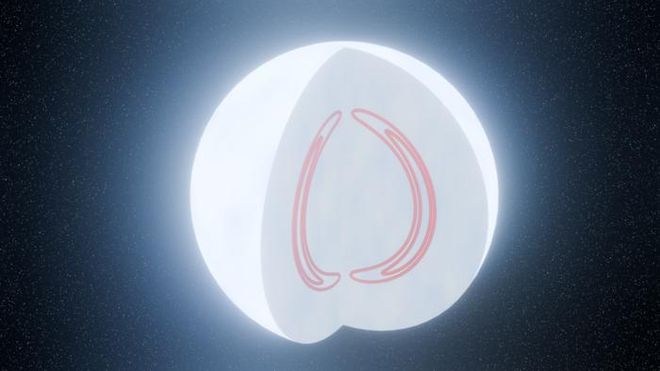
Evolution of a star can change the magnetic field.
(Image Credit: © Lukas Einramhof | ISTA)
Their model shows that this explanation can account for both sets of observations, but only if the magnetic field extends across a large portion of the star’s core rather than being confined to a small region.
“However, this doesn’t mean the stars are more strongly magnetized, only that the magnetic fields must already reach a larger portion of their core,” Einramhof said.
The team also found that these fields likely change shape over time. Instead of staying concentrated near the center, they can reorganize into shell-like structures, with stronger magnetism distributed along a layer within the star.
That shift helps explain how magnetic fields that were once buried deep inside a star can later appear at the surface of a white dwarf.
What This Discovery Means for the Sun and Other Stars
The findings point to the broader idea that magnetism may be a common and long-lived feature of stars, even when it cannot be directly observed.
That possibility is especially relevant for the Sun. Scientists still do not know whether its core contains a magnetic field.
“We’re practically blind to what happens at its center,” said Einramhof in the release.
If magnetic fields are present there, they could influence how material moves inside the Sun and how efficiently hydrogen is transported into the core, a process that could affect how long the star remains stable.
Magnetic fields are already known to shape how stars evolve, but their full role is still not clear. This work indicates they may be more widespread and more persistent than researchers once thought.
“Stars are most likely all magnetic. But we can’t always detect this magnetism,” Einramhof concluded.
Read More: Terrestrial Particles Travel to the Moon by Hitchhiking Along Earth’s Magnetic Field Lines
Article Sources
Our writers at Discovermagazine.com use peer-reviewed studies and high-quality sources for our articles, and our editors review for scientific accuracy and editorial standards. Review the sources used below for this article:
Source: Read Full Article