










‘Spectacular’ Viking coin hoard is likely the largest in history
Archaeologists have uncovered almost 3,000 silver coins so far—and more could come to light
Innlandet County Authority
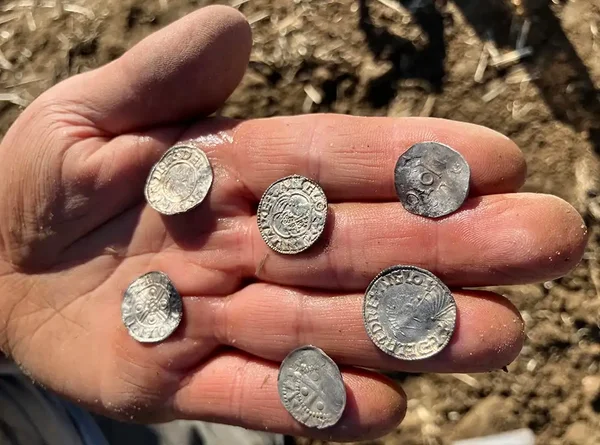
Archaeologists are hailing the discovery of a “spectacular” hoard of nearly 3,000 Viking coins found in a forested area in Eastern Norway. More could yet be uncovered—the search is ongoing.
“This is a historic find. The fact that it is also from the Viking Age makes it even more spectacular,” said the country’s Minister of Climate and Environment Andreas Bjelland Eriksen, in a statement.
The coins were initially discovered by two metal detectorists in a field near Rena in Østerdalen, according to the Norwegian National Agency for Cultural Heritage. On April 10, the pair uncovered 19 silver coins; they immediately informed local officials.
On supporting science journalism
If you’re enjoying this article, consider supporting our award-winning journalism by subscribing. By purchasing a subscription you are helping to ensure the future of impactful stories about the discoveries and ideas shaping our world today.
The hoard includes specimens from the 980s to the 1040s—the height of the Vikings’ power. Notably, many of the coins are foreign made, originating from England, Germany, as well as Denmark and Norway. The Vikings dominated much of what is now Scandinavia, but they ventured by sea to many other countries, including Britain, Iceland and even the Americas.
“Foreign coinage dominates the circulation of money in Norway up until Harald Hardrada (1046–1066) established a national coinage,” said Svein Gullbekk, an archaeologist at the University of Oslo, in a statement from the university. Hardrada, also known as Harald III, served as king of Norway from 1046 to 1066. During his tenure, the king’s mint replaced most of the foreign currency in circulation, according to Gullbekk. “The hoard was deposited right at the beginning of this development,” he said.
It’s possible that the coins are related to iron works in the area, said archaeologist Jostein Bergstøl from the University of Oslo’s Museum of Cultural History, in the same statement.
“From the 900s until the late 1200s there was an enormous iron production in this area. Ore was extracted from the bogs, and the processed iron was exported to Europe,” he said.
Archaeologists are still probing the site as they hope to gain more insight into the extent of the treasure and why it has lain there for so long.
“This is a truly unique discovery of the kind one might only experience once in an entire career. To be present when something like this comes to light is simply a great experience, both professionally and personally,” said local archaeologist May-Tove Smiseth, in the same statement. The last time a large stash of Viking coins was discovered in Norway was in 1950, according to the University of Oslo statement.
It’s Time to Stand Up for Science
If you enjoyed this article, I’d like to ask for your support. Scientific American has served as an advocate for science and industry for 180 years, and right now may be the most critical moment in that two-century history.
I’ve been a Scientific American subscriber since I was 12 years old, and it helped shape the way I look at the world. SciAm always educates and delights me, and inspires a sense of awe for our vast, beautiful universe. I hope it does that for you, too.
If you subscribe to Scientific American, you help ensure that our coverage is centered on meaningful research and discovery; that we have the resources to report on the decisions that threaten labs across the U.S.; and that we support both budding and working scientists at a time when the value of science itself too often goes unrecognized.
In return, you get essential news, captivating podcasts, brilliant infographics, can’t-miss newsletters, must-watch videos, challenging games, and the science world’s best writing and reporting. You can even gift someone a subscription.
There has never been a more important time for us to stand up and show why science matters. I hope you’ll support us in that mission.
Source: Read Full Article