









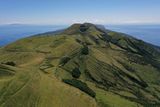
In March 2022, the small Azorean island of São Jorge experienced a sudden series of earthquakes after nearly 60 years without major seismic events. The shaking continued for months, with micro-earthquakes continuing for 2 years, but what was happening deep underground remained a mystery.
Now, an international team of researchers thinks they have a clearer answer. By analyzing seismic data from both land and seafloor, along with satellite imagery, they concluded that magma had risen from more than 12 miles below the surface, only to stall about a mile underground. Simply put, it was a near-eruption that never quite made it. The study, published in Nature Communications, describes how the magma surged upward in just two days, in a volume equivalent to roughly 32,000 Olympic-sized swimming pools.
“This was a stealthy intrusion,” said lead author Stephen Hicks from University College London in a statement. “Magma moved quickly through the crust, but much of its journey was silent, making it difficult to forecast whether an eruption would occur.”
The researchers say that understanding this unusual event in the geologically complex Azores could help improve how scientists forecast volcanic activity in the future.
Underground Magma Swell Made the Island Grow Taller
When magma pushes upward through the layers of Earth’s crust, it often leads to volcanic eruptions. But not always. Sometimes, it stalls at various depths, stopping short of breaking through the surface.
That’s exactly what happened beneath São Jorge. The Azores sit along the Terceira Rift, where the Eurasian and African tectonic plates are slowly pulling apart, making seismic activity relatively common. The island itself, just 35 miles long and about 4 miles wide, has a history of powerful earthquakes, including a magnitude 7.5 event in 1757, one of the largest earthquakes in the Azores.
After the 2022 earthquakes began, researchers reconstructed the underground activity using a combination of seismic readings, GPS measurements, and satellite data. These tools revealed that the ground had risen by nearly 2.5 inches, which gives strong evidence that magma had entered the shallow crust. Over long timescales, this kind of uplift is actually one of the ways islands grow taller.
They also found that the magma traveled along a major fault system running through the island, known as the Pico do Carvão Fault Zone.
Read more: Mount Etna May Stem From a Rare Magma Mechanism, Explaining the Volcano’s Puzzling Origins
Faults Can Guide Magma and Reduce Pressure
Faults and fractures in Earth’s crust can act like pathways for rising magma, though scientists are still working to fully understand this relationship. In São Jorge’s case, the fault system appears to have played a surprisingly complex role.
Previous studies had shown that this fault zone was capable of producing large earthquakes in the past. During the 2022 unrest, instead of one major quake, researchers observed many smaller ones clustered along the fault that were triggered by the movement of magma below.
According to the researchers, the fault acted as a kind of guide, helping magma move upward more easily. At the same time, it may have allowed gases and fluids to escape sideways, reducing pressure within the magma and ultimately preventing an eruption.
“The fault acted like both a highway and a leak,” said co-author Pablo González of the Spanish National Research Council in the release. “It helped magma rise, but may also have prevented an eruption.”
Grasping How Magma Can Be Stealthy Will Help Future Forecasts
Understanding how magma moves beneath the surface is key to making sense of volcanic unrest and predicting what might happen next. The Azores offer a rare natural laboratory, where active magma systems intersect with large, earthquake-generating faults. This makes it easier for scientists to study how tectonic structures and molten rock interact in real time.
The observations from the São Jorge events suggest that massive surges of magma can develop rapidly without warning, but also how geological faults impact whether that magma reaches the surface or gets stuck below. Both insights are crucial to making volcanic activity easier to anticipate.
“This study supported local authorities in assessing a potential volcanic threat,” said co-author Ricardo Ramalho of Cardiff University in the release. “[It highlights] the value of combining onshore and offshore geophysical data for accurate detection and localization of seismic events and ground deformation.”
Read more: The Atlantic Ocean May Have Its Own Grand Canyon — and It Might Be Even Bigger
Article Sources
Our writers at Discovermagazine.com use peer-reviewed studies and high-quality sources for our articles, and our editors review for scientific accuracy and editorial standards. Review the sources used below for this article:
Source: Read Full Article