









In bed afterward, recovering from his father’s assault, Michael reads an illustrated Peter Pan book in which a drawing of the villainous Captain Hook is hand-labelled “Joseph”—a blatant foreshadowing of Michael’s refuge in a fantasy version of childhood. Soon, his real childhood is overtaken by his career, when Joseph pulls the group—now called the Jackson Five—out of school for a Chicago gig. The group is a hit with the audience, and, in the wings, an executive for Motown Records, Suzanne de Passe (Laura Harrier), slips Joseph her card. With planted irony, she praises Michael’s “God-given talent,” as Joseph’s hint of a sneer suggests that he’s claiming credit for it. (Domingo’s performance, which seethes with a ferociously warped sense of purpose, is far subtler and more varied than the script’s rhetorically heated but underdeveloped character.) The movie doesn’t take its time: cut to Los Angeles, where the Jackson Five is recording for Motown, under the guidance of its founder, Berry Gordy (Larenz Tate). Gordy coaches Michael through the vocals of “I Want You Back” and, in the process, initiates him in the technical art of making records. He also offers a form of mentorship altogether different from Joseph’s reign of terror.
As the lead singer and the prime personality of the Jackson Five, Michael is propelled into stardom and the compromises that come with it, starting when Gordy advises him to lie about his age. One compromise that weighs heavily on him is the fact that he has no friends, and the depiction of him as an isolated, idiosyncratic young adolescent stokes pathos simply and plainly. To fill his solitude, he buys animals (a snake, a rat, a llama; eventually, a chimpanzee and even a giraffe). Human peers, he laments, only gawk at him and want a photo. Katherine, his companion in nighttime TV-movie viewing (“Singin’ in the Rain,” the Three Stooges), says that she always knew that he was different, and she exhorts him to embrace his difference: “Let your light shine,” she tells him. And so he does—in scenes set seven years later, in 1978, when Michael, now an adult played by Jackson’s real-life nephew Jaafar Jackson, goes behind Joseph’s back to pursue a solo career. (The group had, by then, moved to Epic Records, a division of Columbia.)
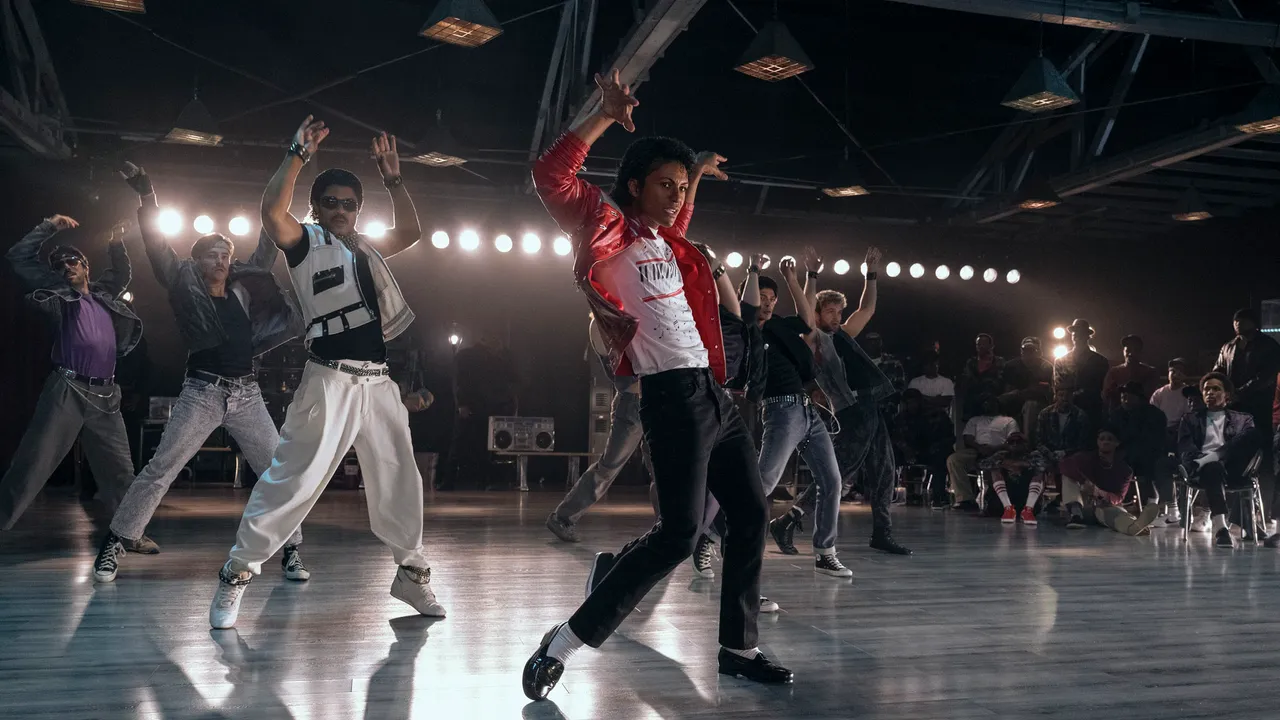
As the grownup Michael asserts himself artistically and professionally, the drama becomes pugnacious, with Fuqua and the screenwriter John Logan filling in fine-grained details of business maneuvers whose glaring ironies are pierced with pain. Michael, while working on his first solo album with Quincy Jones (Kendrick Sampson), can’t bring himself to tell his father; when Joseph is nonetheless informed, he responds with a power play of his own. To wriggle out of Joseph’s grasp, Michael hires a brash young lawyer, John Branca, played by Miles Teller, who lends the coolly confident character a delightfully rough edge. (The real-life Branca, who was also Jackson’s business adviser, is an executor of Jackson’s estate and a producer of the movie.) Thus ably abetted, Michael insists that the record company’s head, Walter Yetnikoff (Mike Myers, bringing outrageous yet principled streetwise humor), force MTV—considered then to be denying Black artists airtime—to broadcast the music video of “Billie Jean,” a key step toward making it a worldwide hit.
With this plethora of behind-the-scenes incidents, “Michael” becomes a vigorously effective business movie. Unfortunately, it’s far less detailed or effective in its portrayal of the title character, and the trouble starts with the script, which omits many matters of incontrovertible interest even beyond the allegations of child abuse. For starters, there’s nothing of the eternal triangle of sex, politics, and money. The story is filled with dealmaking, but just how rich the Jackson family, and Michael himself, get from their success goes unspoken, unsuggested—except that it’s plenty. As for politics, a TV report about gang violence inspires Michael to head into Los Angeles (accompanied by his bodyguard and driver, Bill Bray, played by KeiLyn Durrel Jones) to meet some streetwise young people in the hope of using dance to bring peace, but his awareness of the world seems to go no further. Sex, meanwhile, is simply not a part of Michael’s life in any way, nor is its absence acknowledged—is he naïve, shy, asexual, repressed? Even Michael’s social life is left blank, far beyond his adolescent solitudes. Young Michael may have seemed strange, or just plain different, to kids his own age, but what about the adult Michael, whose professional life took him outside the family orbit and into offices, studios, and night clubs? Did he never meet and talk with other stars? And what do stars discuss, anyway? Fuqua and Logan can’t be bothered to figure it out.
Source: Read Full Article