










At the very tip of a scorpion’s stinger, where it pierces prey, the material changes. That needle-like point is reinforced with zinc. Just beneath it, the structure shifts again, with a different metal taking over. Together, they form a layered weapon built to stab, grip, and endure repeated use.
A study published in the Journal of the Royal Society Interface finds that, across species, metals like zinc, manganese, and iron are concentrated in specific parts of a scorpion’s stinger and claws, reinforcing the areas under the most stress. The research, led by scientists at the Smithsonian’s National Museum of Natural History and the Smithsonian’s Museum Conservation Institute, shows that this pattern also varies with each species’ hunting style, hinting that the materials are tuned to behavior, not just strength.
“Scorpions are incredible hunters, and while we knew that metals strengthen the weapons in some species’ arsenals, we don’t know if all scorpions’ weapons contain metal, and if so, whether this metal enrichment relates to how they hunt,” said Sam Campbell, a graduate student fellow at the National Museum of Natural History, in a press release. “We decided to use microanalytical techniques to unravel where and how these metals are distributed.”
How Metals Strengthen Scorpion Stingers and Claws
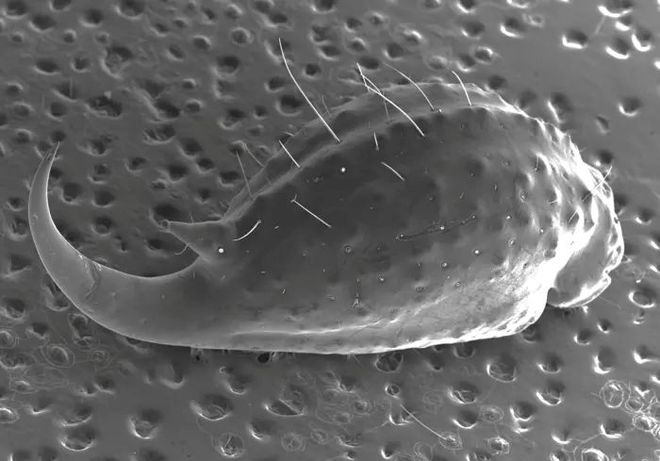
SE micrograph of a scorpion stinger.
(Image Credit: Sam Campbell/University of Queensland)
Scorpions rely on two main tools to subdue prey: their pincers and their stinger. But not all species use them the same way.
To see how those differences play out, researchers analyzed 18 species using high-resolution electron microscopy and X-ray techniques, mapping where metals are concentrated at a microscopic scale. What they found was reinforcement placed only where the weapons experience the most strain.
That pattern is especially clear in the pincers. Metals appear only along the cutting edge of the movable outer segment, the part that grips and slices into prey. Depending on the species, this edge contains either zinc alone or a combination of zinc and iron, strengthening the narrow region that does most of the work.
“The microscopic-scale methods we used allowed us to identify individual transition metals in extremely high detail, showing us how nature skillfully engineered these metals in the scorpion’s weapons,” said Edward Vicenzi, study co-author.
Read More: What’s So Special About the Deathstalker Scorpion?
Why Some Scorpions Use Metal Differently
Zinc appeared more often in species with long, slender pincers — the kind used to grab and hold prey rather than crush it. These scorpions tend to rely more on their stinger, using their claws to control prey before delivering venom.
That shift changes how the metal is likely functioning. Rather than simply increasing strength, zinc may help reduce wear, allowing thinner pincers to withstand repeated stress without breaking.
“Long claws need to grasp prey and prevent it from escaping before being injected by venom. This is an interesting finding because it suggests an evolutionary relationship between how a weapon is used and the specific properties of the metal that reinforces it,” said Campbell.
What These Reinforced Weapons Reveal About Evolution
Only a small fraction of the roughly 3,000 known scorpion species had previously been examined for metal reinforcement. By looking across a wider range and using consistent methods, the researchers were able to identify patterns that extend across the group.
That approach could now be applied more broadly. Metals have been found in the jaws, stingers, and other structures of animals like spiders, ants, bees, and wasps, but they haven’t always been studied in a comparable way.
Looking at where these materials are placed, not just whether they are present, could help explain how different species have adapted their tools for hunting, defense, and survival.
“Not only does our work illustrate the material properties of scorpions’ weapons, but it establishes a new approach towards analyzing the role of metal enrichment across the tree of life,” said Hannah Wood, senior author of the study.
Read More: Oldest Known Scorpion May Have Been First To Explore Land
Article Sources
Our writers at Discovermagazine.com use peer-reviewed studies and high-quality sources for our articles, and our editors review for scientific accuracy and editorial standards. Review the sources used below for this article:
Source: Read Full Article