









There’s a bit of acting advice that’s often ascribed to Noël Coward: “Speak clearly, and don’t bump into the furniture.”
But if you’re Kelli O’Hara and Rose Byrne, by all means, slide down the staircase, nosedive over the settee and slur your words while tossing back two strong martinis and a case of Dom Pérignon. The actors check every one of those boxes during the drunken high point of “Fallen Angels,” the revival of a nearly forgotten Coward play that’s being performed on Broadway for the first time in 70 years.
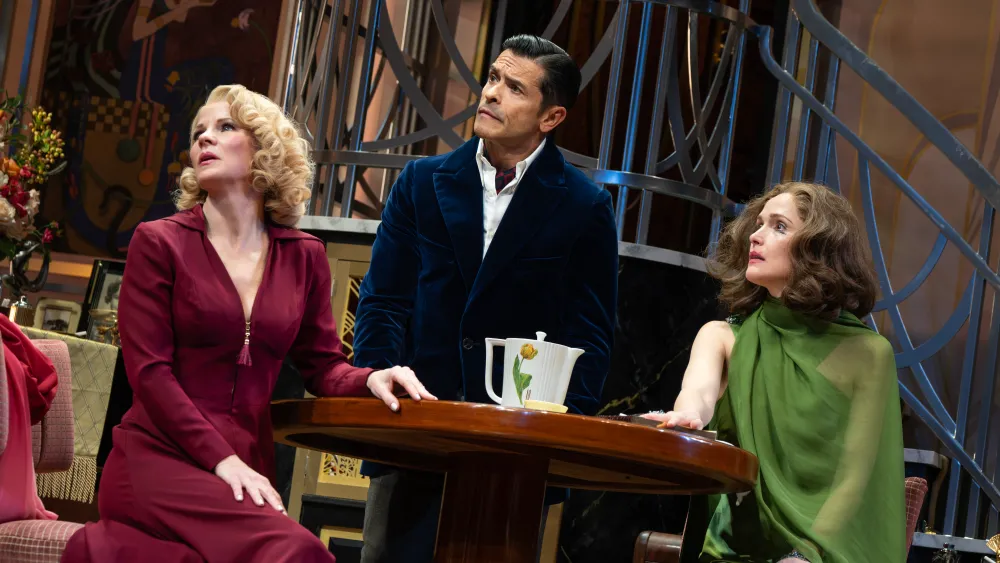
The show follows two upper-crust friends, Julia (O’Hara) and Jane (Byrne), who discover their former lover Maurice (Mark Consuelos) has touched down in London while their husbands are on a golf trip. Excited yet anxious over the prospect of reconnecting with the man that got away, the pair fortifies themselves with cocktails and bubbly during a boozy dinner. “Champagne is a great strengthener,” Julia assures Jane, who is worried the two will “go down like ninepins” if Maurice is as “attractive and glamorous as ever.”
But instead of paving the way for some good ol’ fashioned infidelity, the liquid courage causes the women to turn on each other, with the evening devolving into inebriated insults and recriminations. And the two stars, who at first seem to be playing in different registers with O’Hara launching her punchlines towards the balcony and Byrne aiming for the second row, harmonize to deliver a master class in physical comedy. It’s demented, hilarious fun to see Byrne kick off her heels and rappel down her chair or witness O’Hara dipping her after-dinner strawberries into her Cordial Medoc as though dunking shrimp into cocktail sauce. The two are so silly, so loopily in synch, that the scene, which occurs halfway through the second act, lifts the entire show, giving it a buoyancy that has been lacking during its exposition-heavy beginning.
So what to make of “Fallen Angels”? First produced in 1925 when Coward was just 24, it was an attempt to put a stiff upper lip spin on French farce. Although scandalous in its day for its frank depiction of female desire and open discussion of infidelity and premarital sex (Maurice “had” Julia in Pisa and Jane in Venice and “Florence and Florence”), the show seems positively tame post-“Sex and the City,” “Bottoms” and “Booksmart.” When the play premiered, it was nearly banned by the censors, and Coward had to tone things down to get the Lord Chamberlain’s seal of approval. He added the naughty bits back in during a 1958 revision, but the show could have benefitted from a full rewrite, not just a polish.
Some lines have Coward’s trademark sparkle (“I have heard that the worst part of parenting is the children”), while others feel like the product of a young playwright still trying to find his voice. And the main characters are little more than soused ciphers, whose one defining trait is their barely contained horniness. They lack the shading — the pathos hiding behind elegantly crafted quips — that Coward brought to the protagonists of his masterpieces, “Private Lives” and “Design for Living.”
Roundabout Theater Company’s Interim Director Scott Ellis directs “Fallen Angels” with screwball flair, staging the crossed-wire mishaps, bedroom hijinks and tipsy pratfalls like a Jazz Age “Noises Off.” He also wisely encourages O’Hara and Byrne to go-for-broke and milk every punchline, but Ellis has less success coaxing memorable performances from the show’s supporting players. Aasif Mandvi and Christopher Fitzgerald barely register as Jane and Julia’s oblivious husbands, while Consuelos, who plays Maurice as a suave cuckolder with a dodgy European accent, should probably stick to daytime TV. But Tracee Chimo, who plays a bubbly, know-it-all maid, is a standout. Likewise, David Rockwell’s set, an elegant Art Deco dining and drawing room where much of the action unfolds, provides a stylish backdrop to the proceedings, while the chandelier that soars over the stage also serves as a sight gag that ends the show on a slyly subversive note.
If only the 90 minutes that preceded that killer capper had more fizz to them. O’Hara and Byrne may be bleeding for every laugh, but you can’t ignore the fact that “Fallen Angels” is one of Coward’s lesser works. The play proves that even in his 20s, he was already perfecting his transgressive wit.
However, the other elements of Coward’s genius, that alchemy of humor and humanity that made him one of the last century’s greatest playwrights, would come with age.
Source: Read Full Article