










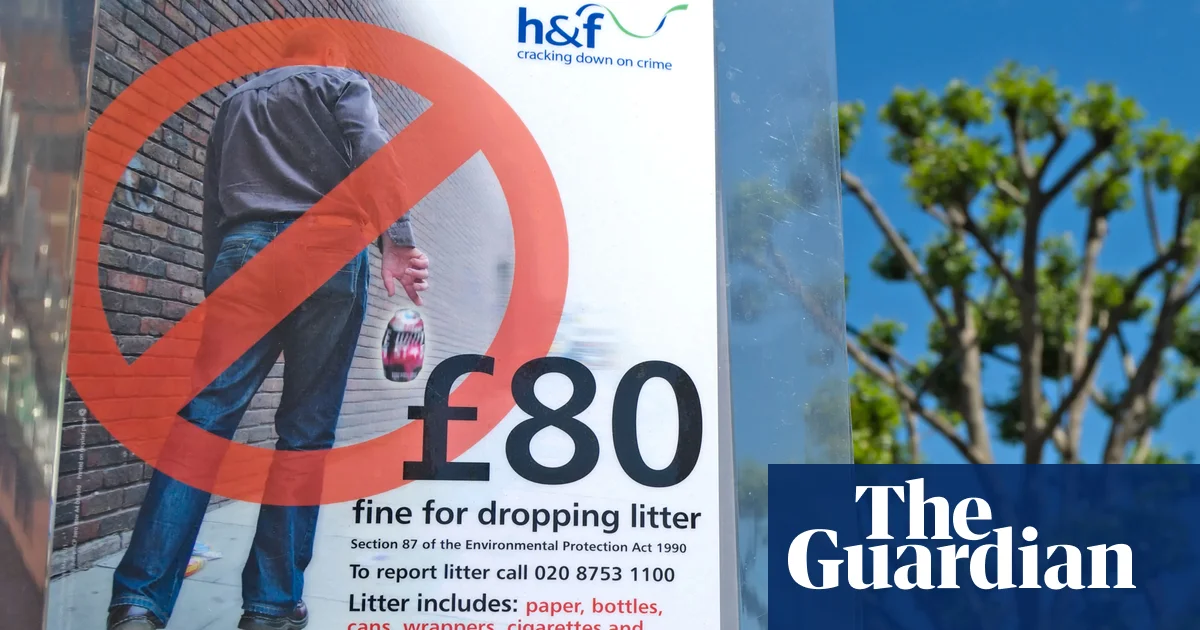
My son was fined £500 after dropping a cigarette butt in Southwark, London. He says the enforcement officer physically prevented him from picking it up, and told him he would escape a fine if he provided ID, and the police would be called if he didn’t. He complied and was promptly issued with a fixed-penalty notice (FPN).
However, £500 is more than a typical fine for a dangerous offence such as speeding.
I’ve since found fines and enforcement vary dramatically between London boroughs. Barnet charges £100, but drop your cigarette on the Enfield side of Cockfosters Road and your fine will be £500. Same “crime” a few yards apart and a 400% increase. These fines are not proportional and not fair.
TH, London
I should start by saying that littering is a national scourge and flung fag ends an environmental hazard. However, the government guidance to councils on enforcement, which last month was made legally binding, is unambiguous: the goal is to “educate” and “change behaviour”, and enforcement should be “transparent, accountable, proportionate and consistent”.
A £500 penalty for a first, or minor, offence strikes me as disproportionate, and the huge variations between fines across London are confusing and unfair.
Government guidance also requires councils to publish their enforcement policies so that the public can hold them accountable. But you discovered that only one London borough seemingly complies. Of even more concern, a number of councils outsource enforcement to private companies – in some cases the same private companies that issue parking fines.
In Southwark’s case, it’s APCOA, which will be a familiar name to many drivers. This matters because litter enforcement officers have significant powers. They can issue an instant penalty for an alleged offence and, unlike a parking ticket, these are issued face to face. This, and the 50% reduction for prompt payment, piles on pressure to stump up. Once you have stumped up, you can’t challenge it.
I put these points to the Department for Environment, Food and Rural Affairs. It ducked most. “Litter louts must be stopped from spoiling our streets, which is why we have given local authorities clear guidance and powers to take action,” it says. “Enforcement action should be proportionate so that councils can focus their resources on the worst offenders.”
Southwark tells me the enforcement officer had acted properly. It says: “Littering is an issue residents tell us they feel strongly about, which is why we take a firm approach. Our contractor’s officers are authorised to issue FPNs where offences are witnessed, in line with national and local guidance.”
APCOA tells me its teams “work in accordance with standard operating procedures, which were followed in this instance”. It says it does not retain proceeds of FPNs.
FPNs can be challenged with the council. Otherwise, court is the only option, with the risk of soaring costs.
We welcome letters but cannot answer individually. Email us at consumer.champions@theguardian.com or write to Consumer Champions, Money, the Guardian, 90 York Way, London N1 9GU. Please include a daytime phone number. Submission and publication of all letters is subject to our terms and conditions.
Source: Read Full Article