









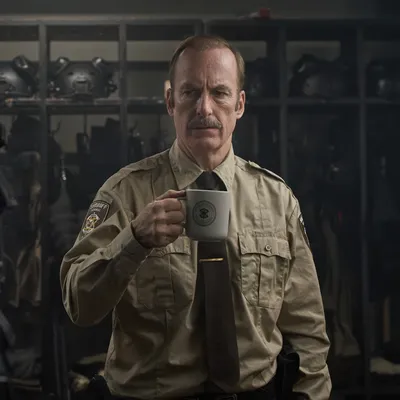
Photo: Magnolia Pictures/Everett Collection
So Bob Odenkirk is really determined to see this thing through, huh? Fresh off last year’s Nobody 2, his sequel to the modest 2021 dadsploitation hit Nobody, he’s back with another middle-age kill-fest in Normal, named after the sleepy midwestern town that the movie will soon turn into a semi-ironic slaughter zone. These anonymous-sounding titles are not coincidental. Unlike some of his more strapping forebears (think Liam Neeson, Kevin Costner, or Aaron Eckhart), Odenkirk specializes in nobodies and normals: people one would not expect to be killing machines. That’s sort of the joke of these movies, and it’s not exactly a new joke. But Odenkirk’s energy can still engage us, if only because he himself often looks like he’s wondering what he’s doing here.
In Normal, our guy plays Ulysses, a substitute sheriff who’s just holding down the fort for a few weeks until a new sheriff can be elected after the old one passed away under strange circumstances. Snowy, sleepy, half-abandoned, but also quite pleasant, Normal, Minnesota (town motto: “We like it here”), is a place of “big people, small problems,” and it seems to be an ideal way station for the constantly drifting Ulysses, who, true to his name, is estranged from his wife and doesn’t seem to be in any hurry to get back home. We do know that nastiness is afoot right from the film’s brutal opening scenes, which take place at a yakuza meeting in Osaka, Japan, where a henchman is beheaded and the other is instructed, minus one pinky, to head to Normal and “redeem” himself. So while Ulysses does his daily rounds and we meet the quirky townspeople, we may start to wonder what roles they’ll all play in the surely gruesome mayhem to follow.
Normal was written by Derek Kolstad (who wrote the Nobody films, as well as most of the John Wick movies) and directed by Ben Wheatley, a Brit who used to be known for his odd approach to genre but who has in recent years directed stuff like Meg 2: The Trench. Wheatley has always had a decent handle on atmosphere, and Normal definitely possesses more of a sense of location than other pictures of its ilk. The action itself is occasionally interesting, but really, what even counts as interesting anymore? The genre has been reduced to a bingo card. Does somebody trip at one point and blow their own head off? (Cinematically, we still haven’t left the Age of the Accidental Discharge.) Does someone get stabbed in the eyes? Does someone’s head get crushed with a mallet? Maybe you haven’t seen these particular kills before and you’ll be amazed. Maybe you have seen them before, and you’ll want to see them again. Maybe the meaninglessness is the point. I was never bored by Normal, but I’d also be lying if I said I was ever excited by it. Maybe it’ll help you forget your troubles for an hour or two, but there’s also a good chance you’ll forget the movie itself in even less time.
But that’s also where Odenkirk’s presence helps, too. As much as I wish Kolstad’s script had done more with this character and that Wheatley had done more with the action, the actor’s perpetual befuddlement gives everything a certain existential charge. Even as he’s blowing people away, he has a “Who, me?” expression on his face, as if all that death and destruction were just a bad dream he was recounting. “Life’s a bit easier when you care a little less,” Ulysses tells us early on, and that’s obviously supposed to be some easy character shorthand we can point to later to indicate how much he’s genuinely come to care as the film proceeds. But the truth is he never really starts caring. In that sense, he makes a fine audience surrogate.
Source: Read Full Article