










Disease has shaped human history for a long time, from the first pandemics of bubonic plague to the first bouts of cholera, influenza, and, eventually, COVID-19. But how long has disease influenced the survival and spread of modern humans, exactly?
A new paper has harnessed environmental and epidemiological data to show that malaria caused by Plasmodium falciparum informed how human populations moved throughout sub-Saharan Africa around 74,000 to 5,000 years ago.
According to the paper, published today in Science Advances, much of that time period predated the development of agriculture, hinting that malaria had a large impact on humanity, long before the arrival of the agrarian lifestyle.
“This study opens up new frontiers in research on human evolution,” said Eleanor Scerri, a study author from the Max Planck Institute of Geoanthropology, in a press release related to the research. “Disease has rarely been considered a major factor shaping the earliest prehistory of our species, and without ancient DNA from these periods, it has been difficult to test. Our research changes that narrative and provides a new framework for exploring the role of disease in deep human history.”
Read More: Malaria Vaccines Could Be Game-Changers
Much More Than Climate Change
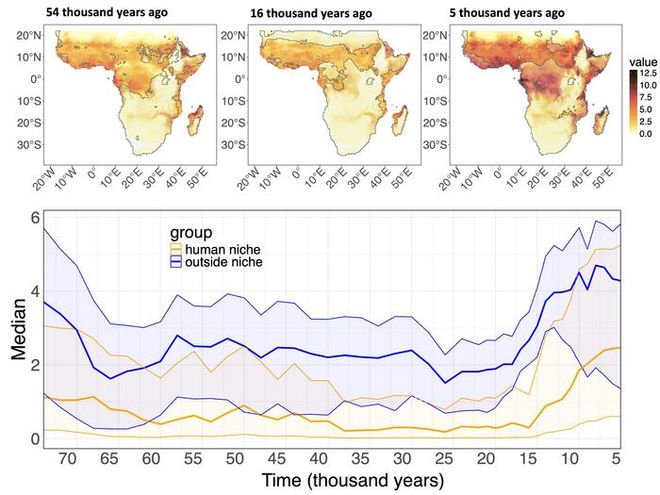
Comparing the extent of the human niche and potential malaria transmission risk through time.
(Image Credit: Colucci, et al., Science Advances, 2026.)
Recent research has hinted that Homo sapiens arose over time, from several populations throughout Africa, rather than a single population, whose encounters with each other are typically explained in the context of climate change: As temperatures and humidities fluctuated, humans set off in different directions, merging, mingling, and dispersing as they migrated.
But other factors — including infectious diseases, whose origins are often tied to the invention of agriculture — have been overlooked for their potential impact on our species’ early expansion.
To determine how disease shaped the dynamics and distribution of H. sapiens, the study authors took the modern distribution of mosquitoes, a major malaria vector, and approximated the ancient distribution of the insects in sub-Saharan Africa between 74,000 and 5,000 years ago. They then modeled how that ancient distribution would’ve shifted as the climate changed throughout the same time period, helping them demonstrate which regions had a higher risk of malarial transmission over the millennia.
Comparing and contrasting these areas with the areas where the archaeological traces of H. sapiens have been found, the study authors then revealed how the risk of infection impacted the selection of human habitats thousands of years ago.
“We used species distribution models of three major mosquito complexes together with palaeoclimate models,” said Margherita Colucci, another study author from the Max Planck Institute of Geoanthropology and the University of Cambridge, in the release. “Combining these with epidemiological data allowed us to estimate malaria transmission risk across sub-Saharan Africa.”
Mosquitoes, Malaria, and Human Migration
According to the study authors, the findings suggest that malaria had a significant effect on the dispersal of our species, with humans avoiding or struggling to survive in locations with a high risk of malarial transmission. Over time, these tendencies determined which populations converged and diverged, when and where, changing the course of human history and altering the population dynamics that continue to characterize our species today.
“The effects of these choices shaped human demography for the last 74,000 years, and likely much earlier,” said Andrea Manica, another study author from the University of Cambridge, in the release. “By fragmenting human societies across the landscape, malaria contributed to the population structure we see today. Climate and physical barriers were not the only forces shaping where human populations could live.”
Read More: One Small Genetic Tweak May Stop Mosquitoes from Spreading Malaria
Article Sources
Our writers at Discovermagazine.com use peer-reviewed studies and high-quality sources for our articles, and our editors review for scientific accuracy and editorial standards. Review the sources used below for this article:
Source: Read Full Article