










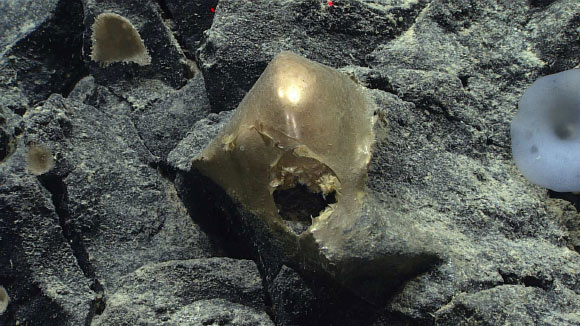
In the lightless depths of the Gulf of Alaska, approximately 3,251 m (two miles) below the surface, a softball-sized golden object clinging to a rock left marine scientists and the general public equally baffled. Was it an egg? A sponge? Something altogether unknown? New research led by the Smithsonian National Museum of Natural History suggests a far more intriguing answer: the ‘golden orb’ is the remains of a rarely seen species of anemone.

This ‘golden orb’ was found at a depth of about 3,300 m in the Gulf of Alaska. Image credit: NOAA Ocean Exploration, Seascape Alaska.
The ‘golden orb’ was collected on August 30, 2023, by the remotely operated vehicle Deep Discoverer, launched from the U.S. exploration vessel Okeanos Explorer.
Around 10 cm (4 inches) across, the mysterious object was found among small glass sponges on the seafloor southwest of Walker Seamount in the Gulf of Alaska.
Its smooth, metallic sheen and torn opening quickly sparked speculation about its origin.
“Initial examination of the gross morphology revealed the specimen to have no indication of typical animal anatomy (mouth, gut, muscle tissues, etc.), but rather to consist of a loose aggregation of fibrous material covered by a smooth, layered surface,” said study first author Dr. Steven Auscavitch and colleagues.
Further examination under light microscopy revealed that the surface was packed with specialized stinging structures unique to Hexacorallia, a group of cnidarians that includes sea anemones and stony corals.
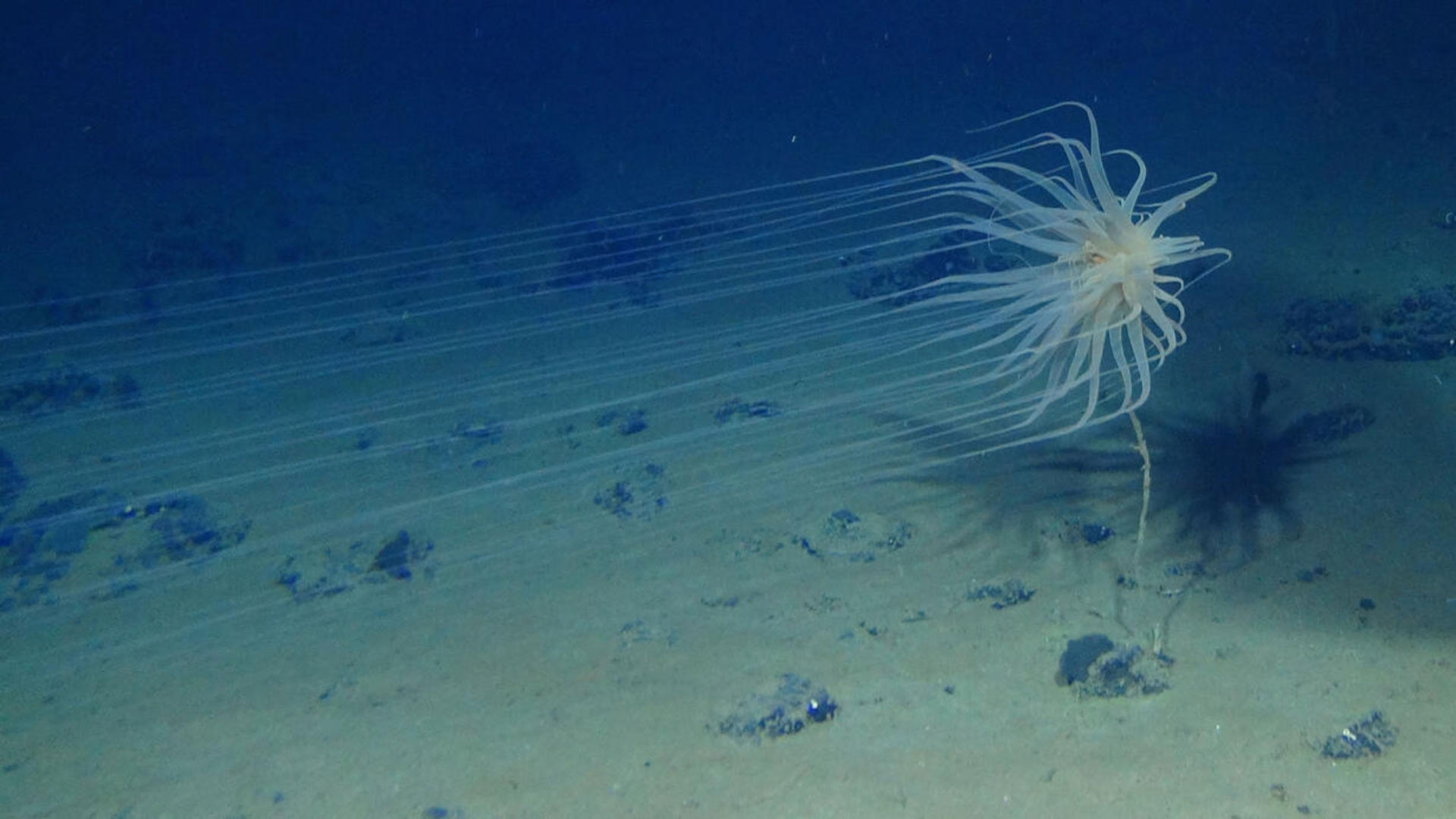
Relicanthus daphneae has pale purple or pink tentacles that can extend almost 2.1 m (7 feet) long. Image credit: Craig Smith & Diva Amon, ABYSSLINE Project.
The researchers also examined a similar specimen collected in 2021 during an expedition on Schmidt Ocean Institute’s Research Vessel Falkor and found similar stinging structures.
Genetic analysis confirmed the connection: DNA recovered from the ‘golden orb’ matched Relicanthus daphneae, an enigmatic deep-sea anemone species known for its large size and long, flowing tentacles.
Together, the evidence pointed to a surprising conclusion: the ‘golden orb’ was not a living organism but a biological remnant that formed at the base of the anemone.
The specimen was the part of a Relicanthus daphneae individual that attached to the rock substrate.
“The specimen represents a novel microhabitat consisting of a remnant cuticle originally secreted by Relicanthus daphneae, itself a rarely encountered and recently described species, which occurs between 1,200 and 4,000 m (0.75-2.5 miles), and microbial community living on and beneath its cuticle and tissue,” the scientists said.
“These significant discoveries enabled by collection would have been unlikely were it not for its unusual golden color and the specimen’s mysterious egg-like appearance.”
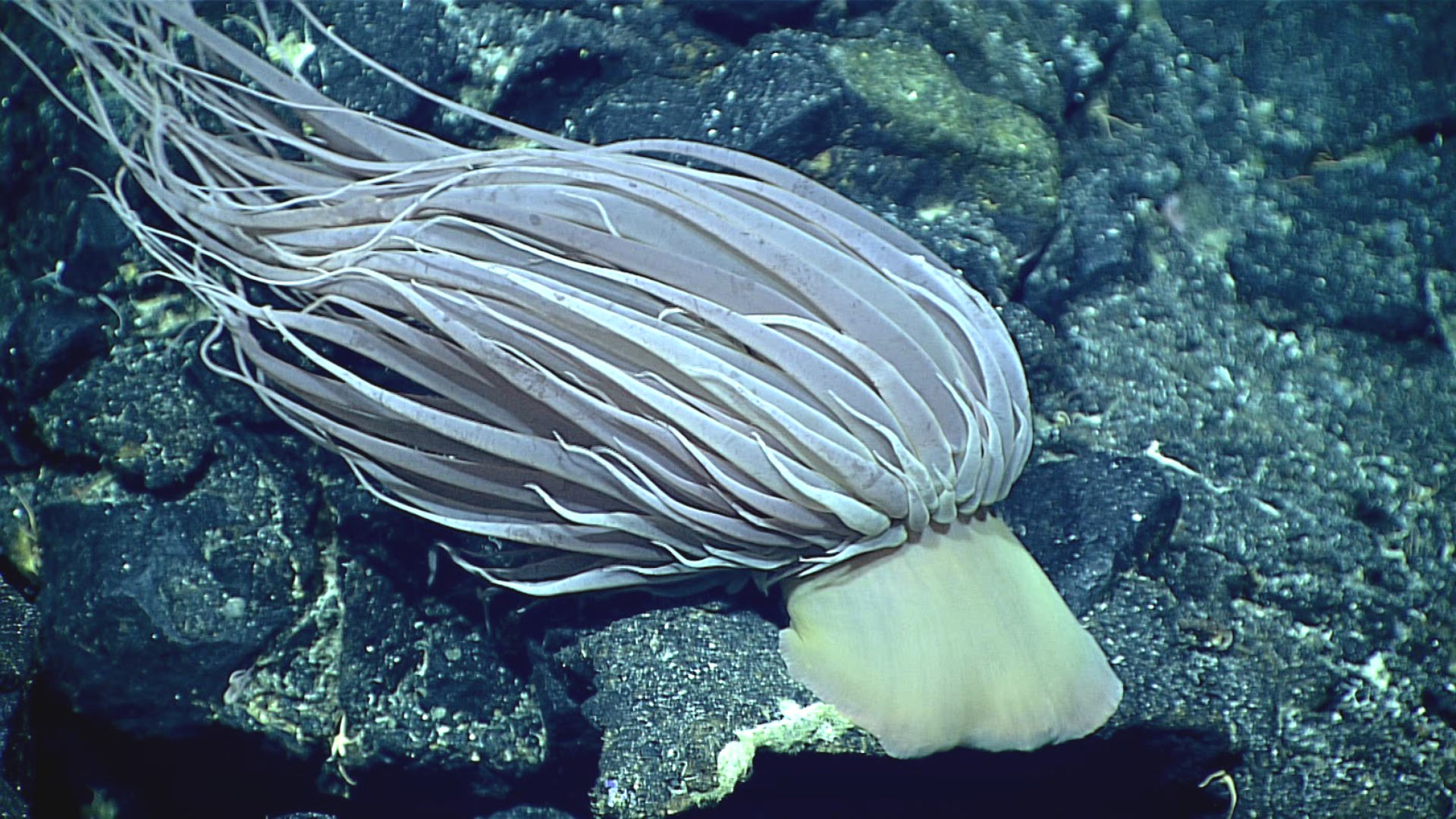
This Relicanthus daphneae was observed during a 2016 expedition on NOAA Ship Okeanos Explorer in the Mariana Islands region. Image credit: NOAA Ocean Exploration, Deepwater Exploration of the Marianas.
Though seldom collected, Relicanthus daphneae is thought to be globally distributed.
Individual polyps can reach about 30 cm (12 inches) across, with long, sinuous tentacles that may stretch twice that width.
Observations suggest the animals perch on rocks or sponges, extending their tentacles into passing currents to capture prey.
They may also move across the seafloor, potentially leaving behind trails of the same golden cuticle.
Exactly why they shed this material remains uncertain. One possibility is a form of asexual reproduction known as pedal laceration.
“Our findings underscore the extent to which the biodiversity and organismal biology of obscure deep sea fauna broadly remain unresolved and highlight the value of whole-specimen collections and rigorous taxonomic follow-up in telepresence-enabled ocean exploration,” the authors concluded.
Their paper was published online April 21, 2026 on the bioRxiv preprint server.
_____
Steven R. Auscavitch et al. The Curious Case of the Golden Orb – Relict of Relicanthus daphneae (Cnidaria, Anthozoa, Hexacorallia), a deep sea anemone. bioRxiv, published online April 21, 2026; doi: 10.64898/2026.04.17.719276
Source: Read Full Article