










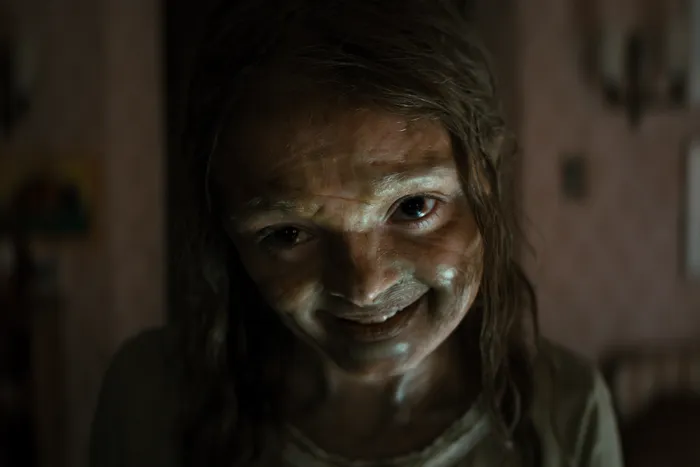
A parent’s love is supposed to be boundless and unconditional, but you have to snicker the first time that Charlie Cannon (Jack Reynor) and his wife, Larissa (Laia Costa), are reunited with their daughter after a nightmarish eight-year absence. Katie is a mischievous little girl played by Emily Mitchell when she disappears mysteriously from the backyard of the family’s temporary digs in Cairo, where they’ve been living for five months while Charlie works as a foreign correspondent for an American news channel. When Katie comes back into the couple’s life after being discovered inside a very old sarcophagus found on the site of a plane crash, she’s played by Natalie Grace under layers of prosthetics and makeup, and while she’s technically alive, she looks like a none-so-fresh corpse. Her flesh is desiccated and gray, her hands and feet are jagged claws, and her breath comes out in rasps. She’s in a catatonic state from the trauma of whatever she experienced, the doctor claims, but she also has to be kept under heavy sedation to keep her from clawing at her own skin. Despite that, he insists home is the best place for her recovery. When her mother and father gently reach out to caress the stringy wreckage of Katie’s hair, you wait for the girl to whip her head around and sink her teeth into one of their hands.
Naturally, that does eventually happen, but holy hell does it take a long time. The Mummy is an enormously silly gross-out flick that for some reason believes it ought to be a meditative slow-burn affair. (I can’t bring myself to call the movie by its government name, Lee Cronin’s The Mummy, which it was presumably titled to distinguish it from Tom Cruise’s The Mummy and Brendan Fraser’s The Mummy, but which creates the impression that writer-director Lee Cronin, best known for Evil Dead Rise, is some kind of a household name.) But it just doesn’t have enough going on to justify the shuffling pace it takes from arid Cairo to the arid American Southwest, where the Cannon family, which also includes teenage Sebastián (Shylo Molina) and young Maud (Billie Roy), who was not yet born when her elder sister was kidnapped, have hunkered down. Hereditary it’s not — not in its attempts to show the wrongness that starts simmering in the New Mexico gothic Albuquerque house in which most of the film takes place, and not in its depictions of parental guilt and grief. By the time The Mummy gets around to unfurling its freak flag for an incoherent but lively final act involving peeling skin, reanimated bodies, and an attack by way of a regurgitated scorpion, it’s long ago exhausted any good will it might have counted on to get us there.
The Mummy is, confusingly, a Warner Bros. release that shares a producer, Jason Blum, with two of the recent reimaginings of Universal Monster classics, The Invisible Man and Wolf Man, without technically being one itself. The only thing it really has in common with Boris Karloff’s The Mummy is the idea of being wrapped in bandages and entombed alive, which is what was clearly done to Katie when she turns up in that mysterious basalt casket, a somehow living girl sealed up where inspecting archaeologists expected to find an ancient corpse. It’s a genuinely horrific idea, being shut away in the airless dark, but it’s not one that Cronin explores on any visceral level. Katie, when she starts actively acting malevolent, reveals herself to be your standard possessed kid — vomiting, floating, contorting, and whispering taunts and pleas in an artificially sweet voice that takes swerves into the demonic. Maybe there’s not a lot to a mummy once she’s out of her bandages? Or maybe The Mummy just isn’t very inspired.
It definitely isn’t able to figure out how to avoid the exotification that comes with its concept, though it does at least include a Cairo-based detective character, Dalia Zaki (May Calamawy), to keep the story half planted in its home turf. Dalia is dogged, though that’s really all we learn about her, as she works to unravel the mystery of what happened to Katie while the other characters get up in their feelings. We know from the opening sequence that the mystery involves a stern Egyptian woman (Hayat Kamille) who lives on a farm with her family and who practices magic, though the degree to which this woman is doing what she has to versus doing something that advantages her bloodline in some way is something that movie never sorts out. The fact that the family is about to be banished from their ancestral land so that it can be flooded would indicate the former, because they sure don’t seem to be enjoying any supernatural benefits from their terrible rituals. But the ending of the movie abruptly shifts all the fault to the matriarch in a way that suggests what really matters is who she dared to choose as her target, crouching at the end of garden in the dark holding out treats like a witch in a fairytale — a figure of foreign otherness, there to menace this blue-eyed American child.
Source: Read Full Article