









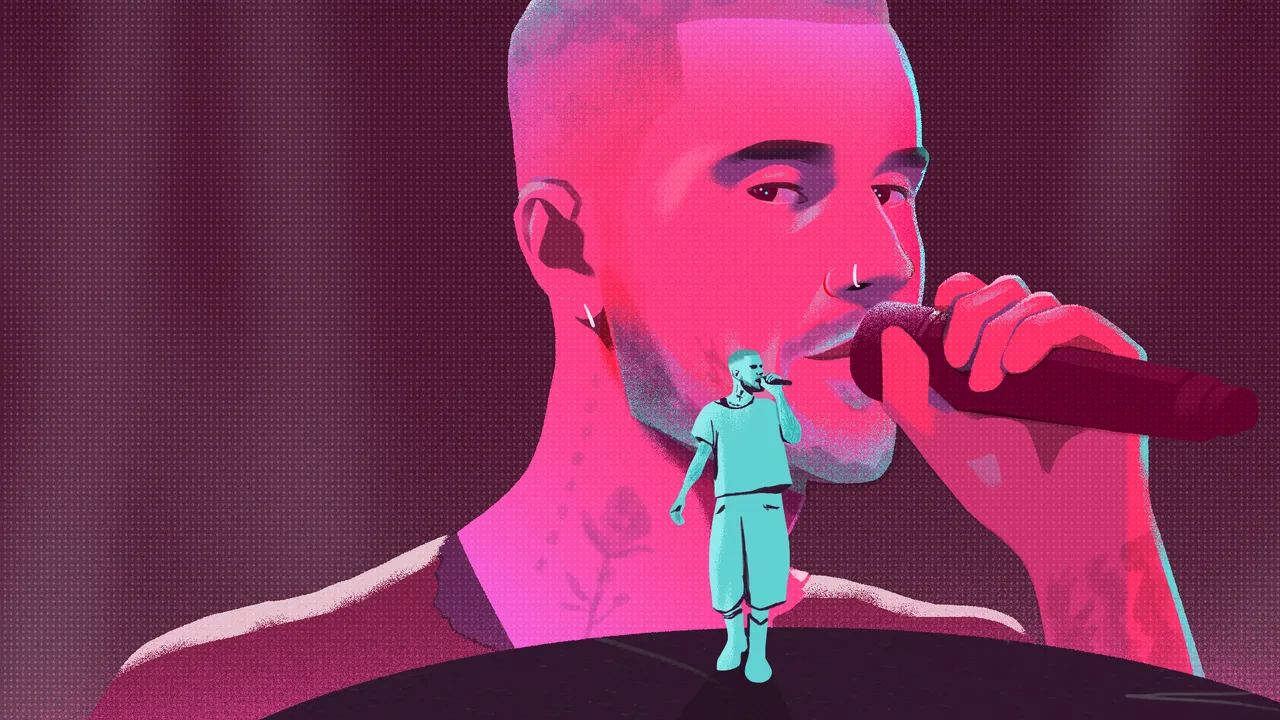
On the first Saturday of Coachella, Justin Bieber started his concert by looking down at a camera on the floor of the stage. If you were watching the show at home, on a laptop or a TV screen, via Coachella’s live stream on YouTube, he was, for a moment, looking you dead in the eye. If you were out in the Coachella Valley, near Palm Springs, where young people flock annually to get loud, hear their favorite tunes played live, hallucinate in group settings, and herald the coming of summer, you saw Bieber’s gaze emanating from a pair of huge screens. Either way, before things had really gotten going, the pop star was already acknowledging the fact that the “liveness” of his performance was a subtly shifting, always mediated, geographically expansive quality. He was in California, but also, if you wanted, in Albuquerque or Seoul or the South of France. If you could meet his gaze, outside or in bed, you were in some sense right there with him, humming along.
He was singing a song called “All I Can Take”—a distressing title that offers to catalogue, down to the most minute speck of experience, the limits of the singer’s patience, or of his sanity. In reality, though, the song’s lyrics are downbeat but vague, held together by a loose emotional logic. “These symptoms of my sensitivity,” Bieber sang. “There’s things that I can’t change: Lord knows I’ve tried. Ooh baby, we can leave it all behind.” It’s a love song, sort of. Maybe it narrates a moment after the singer has already had more than he can “take,” when he has finally decided to use romantic love as a fugitive vehicle, speeding him away at high velocity from the details of overwhelming everyday life.
Bieber’s stage was large, roundish, and mostly bare, with a hilly ridge around the edges. It was populated by neither background singers nor a band. It looked like a catcher’s mitt that had been flattened and truncated, or a diorama of a desert with the suggestion of many mountains surrounding it. He was alone, except for a thin lectern holding an Apple laptop. In its minimalism, chic or shabby, depending on your perspective, the stage looked a lot like the setup for Bieber’s recent performance at the Grammys, where he appeared naked except for a pair of socks and some baggy boxers, played the electric-guitar part for his song “Yukon” until he’d successfully recorded and looped it, then sang plaintively, unhelped by the company of other bodies or the excitements of, say, pyrotechnics.
Bieber, the former child star who, now past thirty, often gestures at a deep well of discontent, is currently in a stripped-down, melancholy, D.I.Y. phase. A guy who gets famous in the music business at such a young age—Bieber was barely a teen-ager when the world came to know his high, clear voice and innocent face—can’t help but be labelled a product, furnished with beats and lyrics, and made to play a part. Now Bieber wants us to know that he’s got his own ideas, his own artistry, his own bad mood. The only way to get the message across is to raze the usual clutter of spectacle.
Source: Read Full Article