










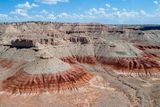
The Colorado River has been flowing through the Grand Canyon for over 5 million years, but the two weren’t united to begin with. For millions of years before finding its current course, the river followed a path that didn’t traverse the Grand Canyon. Now, scientists think they’ve found an explanation for how the river found its way into the canyon.
A new study published in Science suggests that the Colorado River was integrated into the Grand Canyon when multiple ancient lakes connected to the river gradually filled and spilled over into the canyon. The age of zircon crystals within the Bidahochi basin in Northern Arizona lends weight to this spillover hypothesis, shedding light on the origins of the river’s altered course.
“After integration, transported sediment would have given the newly formed Colorado River the tools to start carving the canyon. Some reaches were likely newly carved and others where paleocanyons were would have been significantly deepened by the integrated Colorado River over millions of years,” study author Ryan Crow, a geologist with the U.S. Geological Survey, told Discover.
How the Colorado River and Grand Canyon Met
A precursor to the modern Colorado River existed in western Colorado at least 11 million years ago. Researchers have proposed numerous pathways for the early river, believing that it may have flowed almost parallel to the current river, as well as northwest and southeast of the Grand Canyon.
The river didn’t exit the Grand Canyon as it does now until 5.6 million years ago, leaving a significant gap in the river’s history. Researchers have proposed several theories to make sense of the river’s adjusted path into the canyon, from headwater erosion to karst piracy, which involves large volumes of water being transported through cave networks.
The new study, however, has unearthed evidence that the spillover of a paleolake system was the main process by which the Colorado River was channeled into the Grand Canyon.
The study authors came to this conclusion after using uranium-lead dating on zircon crystals within volcanic ash beds and sandstones at the Bidahochi formation; this area is home to a large basin that once contained a system of ephemeral lakes — temporary bodies of water that may either discharge or recharge water, and are commonly found in arid regions.
These lakes, which once covered much of Northeastern Arizona according to the National Park Service (NPS), deposited sediments like silt, clay, and sand, which represent the lower part of the Bidahochi formation. Ash and lava ejected by nearby volcanoes also reached the basin; the ash formed fine-grained layers within the lake sediments.
Read More: Spike-Toothed Worm and Other Creatures Lived in Grand Canyon 500 Million Years Ago
Searching for Fingerprints
Uranium-lead dating of zircon is often used to determine the age of rocks, and this method is especially valuable because zircon grains act like fingerprints in the geologic record, allowing researchers to trace sediment sources and river connections throughout ancient history.
The study authors found that the composition and age distribution of zircon grains in the upper Bidahochi formation (representing a span of time 7 to 6 million years ago, during the late Miocene epoch) match evidence found in early Colorado River deposits. This suggests that the Bidahochi formation shares a sediment source with the river and that it was likely connected to the river by 6.6 million years ago.
Additional evidence, including increased sediment accumulation and similarities among fossil fish found in the Bidahochi formation and surrounding rivers, also indicates that the Colorado River was flowing into and filling the basin for over a million years before extending downstream into the Grand Canyon.
Carving the Grand Canyon
The study authors believe that the spillover of lakes into the Grand Canyon is likely what set the current course of the Colorado River, although other factors like groundwater flow or erosion may have played smaller roles.
In the nearly 5 million years since this change, the Colorado River has been continuously carving the Grand Canyon wider and deeper; one way it does this is through downcutting, which happens as the river carries large rocks and boulders that act like chisels, chipping away at the riverbed, according to the NPS. It’s this lasting influence from the river that has shaped the Grand Canyon into the geologic wonder we see today.
“Past work shows that over the last million years the Colorado River has been carving into rock at an average rate of about 100-160 meters [328-525 feet] per million years, so the process of canyon carving continues, and the canyon we see today is the result of about 5 million years of river incision and erosion,” said Crow to Discover.
Article Sources
Our writers at Discovermagazine.com use peer-reviewed studies and high-quality sources for our articles, and our editors review for scientific accuracy and editorial standards. Review the sources used below for this article:
Source: Read Full Article