










What counts as a “calm day” depends entirely on the planet you’re standing on. On Earth, a light wind might barely disturb the surface of a lake. But on Saturn’s moon Titan, that same breeze could set off waves several meters tall.
That counterintuitive idea comes from a new model developed by researchers at MIT, described in the journal Geophysical Research: Planets, designed to predict how waves form on worlds beyond Earth. The model, called PlanetWaves, is the first to bring together all the key factors that shape wave behavior — including gravity, atmospheric pressure, and the physical properties of a planet’s surface liquids. By applying it to Titan, ancient Mars, and several exoplanets, researchers are beginning to map how alien seas might behave, and what those differences reveal about planetary environments.
“On Earth, we get accustomed to certain wave dynamics,” said study author Andrew Ashton, in a press release. “But with this model, we can see how waves behave on planets with different liquids, atmospheres, and gravity, which can kind of challenge our intuition.”
Waves on Alien Oceans Across the Solar System
Waves are more than surface motion; over time, they can reshape entire landscapes. On Earth, they erode coastlines, move sediment, and influence how rivers meet the sea. But predicting how waves behave elsewhere has been difficult, in part because most models only focus on Earth-like gravity, atmospheres, and liquids.
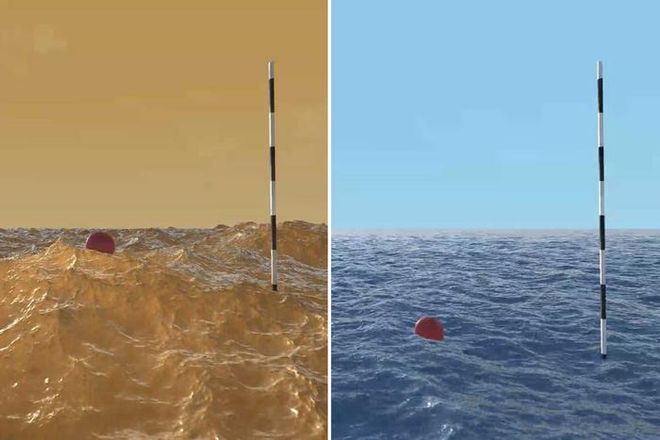
Small ripples on a lake on Earth (right) would make large waves on Saturn’s largest moon, Titan (left).
(Image Credit: Taylor Perron, Una Schneck, et al/CC BY-NC-ND)
The new approach accounts for how easily a liquid resists motion, how dense it is, and how much tension holds its surface together, along with the surrounding atmospheric pressure. Together, these factors determine how quickly ripples form and how large they can grow.
“There have been attempts in the past to predict how gravity will affect waves on other planets,” said lead author Una Schneck. “But they don’t quantify other factors such as the composition of the liquid that is making waves.”
To test the model, the team compared its predictions with decades of wave data from Lake Superior. When the results closely matched the observed conditions, researchers then applied the model to worlds like Titan by inputting its gravity, atmospheric pressure, and methane-rich lakes to simulate how waves would form there.
Why Gentle Winds Create Massive Waves on Titan
When applied to Titan, the model showed a very different kind of ocean behavior. It is the only known world beyond Earth with stable liquid lakes, though its seas are made of methane and ethane.
Under those conditions, lower gravity and lighter liquids mean that wind transfers energy more efficiently into motion. As a result, even gentle winds could generate large, slow-moving swells.
“It kind of looks like tall waves moving in slow motion,” Schneck said. “If you were standing on the shore of this lake, you might feel only a soft breeze but you would see these enormous waves flowing toward you.”
Read More: Water May Have Been Collecting in the Moon’s South Pole for Over a Billion Years
From Ancient Mars to Lava Worlds, Waves Behave in Extreme Ways
The model also offers a way to look back in time. On ancient Mars, where lakes may once have filled large basins, the gradual loss of atmospheric pressure would have made waves harder to form over time, requiring stronger winds to produce the same effects.
Beyond our solar system, on a Venus-like exoplanet with lakes of sulfuric acid, the model suggests it would take powerful winds just to produce small ripples. On another world thought to host oceans of molten rock, even hurricane-force winds would generate only shallow waves a few centimeters high.
Those findings highlight how dramatically wave behavior can vary from one world to another, and how much those differences depend on a planet’s gravity, atmosphere, and surface liquids.
Read More: Artemis II Catches Glimpse of the Moon’s Grand Canyon, a Basin That Looks Like a Giant Bullseye
Article Sources
Our writers at Discovermagazine.com use peer-reviewed studies and high-quality sources for our articles, and our editors review for scientific accuracy and editorial standards. Review the sources used below for this article:
Source: Read Full Article