










The first-of-its-kind genetic medicine treats a rare and profound otoferlin-related hearing loss, and will be made available by Regeneron for free in the United States.
You have full access to this article via your institution.
The US Food and Drug Administration’s approval of Regeneron Pharmaceuticals’ Otarmeni (lunsotogene parvec-cwha) gene therapy for a form of genetic hearing loss is a milestone both for genetic medicine and for the field of otolaryngology. It represents the first gene therapy for hearing loss, and its extraordinary efficacy seen in the ongoing CHORD registration trial will encourage further research and investment in an area that has been relatively neglected so far. What’s more, in an unprecedented move, Regeneron has decided not to charge US patients for the therapy.
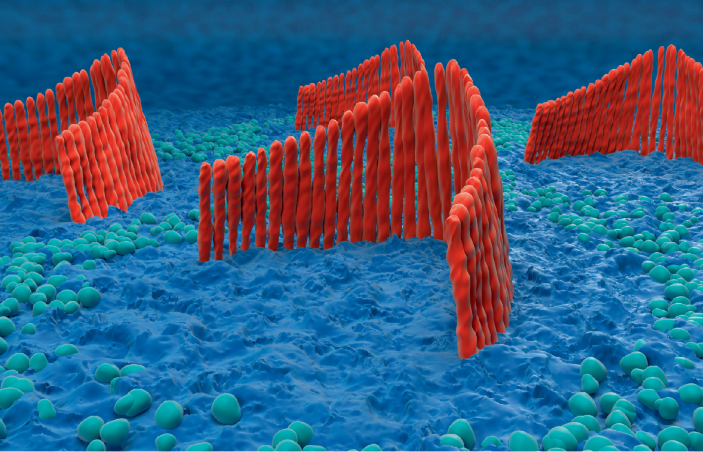
Inner ear hair cells.
Credit: Nemes Laszlo/Alamy
“As we saw the amazing CHORD clinical data, we had many discussions internally about how to make sure this scientific breakthrough would be able to reach its full potential and help as many people as possible,” says George Yancopoulos, Regeneron’s co-chair, president and CSO. At the same time, the company disclosed an agreement with the US government under which it will align the cost to Medicaid of some current and future products with the prices set in a defined group of developed countries.
On the CHORD trial, 80% of participants improved their hearing enough to meet or surpass the study’s endpoint; 42% achieved normal hearing that included whispers. Before treatment, they would have been unable to hear a gas-powered lawnmower. “I think it’s surpassed everybody’s expectations,” says Lawrence Lustig of Columbia University Irving Medical Center, who was a clinical investigator on the trial.
Otarmeni (previously known as DB-OTO) is licensed for children and adults born with severe or profound hearing loss due to biallelic mutations in the OTOF gene. It encodes otoferlin, a protein expressed in the inner hair cells of the cochlea — the fluid-filled structure in the inner ear that converts mechanical vibrations caused by sound waves into electrical signals that are relayed to the brain by the auditory nerve. Otoferlin plays a key role in transducing the signals that generate the nerve impulses needed for sound perception. Up to now, the only available treatment has been cochlear implantation.
Because the OTOF gene is too large to package into adeno-associated virus (AAV) vectors, Otarmeni delivers two DNA fragments packaged into a dual hybrid AAV system; following recombination, these encode the cDNA of the full-length protein. The transgene is under the control of a synthetic promoter that restricts its expression to inner hair cells.
Otarmeni elicited clinically meaningful responses in 11 of 12 recipients (aged 10 months to 16 years), according to an interim analysis of data from an ongoing phase 1/2 registration trial. After 48 weeks’ follow-up, 5 attained normal hearing and another 5 were able to hear speech at typical conversational levels.
Genetic testing for congenital hearing loss is not routine, however, and some individuals likely to benefit from Otarmeni are not identified by current methods. “It’s still only a fraction of them who are receiving genetic testing, even after being diagnosed with hearing loss,” says Jonathon Whitton, vice president, genetic medicines, at Regeneron, who led development of the therapy. Lustig says he believes that Otarmeni will usher in universal genetic testing for all newborns diagnosed with some form of hearing loss. This would have “some amazing downstream consequences,” he says, as it would open up the possibility of conducting long-term outcomes research into different types of genetic hearing loss.
In early 2026, Eli Lilly entered a deal worth $1.12 billion with Seamless Therapeutics to apply the biotech’s site-specific recombinase gene editing platform to correct genetic mutations that cause hereditary deafness. Several other firms and research institutions are in the clinic with similar AAV-based therapies, including Akouos (a Lilly subsidiary); Sensorion, of Montpellier, France; and Otovia Therapeutics and the Eye and ENT Hospital of Fudan University, both of Shanghai. The main differences between these and Otarmeni lie in the choice of AAV capsid and in the delivery methods. Some have also reported promising clinical trial data.
Otoferlin-mutation-associated hearing loss accounts for just 1–3% of congenital hearing loss across different populations. It was an ideal proving ground for gene therapy as OTOF expression is largely confined to the cochlear inner hair cells, and its absence does not otherwise affect the ear’s development or structure, which remain intact. So far, mutations in over 150 genes have been associated with genetic hearing loss. Of these, only a small minority are targets for existing gene therapy programs, all of which are still preclinical. Regeneron is working on several other gene therapy programs for hearing loss, says Whitton, including one targeting GJB2, which is associated with the most prevalent form of congenital hearing loss. It encodes gap junction-β2 protein, or connexin 26, which is essential for regulating the flow of potassium in the inner ear. “There are more complexities with that than there are with otoferlin,” he says.
Source: Read Full Article