








Most Angelenos know Frank Gehry as the rebel architect whose deconstructivist buildings reinvigorated L.A. amid its late-century identity crisis.
Fewer know him as the sentimental sculptor celebrated in Gagosian Beverly Hills’ upcoming “Frank Gehry” exhibition, the first to showcase Gehry’s work since his death in December. Curated by those who worked with and loved the famous architect, the show, scheduled to open May 14 and run through June 27, is equal parts tribute and art presentation. It will feature several of Gehry’s animal-themed sculptures, including a rarely seen stainless steel bear figure, on loan from the artist’s family.
The exhibition will also include the first public screening of Gehry’s entry in Gagosian Premieres, a series of videos by the gallery showcasing new art exhibitions through a mix of intimate artist interviews, studio visits and specialized musical performances.
By spotlighting Gehry’s artistic practice rather than his design ouevre — which includes Walt Disney Concert Hall, Guggenheim Museum Bilbao and Fondation Louis Vuitton — the exhibition reveals a different side of the late visionary, said Deborah McLeod, senior director at Gagosian Beverly Hills.
“I wouldn’t say it’s a retrospective, but it is a chance to stand in the room and be with him,” McLeod said, adding that she “wouldn’t have the hubris to say this is going to offer anybody closure,” but that she hopes it will help people — especially those who worked closest with Gehry — to process his loss.
“Everybody is kind of raw and missing Frank, and it’s just a chance to come together and do this again as his team,” she said.
McLeod curated the exhibition alongside Meaghan Lloyd, chief of staff and partner at Gehry Partners, whom the director said “really speaks for Frank.” Gehry‘s studio will design the show, which was realized in collaboration with the artist’s family.
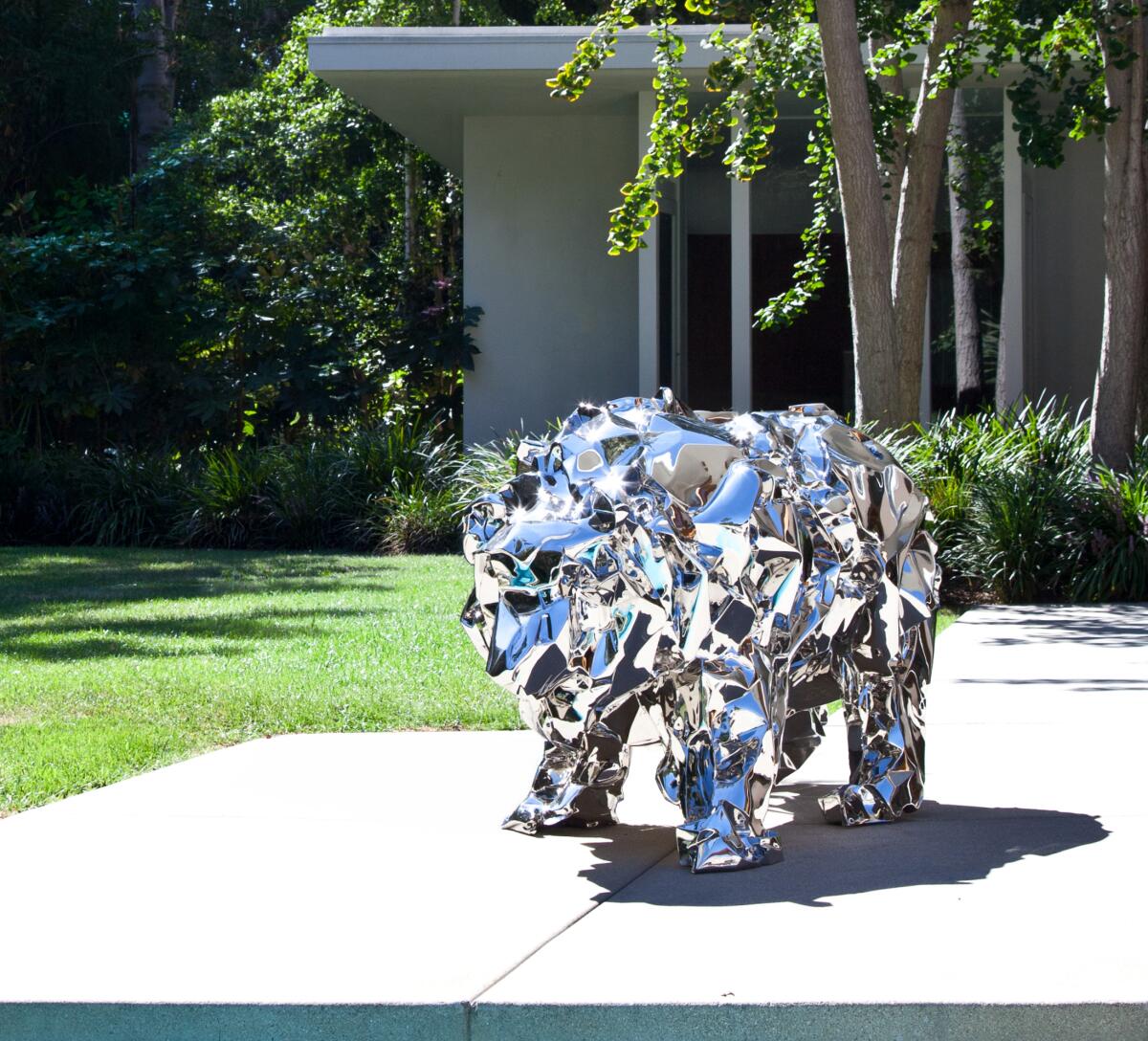
“We didn’t get a chance to put one in the gallery proper. Every time we’d make one, it would get sold,” Deborah McLeod said about Frank Gehry’s bear sculptures.
(© Frank O. Gehry. Photo: Benjamin Lee Ritchie Handler / Courtesy Gogosian)
The highlight of the Gagosian exhibition is an artist proof of “Bear with Us” (2014), which the gallery lifted out of Gehry’s wife Berta Aguilera’s garden with a crane. Another edition of the bear sculpture is on view at the New Orleans Museum of Art, but at Gagosian, the work for the first time will be on view as part of an exhibition.
The stainless steel figure has a crumpled appearance that many believe is the result of Gehry balling up a piece of paper and seeing the bear in the crumple, although McLeod said Gehry told her himself that wasn’t true. The director added that the bear’s form gives the illusion of something “coming into being or dissolving.” The sculpture will likely have the Gagosian’s north gallery completely to itself.
“We’re really going to give him his due,” McLeod said. It was only right for a piece that, to her, reads as Gehry’s “self-portrait.”
A handful of other animal-themed sculptures will populate the south gallery, including a glowing black crocodile, gouache-painted papier-mâché snake lamps, and “Fish on Fire” (2023), the last of Gehry’s fish sculptures to be rendered in copper. Illuminated within the darkened gallery, the pieces will have a “magical” flair, McLeod said.
The first fish sculptures Gehry made in the ’80s were contained, even still. But when he returned to the fish form 30 years later, Mcleod said, “they started to become actually Baroque, so that’s kind of neat to see that evolution.”
Rounding out the exhibition are a series of ink, watercolor and acrylic works on paper that “express the energetic motion of fish in networks of black line and clouds of color,” a news release said.
A portion of the pieces in the exhibition will be available for purchase, with a detailed checklist to come.
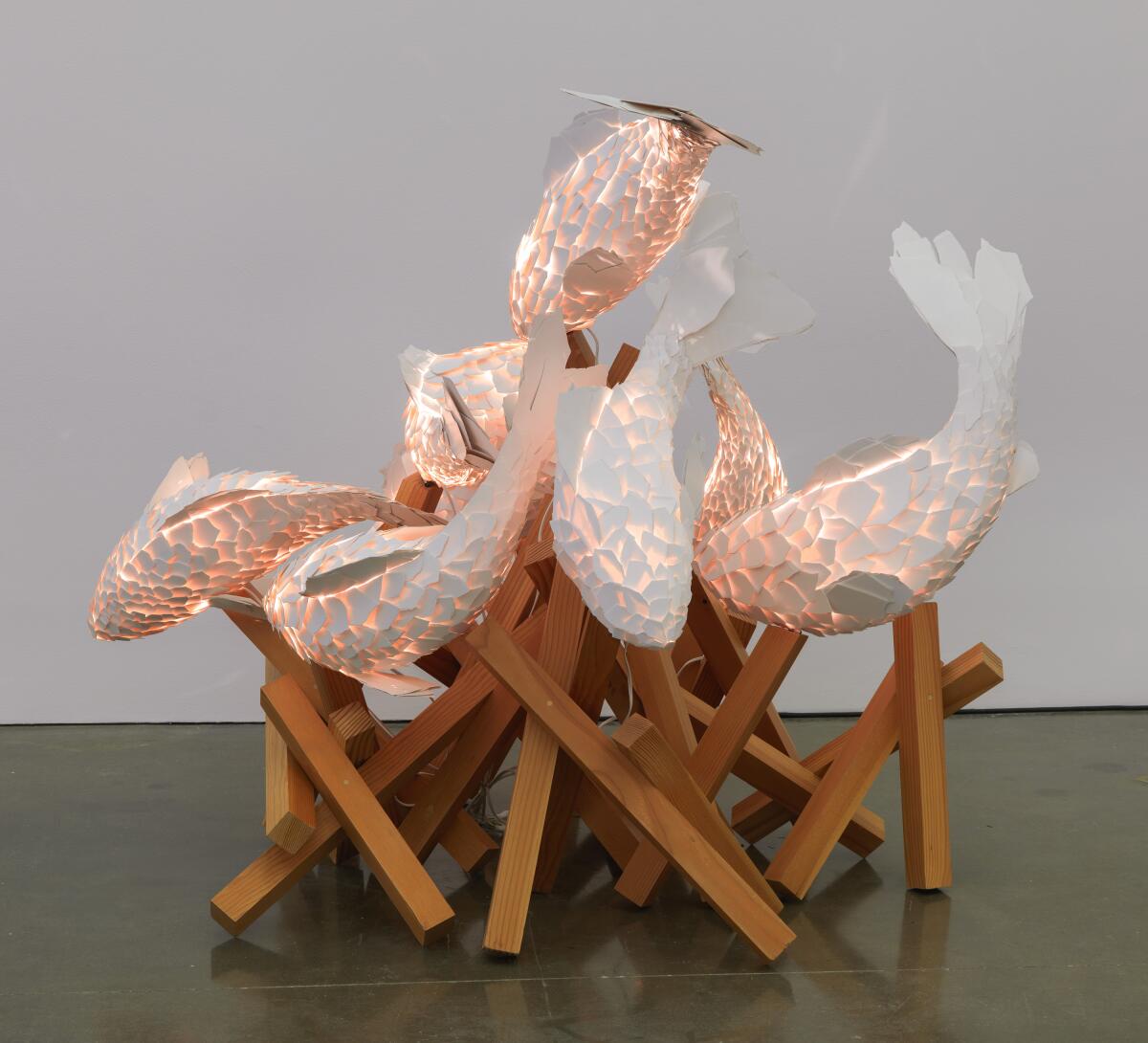
The first Frank Gehry Fish Lamps were exhibited in 1984 at Gagosian in Los Angeles.
(© Frank O. Gehry. Photo: Robert McKeever / Courtesy Gagosian)
Gehry’s designs breathed life into the city’s core, but he didn’t get to finish a number of his most exciting plans, including one to transform the 51-mile-long L.A. River.
And while his architecture was his great gift to his adoptive hometown — his art was his gift to himself.
“As one of the busiest architects in the world, imagine the math and the minutiae that you have to go through,” McLeod said, noting the enormous pressure from clients that Gehry must have felt in his daily practice.
“For him, just to make something the shape he wants to make it, plug it in … I know it was a huge relief for him,” she said. “I know how much he loved doing it, and I loved being a part of that part of his life.”
Source: Read Full Article