










Ethiopia’s Afar region is home to incredible natural diversity. Erta Ale is a shield volcano with boiling lava lakes. Dallol is an otherworldly thermal system boasting vibrantly colored pools. But Afar is also home to a region of great interest to archaeologists studying tens of thousands of years of human history.
The region’s Middle Awash study area bursts with remnants of long-lost civilizations. A new study has characterized life in the region 100,000 years ago during the Stone Age. The research was published in Proceedings of the National Academy of Sciences.
Read More: A 2.6-Million-Year-Old Jaw Uncovers a Missing Hominin From the Afar Region
Uncovered Remains at Halibee
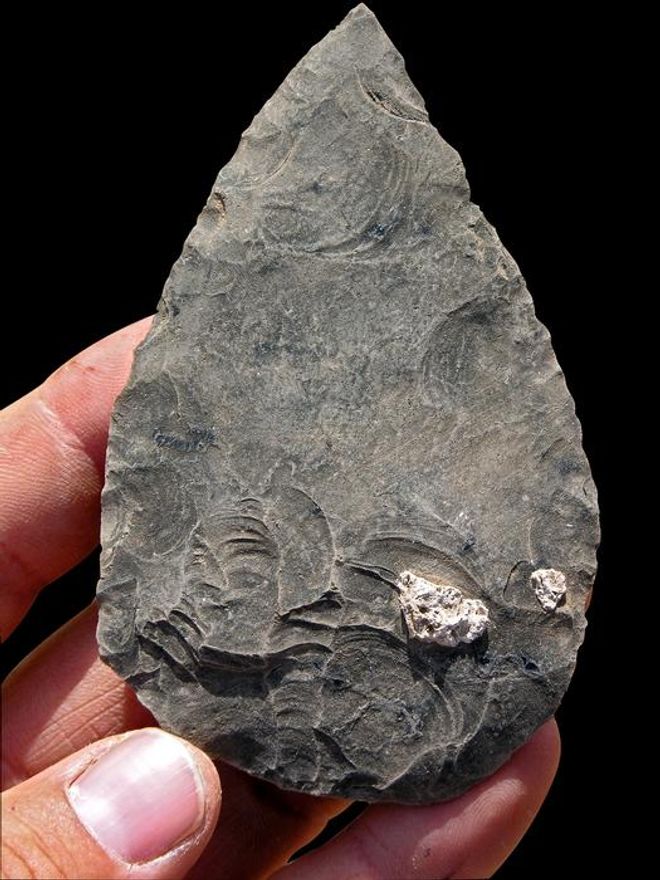
Large obsidian point from the Middle Stone Age.
(Image Credit: Tim White)
The dig at the Halibee archaeological site revealed thousands of stone tools, partial fossil skeletons of three Homo sapiens, and a large cache of animal fossils. Yonas Beyene, an archaeologist at the French Center for Ethiopian Studies in Addis Ababa, led the new study.
Many recent high-profile archaeological finds have occurred deep in caves, where artifacts are preserved from the open air. Halibee is totally different. This open-air site was originally a floodplain traversed by successive groups rather than continually inhabited. Seasonal river floods would bury anything these groups left behind in sediment.
Beyene and his team have spent years digging these samples up from the ancient riverbed. Unlike cave digs, where artifacts from different eras can be mixed, artifacts at Halibee are easier to separate and date.
Revealing the Cause of Death at Halibee
The stone artifacts found at Halibee show that early H. sapiens cut local rock into both sharp cutting tools and blunter, heavy-duty implements. The majority of the tools were made from basalt sourced locally. A small number of artifacts — just two percent of the total find — were made from obsidian, a rock not found locally. These tools were likely brought from afar by migrants or traded for.
The human remains at the site, according to the study, reveal that they each died in different ways.
The first set of remains, likely of a male, appeared to have been buried quickly after death — his skeleton was in good shape. It’s unclear whether he was buried by other humans as a custom or simply swallowed up by the river’s sediment.
The second set of remains was in much worse condition. All that Beyene’s team could find were some charred bones and a molar. This could suggest the individual was cremated, but further study will be required to confirm this.
The third ancient human died somewhat less pleasantly. They appeared to have been gnawed on by carnivores shortly before or after death. The bones were scarred and fractured.
It’s unclear what animals may have devoured this unfortunate human, but the dig turned up fossils from a menagerie of beasts, including snakes, lizards, monkeys, and even large predatory felines.
The authors concluded that humans and animals likely lived together at Halibee. The huge trove of artifacts will take many years to comb through. Additionally, the authors expect to find even more artifacts from the Pleistocene era in the next layer of the dig. Halibee will continue providing discoveries for generations.
Read More: These Two Ancient Human Species Lived in Tandem Around 2.8 Million Years Ago
Article Sources
Our writers at Discovermagazine.com use peer-reviewed studies and high-quality sources for our articles, and our editors review for scientific accuracy and editorial standards. Review the sources used below for this article:
Source: Read Full Article