









Following a recent update, a small warning has appeared in Bambu Studio, the slicer software that Bambu Lab forces on you if you want to use all the features of your printer. But, like most nagging tactics from companies that would rather you never venture beyond their ecosystem, there’s nothing to worry about.
Bambu Studio now warns you about third-party filaments
As of April 2026, Bambu Studio now warns you in eye-catching orange text that “Using non-bambu [sic] filament may have printing quality issues.”
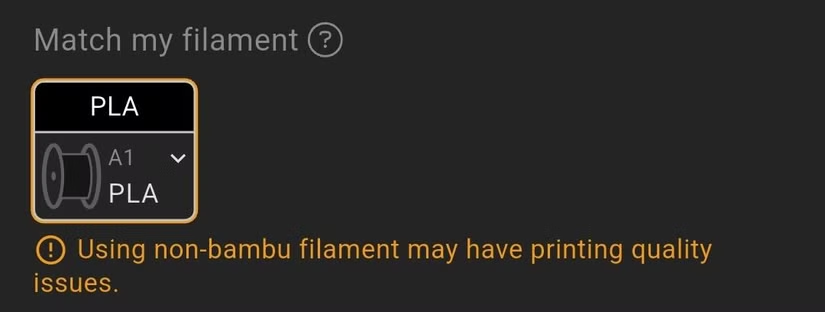
The uncapitalized, partial company name is surprisingly on-brand for a company that has had typos on packaging in the past. To read into this a little deeper, it could be argued that the company is in such great shape that it can make silly mistakes and still sell truckloads of best-in-class printers.
The printer (and by extension, the software) knows whether or not you’re using Bambu Lab filament since the company uses RFID tags to automatically identify spools. This handy feature makes it possible for Bambu Studio to load the correct filament profile and display the right color on the UI.
It’s one of the main reasons to buy first-party filament if you own a Bambu Lab printer, since it makes swapping and loading filament effortless. When the printer detects that a filament has been loaded but no RFID tag is present, you’ll need to select the correct filament profile manually, in addition to now seeing a warning that implies third-party filaments are somehow inferior.
I’ve had no issues with Bambu Lab filament, but it’s broadly accepted that the company sources its filament from a wide variety of sources. Not all 3D printing material is made equal, but as long as you dry out your filament before you use it and make sure that your filament type matches the abilities of your printer, you should be able to use whatever you like.
For some, name-brand filament just isn’t worth the premium price tag. Just make sure you check reviews and test a spool or two before you buy in bulk to stock up.
Why the warning?
Bambu Lab is trying to build an Apple-like ecosystem of “it just works” 3D printers. You have less freedom than you would with a brand like Creality to mod your printer or Prusa in terms of open-source tinkering, but you get a relatively turnkey printing experience as a result.
Bambu Lab might not produce all of its filament in-house, but it likely has very particular expectations from its suppliers. These filaments are tuned to work just right with Bambu Lab printers, with the filament profile that automatically loads when a spool is detected.
The guesswork of tuning a profile to suit a particular filament is done for you. You don’t need to print a temperature tower to figure out the sweet spot. It’s possible that the company’s customer support is handling a lot of queries from owners experiencing print quality issues as a result of using third-party filaments that aren’t set up correctly in the slicer, and this is an attempt to head this off.
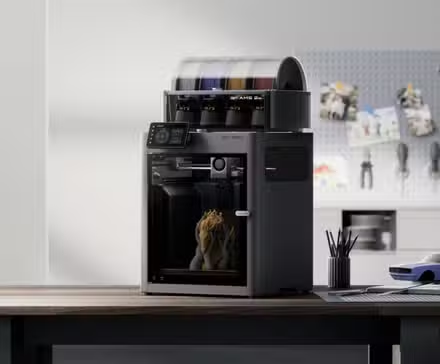
Why Bambu Lab’s latest 3D printer has broken the 3D printing world
Bambu Lab is back in the news (for the right reasons this time).
No need to panic
The appearance of this warning caused some Bambu Lab printer owners to have flashbacks to some of the company’s previous unpopular moves, notably locking printers that want to retain always-online cloud connectivity to Bambu Studio. Some have speculated that Bambu Lab might want to lock users to its own brand of printer filament in the future.
But these fears are as yet unfounded, and very likely unworkable. Bambu Lab has a serious filament problem in that the company simply can’t keep enough in stock to satisfy demand. Locking printer owners to its home brand simply wouldn’t work, and the company has even gone as far as saying this.
In a 2022 Bambu Lab blog post, the company affirmed that “it would be very stupid” to lock printers to certain brands of filament on account of the massive variety of materials, colors, blends, compounds, and other variables on the market. It’s always possible for a company to change its mind, but it’s hard to argue that a closed filament system wouldn’t cripple these printers.
There’s also the small matter of being able to move an RFID tag from one spool to another, then overwriting the filament settings manually in the slicer. It would be trivially easy to overcome the limitation. You can even go as far as ditching Bambu Studio for the self-hosted Bambuddy.
Right now, as Bambu Lab struggles to keep simple filaments like blue PLA and black ABS in stock, many users will just have to get used to this warning, even if they want to use Bambu Lab’s own filament.
This warning isn’t the only Bambu Lab development this month. The company also made headlines with the launch of a shockingly affordable brand-new dual-nozzle printer.
Source: Read Full Article