









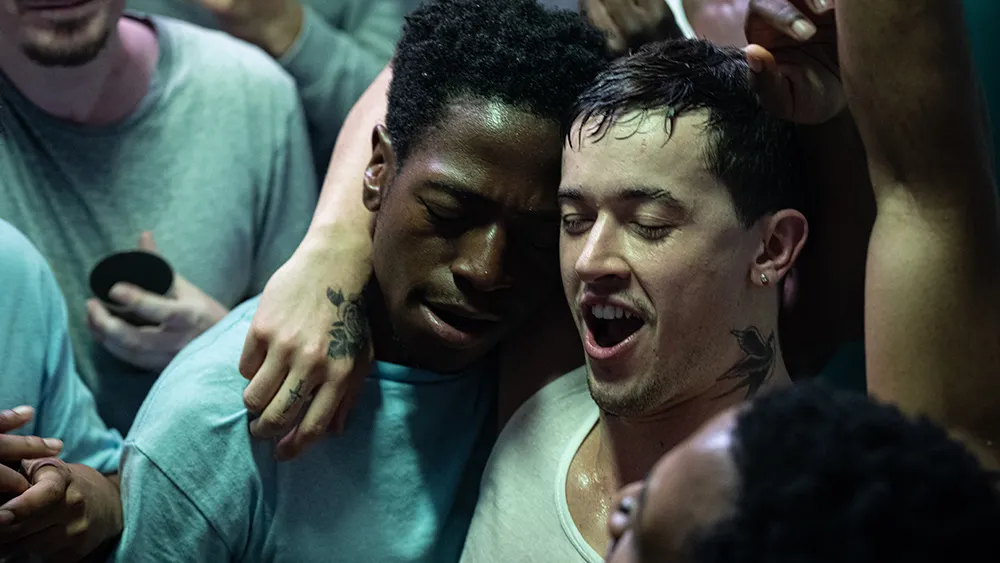
British actor David Jonsson is only five films into his career, but you’d already know his gaze anywhere: Even in a film as spry and bright as the 2023 romcom “Rye Lane,” those crinkly, softly drooping eyes bring an air of old-soul melancholy to proceedings. But they’ve never borne quite as much sorrow as they do in “Wasteman,” a coolly brutal prison drama that follows a pretty rusty narrative template — hardened inmate on the brink of parole struggles to stay on the straight and narrow — but finds more interest in the dueling masculine energies of its two principal stars. If Jonsson, as the nearly-free man in question, is all guarded regret and head-down resilience, Tom Blyth is his lethal opposite number: As a near-feral cellmate from hell, he’s the disruptive force that gives an otherwise predictable film a spark of erratic danger.
Though Jonsson and Blyth’s stealthily adversarial, hot-and-cold double act represents the chief selling point of “Wasteman” — which premiered at last year’s Toronto festival and hit screens in its native U.K. back in February — the film is most emphatically a calling card for first-time feature director Cal McMau, who picked up a surprise win for Best Debut Director at last year’s British Independent Film Awards (beating the more hotly tipped likes of Akinola Davies Jr. and Harry Lighton) en route to a nomination in the BAFTAs’ equivalent category. An artist turned commercials director, he handles proceedings here with equal parts grit and polish, smoothly integrating multiple shooting formats and implied points of view — with an emphasis on vertical cellphone footage that gives us a bristlingly immediate sense of life on the inside.
Slightly less persuasive, however, is the script by Hunter Andrews and Eoin Doran, also taking their first feature credit. Trading in starkly opposed male archetypes but scantly developed characters, it builds some claustrophobic drama around inmates’ jostling for alpha status within these bleak, blue-washed walls, though it’s only glancingly attentive to the systemic failures governing this sordid battle royal, or more specific, unspoken social and racial conflicts presumably coursing through a pressure-cooker microcosm of modern British manhood. (Give or take the flavorful accents, the tone of the drama here is most reminiscent of that decades-old HBO TV provocation “Oz.”)
Jonsson plays Taylor, a watchful, aged-beyond-his-years introvert who has spent 13 years behind bars on a manslaughter charge — missing almost the entire life of his teenage son Adam (Cole Martin), from whom the boy’s mother is determined to keep him estranged. He’s a quiet prisoner if not exactly a model one, with an opioid addiction he can’t kick, funded by his stoic work as a barber to his fellow inmates. When he’s informed that he’s soon to be up for parole — due less to his own good behavior than a need to free up prison space — he’s cautioned not to put a foot wrong; receding into himself is the safest course of action.
It’s a bad time, then, to be paired with a new cellmate, particularly an unholy terror like Dee (Blyth), a grinning, nihilistic thug with a taste for living large — which, in prison confines, amounts to an in-cell air fryer and a shelf for his impressive sneaker collection — and a steady supply of drugs that soon makes him the most popular dealer on the wing, to the consternation of former big dogs Gaz (Corin Silva) and Paul (Alex Hassell). Generous with his stash and with access to his phone — which Taylor uses to communicate with Adam on social media — Dee ropes the addict into his trade, though their tentative friendship is soon subsumed into the prison’s overriding culture of violence.
With his gangly, clammy physicality and strident delivery, Blyth is an electrifying hair-trigger antagonist, jump-starting each scene he’s in and even contributing some leering wit to an otherwise stern affair. “I don’t need to be careful,” he brags to the walking-on-eggshells Taylor: For Dee, being beyond redemption is a point of pride. The actor can’t, however, find much semblance of humanity in this flatly vicious figure, who ultimately serves to highlight the manifold vulnerabilities of our flawed but contrastingly soulful hero, played by Jonsson with a tight, walled-off reserve that seems liable to break at any given moment.
That palpable desperation is compounded by the sheer airlessness of Phoebe Platman’s production design and Lorenzo Levrini’s prowling cinematography, which permits only the odd, stray shaft of natural light into this dank, metallic-hued world. The most explosive setpieces here are the pummelling prison riots, which Levrini charges into with handheld gusto, but the film feels rawest and realest in recurring interludes where the aspect ratio narrows and McMau views prison life (some of it battering, some of it banal) through the grainy lens of the inmates’ devices. A more unusual, subversive work might have stuck to this conceit throughout, but “Wasteman” finds some relief in formal convention.
Source: Read Full Article