










New research by astronomers from the University of California, Riverside, Sam Houston State University and the University of Oklahoma suggests decaying dark matter could have triggered the rapid collapse of early gas clouds, helping supermassive black holes form far sooner than current theories allow.
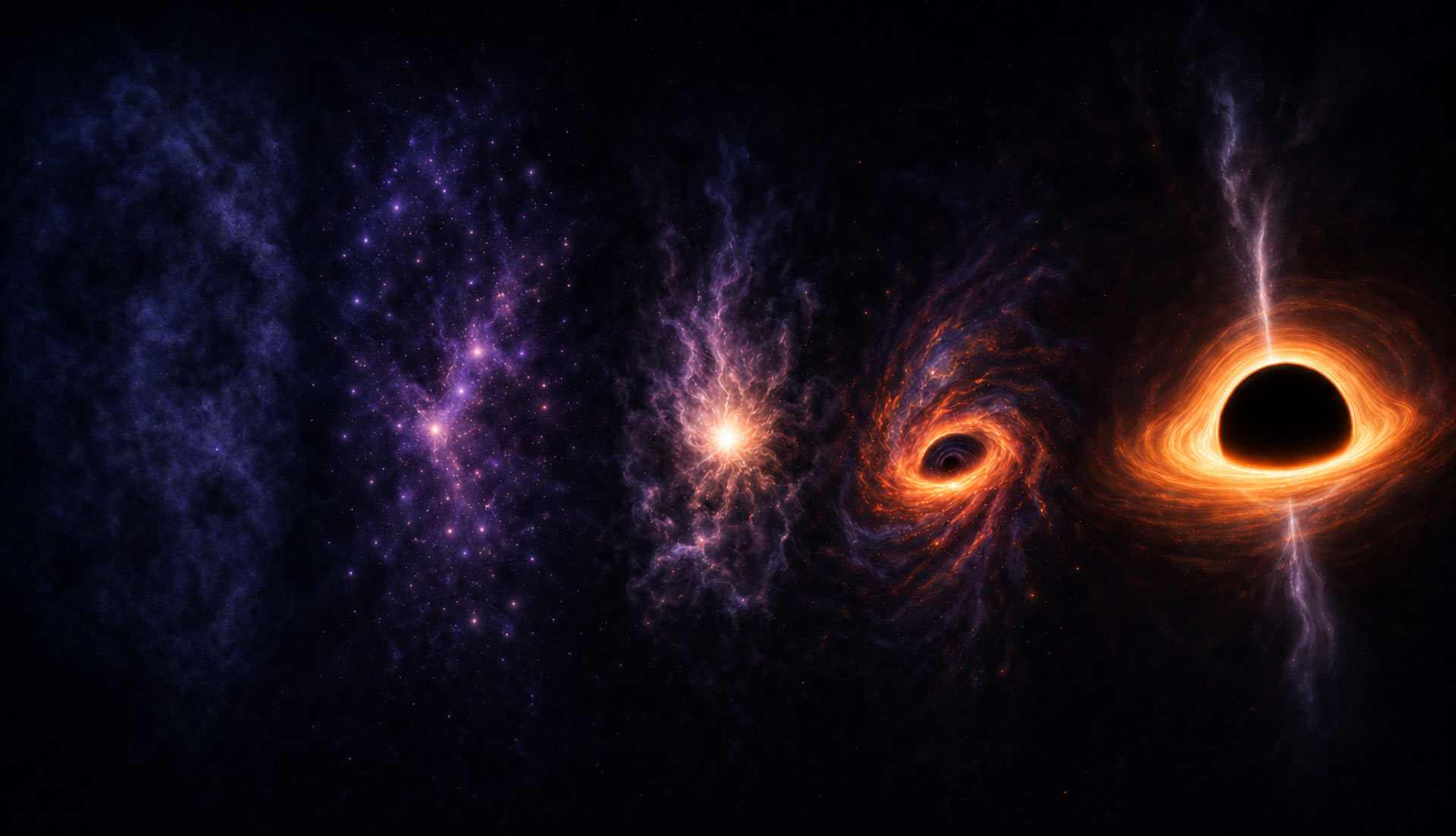
Aggarwal et al. show that the energy released from dark matter decay could alter the chemistry of early galaxies enough to cause some of them to directly collapse into black holes rather than forming stars. Image credit: Aggarwal et al., doi: 10.1088/1475-7516/2026/04/034.
“Our study suggests that decaying dark matter could profoundly reshape the evolution of the first stars and galaxies, with widespread effects across the Universe,” said University of California, Riverside graduate student Yash Aggarwal.
“With Webb now revealing more supermassive black holes in the early Universe, this mechanism may help bridge the gap between theory and observation.”
Aggarwal and colleagues show that if dark matter — the unknown 85% of the matter in the Universe that helps form galaxies — decays, it can leak a small amount of its energy into the gas and supercharge the direct collapse rate.
Each decaying dark matter particle would only need to ‘inject an amount of energy that is a billion trillionth the energy of a single AA battery.’
“The first galaxies are essentially balls of pristine hydrogen gas whose chemistry is incredibly sensitive to atomic-scale energy injection,” said University of California, Riverside’s Dr. Flip Tanedo.
“These are the properties that we want for a dark matter detector — the signature of these ‘detectors’ might be the supermassive black holes that we see today.”
In the research, the astronomers modeled the thermo-chemical dynamics of the gas in the presence of decaying axions.
They found that a window of dark matter masses between 24 and 27 electronvolts could produce the conditions to seed direct collapse black holes.
“The work stemmed from a series of coincidences that brought the right people together at the right time, including a series of workshops that connected particle physicists, cosmologists, and astrophysicists to discuss the big questions in their field,” Dr. Tanedo said.
“We showed that the right dark matter environment can help make the ‘coincidence’ of direct collapse black holes much more likely.”
“In the same way, the support for interdisciplinary work helped make the ‘coincidence’ leading to this work possible.”
The study was published on April 14, 2026 in the Journal of Cosmology and Astroparticle Physics.
_____
Yash Aggarwal et al. 2026. Direct collapse black hole candidates from decaying dark matter. JCAP 04: 034; doi: 10.1088/1475-7516/2026/04/034
Source: Read Full Article