








Canonical has outlined plans to bring AI features to Ubuntu Linux over the next year, with major implications for how the distribution will evolve.
Engineering VP Jon Seager revealed that Canonical will take a two-pronged approach that both upgrades current OS features with AI “in the background” while adding “AI native” functionality for users that like it.
For existing features, Seager pointed to the example of delivering “first-class” speech-to-text capability. There are “minimal” issues with implementing these upgrades, according to the executive. These can usually be done using local AI processing, open source tools, and open weight models (that is, their parameters are accessible and customizable).
For more explicit AI features, Ubuntu will get agentic workflows that are “tasteful,” meet user expectations, and align with the team’s privacy and security values, Seager said. He believed large language models (LLMs) and agents could “demystify” Linux for newcomers, troubleshoot technical problems, and set up software ‘forges’ that let you control the OS from apps and even text messages.
To accomplish these goals, Canonical will grow its teams to keep pace with new models and optimize for as much hardware as possible.
How will Ubuntu Linux use AI responsibly?
Local, private, and transparent code is key
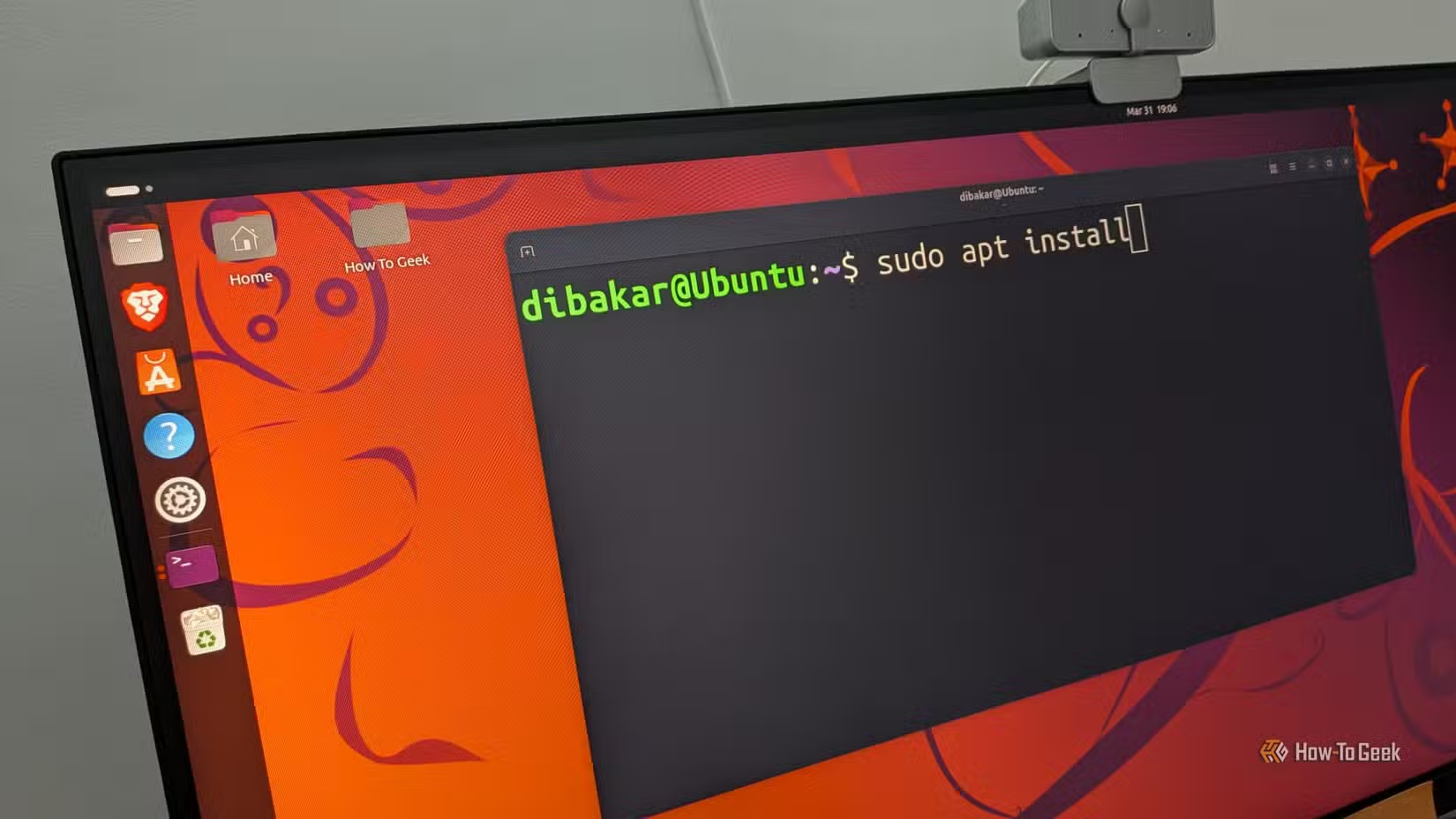
Seager was aware that Ubuntu users might be wary of AI adoption, and detailed how Canonical would integrate the technology in a way consistent with the company’s values.
The leader stressed that Canonical would not simply pick AI based on open weight models, but would take a “balanced view” on the terms that guide those models. It would not only lean toward local and open code, but ethical licensing that includes “clearly defined” links with third-party services. Seager saw Ubuntu as leading by example for “responsible and thoughtful” uses of AI, ideally leading contributors to submit well-crafted code instead of “slop.”
The VP acknowledged that local processing would be difficult in the near term as the largest, most capable models still tend to require a “frontier AI factory” (that is, cloud computing) rather than off-the-shelf PC hardware. But this is a “mostly temporary issue,” according to Seager, and he expected the capability gap to narrow as hardware improved.
As with responsible AI use, Seager wanted Ubuntu to lead the way and be “ready” for wider uses of local AI when the technology arrives.
Ubuntu Linux won’t follow Windows’ AI path
Canonical appears determined to avoid Microsoft’s fate
While the practical implementation of AI in Ubuntu Linux is still a ways off, Canonical is making clear that it won’t follow in Microsoft’s footsteps.
Microsoft has been accused of aggressively pushing its closed Copilot AI system in software and services, to the point where even simple apps like Paint have had prominent features. Recall, a Windows feature meant to help find past content through screen snapshots, raised privacy and security concerns. The strategy sparked a backlash large enough that Microsoft toned down its approach and gave all Windows users the option to uninstall Copilot, even on company-managed PCs.

The uncomfortable truth about Copilot: Microsoft knows it’s useless
Microsoft integrates Copilot across its ecosystem, yet limits where and how it should be trusted.
If implemented as promised, the Ubuntu Linux approach would be more restrained, with greater transparency and privacy. It would also focus on practical integrations rather than marketing services. Canonical mainly sells pro management and support tools. It doesn’t sell productivity services like Microsoft 365, so it has less motivation to push AI for its own sake.
With that noted, Ubuntu users (including in comments on Seager’s statement) are still cautious about AI, including the potential for unauthorized data mining to train models. AI might give Canonical an edge if the demand is there, but it could also push some objectors to alternative, relatively AI-free distros like CachyOS and Mint.
Source: Read Full Article