











The critical system of ocean currents which loops around the Atlantic Ocean is weakening and could be far closer to collapse than previously thought, according to two new studies — an event which would have catastrophic impacts on the planet’s weather and climate.
The Atlantic Meridional Overturning Circulation, known as the AMOC, functions like a vast conveyor belt, transporting heat, salt and freshwater through the ocean and influencing climate, weather and sea levels around the planet.
A growing body of research suggests it’s weakening as human-driven global warming disrupts its delicate balance of heat and salinity, with one study even predicting it could collapse as soon as next decade. But the AMOC is complex and has only been continuously monitored since 2004. Climate models generally agree it’s on course to weaken this century, but there is a huge amount of uncertainty about the extent of its decline.
The stakes are incredibly high; an AMOC collapse, which last happened roughly 12,000 years ago, would cause chaos. It would push Europe into a winter deep freeze, accelerate sea level rise along the East Coast of the US and drive prolonged droughts across a swath of Africa.
The two new studies — one which focuses on the AMOC’s future, the other on its present — provide new and alarming evidence of its decline.
The findings are “important and concerning,” said Stefan Rahmstorf, an oceanographer at Potsdam University who has studied the AMOC for decades and was not involved in either report.

People load water containers onto an animal in a drought-affected area of Kenya in August 2025. The collapse of the AMOC would bring catastrophic impacts including prolonged droughts across a swath of Africa. – Gerald Anderson/Anadolu/Getty Images
In the most recent study, published Thursday in the journal Science Advances, scientists combined climate models with real world data, including ocean temperature and salinity, to map out the AMOC’s future over the next several decades.
They found most climate models underestimate its decline. The AMOC is on course to slow by more than 50% by the end of the century, a “substantial weakening” that’s 60% stronger than that estimated by the average of all climate models, according to the study.
The findings show “pessimistic” climate models, those which show a strong weakening of the AMOC, “are unfortunately the realistic ones,” Rahmstorf said. It heightens fears that it could pass a tipping point as early as the middle of this century, he added, the point at which shutdown “basically cannot be stopped anymore.”
Alarmingly, the AMOC’s weakening could even be more pronounced than the study found because meltwater from Greenland is not included in the climate models, Rahmstorf said.
Thursday’s study follows research published last week by scientists from the University of Miami, who looked at what is currently happening to the AMOC.
They analyzed real world data from four moorings along the western boundary of the North Atlantic Ocean, which have measured water temperature, salinity and the velocity of ocean currents since 2004. They found the AMOC has been weakening at four different latitudes over the past two decades.
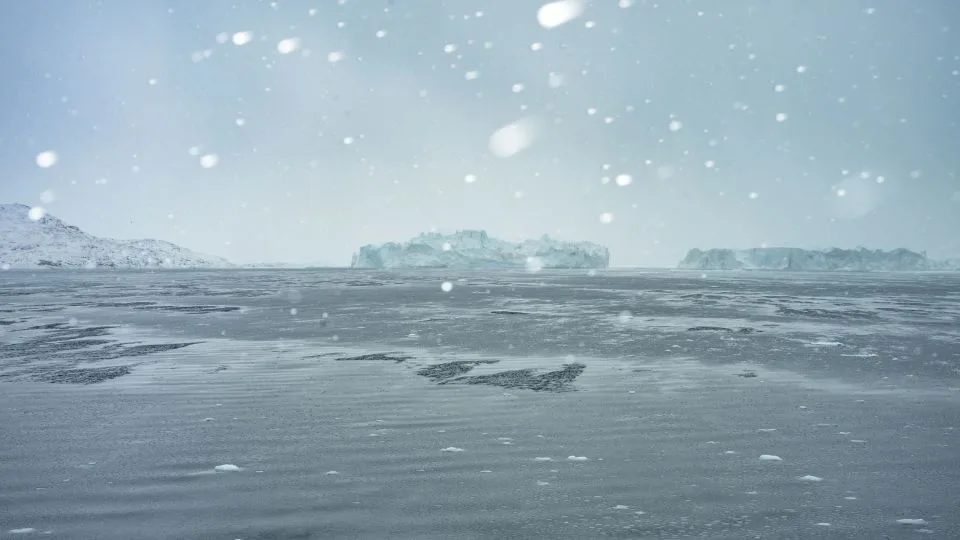
Disko Bay, Greenland, on March 15, 2026. Melting ice is disrupting the balance of salinity that drives the AMOC. – Florent Vergnes/AFP/Getty Images
The fact that weakening was observed at all four locations is significant, said Shane Elipot, a physical oceanographer at the University of Miami and a report author. Although the results only focus on the western boundary of the Atlantic Ocean, this region is “the canary in a coal mine” for what’s happening to the AMOC, he said.
The real-world data helps validate predictions made by climate models, Elipot added. “The worrying part is that the same models are predicting that the AMOC is likely going towards a tipping point where it eventually shuts down,” he said.
The study provides “strong observational evidence that the present-day AMOC is indeed declining,” said René van Westen, a marine and atmospheric researcher at Utrecht University in the Netherlands, who was not involved in the research.
The results of both studies are very worrying, he said. They show AMOC weakening is already happening and is underestimated by current projections.
“This also means that the risk of AMOC tipping is getting more substantial,” he added, “as every additional AMOC weakening pushes the system towards the tipping point.”
For more CNN news and newsletters create an account at CNN.com
Source: Read Full Article