








The New Museum knows that most viewers will be of two minds about “New Humans: Memories of the Future,” a blockbuster exhibition meant to crown the museum’s reopening after a sixty-thousand-square-foot expansion. With more than seven hundred objects, spread across three floors, the show is designed to both stimulate and fatigue you. The official remit is “what it means to be human in the face of sweeping technological changes.” In practice, this means a madhouse of multimedia rooms, packed with gurgling videos and useless machines and humanoid bodies. There are bodies made from scrap metal, bodies pierced with tentacles and affixed with screens for nipples and eyes, bodies broken down for parts, and walls lined with images of skin. In some rooms, paintings are hung salon style. In others, objects are suspended from the ceiling, mounted above doorways, or made to float via balloon. As if to poke fun at the show’s size and ambition, the curators have installed in the lobby a visual joke by the artist Ryan Gander: a tiny animatronic mouse.
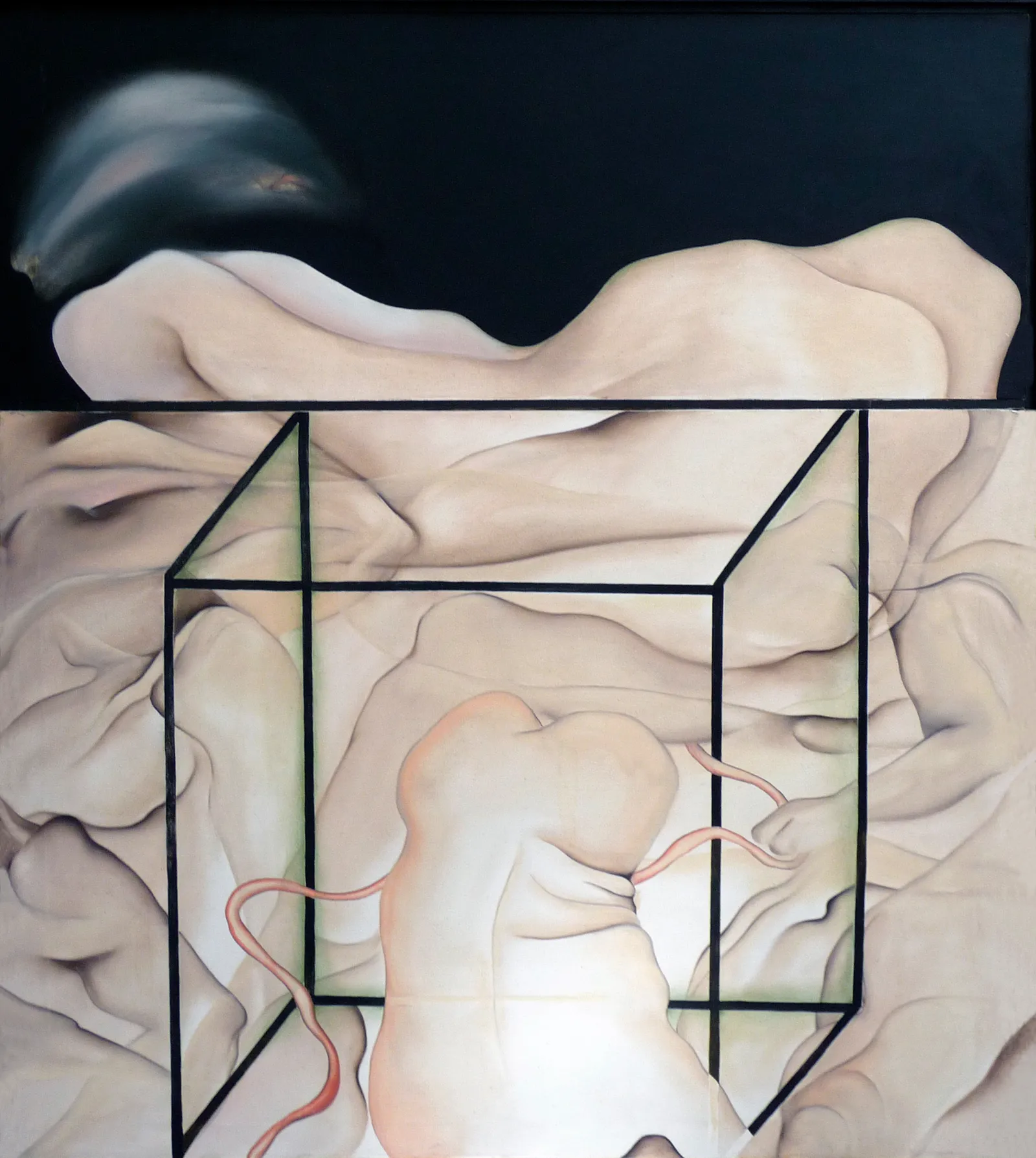
“Birth II” (1967), by Maina-Miriam Munsky.Art Work by Maina-Miriam Munsky / Courtesy Galerie Poll
Still, if we’re looking for “what it means to be human” today, the exhibition isn’t a bad place to start. It operates as a kind of encyclopedic junk pile, with hundreds of discarded visions of how technology might save—or estrange—us from ourselves. The first piece inside the galleries, a 1967 painting by the German artist Maina-Miriam Munsky, depicts a schematic outline of a cube struggling to contain a mass of dreamy flesh. It reads as a diagram of human folly: for centuries, we’ve tried to rationalize and control ourselves, only to be undermined by our excess and unreason. The show continually wobbles between these two poles. In the same room as the Munsky, in a section titled “Reproductive Futures,” a pack of Dadaists and Surrealists represents unreason, while the marvels of the rational are seen in a 1927 video of stickleback fish eggs by Jean Painlevé, a French photographer and filmmaker who trained in biology. In between are a bunch of mongrel appliances that leave both humans and technology worse for wear, like a computer, in a 2024 photo by Sara Deraedt, that seems to be giving birth to a wet child. The entire logic of the exhibition—with science and art, fresh names and familiar ones, lumped together—is here in miniature. Your job is to pick and choose your way through the heap.
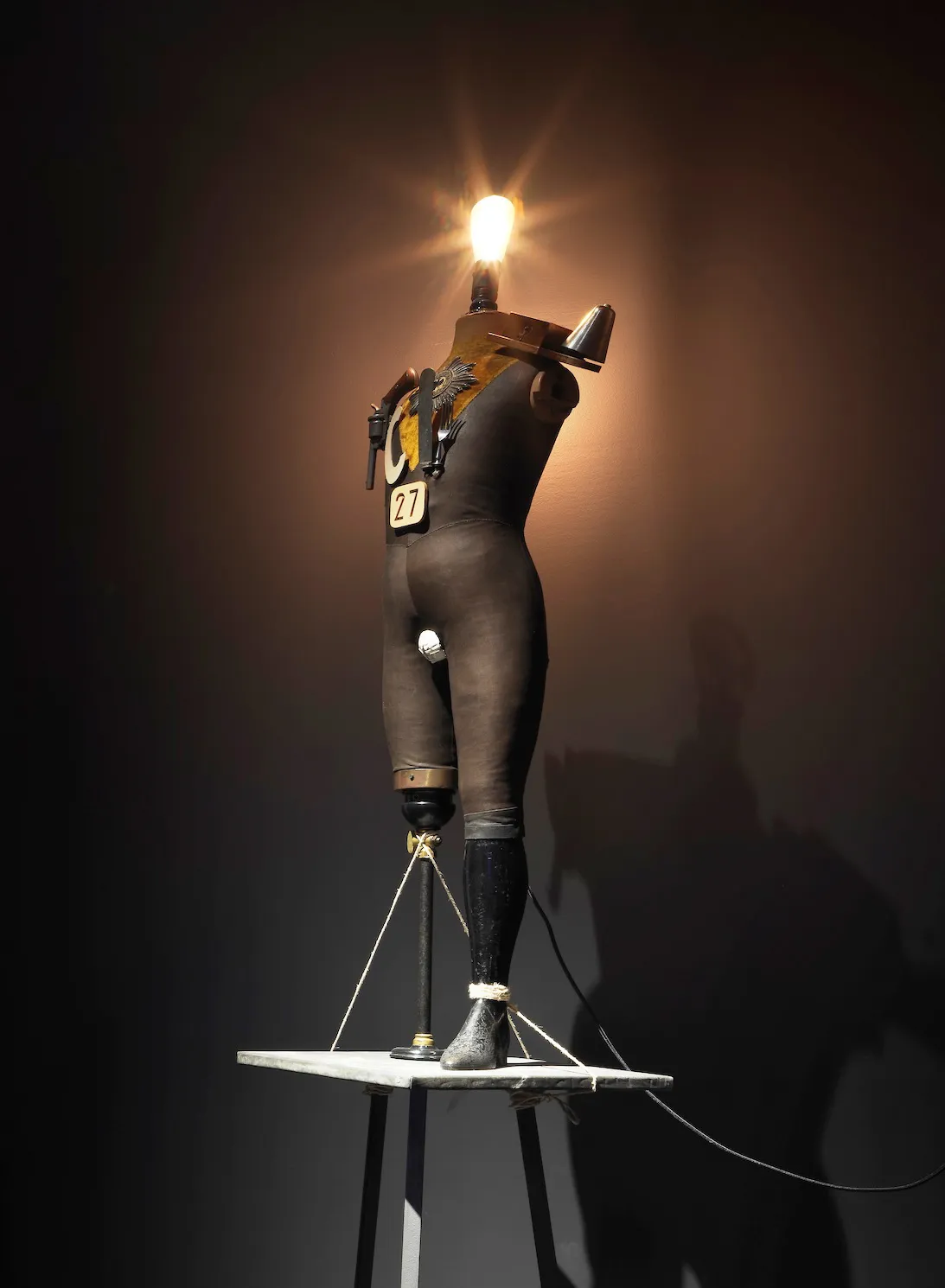
“The Middle-Class Philistine Heartfield Gone Wild” (1920), by John Heartfield and George Grosz.Art Work by John Heartfield and George Grosz / Courtesy New Museum; Photograph by Dario Lasagni
The time line of the show starts roughly with the First World War, when new ideas about the human flourished around the killing fields of the Somme and Verdun. A series of lithographs from the nineteen-twenties, by the Soviet artist El Lissitzky, presents the cast of an opera as geometric puppets made of steely widgets, with Bolshevik-red organs—the body a cog readied for mass mobilization. A capitalist alternative is found in the work of Frank and Lillian Gilbreth, an engineering couple who fastened little lights to workers’ hands and tracked their movements with long-exposure photographs, hoping to reduce motion and increase profit. Often, modernists didn’t have a coherent vision of the body so much as a criticism of it. John Heartfield and George Grosz’s “The Middle-Class Philistine Heartfield Gone Wild” (1920) is a child-size mannequin spliced with odd prosthetics: a revolver for an arm, a set of teeth for genitals, a light bulb for a head, a fork for . . . well, I’m not exactly sure. The piece is half statue, half practical joke. The human becomes a palimpsest of all sorts of contemporary events and psychological possibilities: the soldier blown apart by mortar shells, the worker alienated from his own limbs, the man fearful of a woman’s dentition, the brain replaced by an electrical device. It can be bittersweet, the way a body is rarely just a body.
I almost missed “The Middle-Class Philistine” because of a Technicolor demon wriggling in the air nearby. “The Fireside Angel (Fourth Version)” (2019), by Cyprien Gaillard, is a hologram adapted from a 1937 Max Ernst painting, recalling Marshall McLuhan’s point that the content of a medium is always another medium. Less well known is McLuhan’s theory that art operates as a radar system for detecting disasters before they happen. I expected to see some warning signs in “New Humans,” but had trouble finding them. Hito Steyerl’s “Mechanical Kurds” (2025) shows footage of Kurdish refugees in Iraq who make poverty wages tagging and classifying drone images for Amazon (distinguishing whether something is a weapon, say, or a carton of milk); Sidsel Meineche Hansen has a video of a sex doll unboxing itself. The exhibition doesn’t offer glimpses of the future so much as glimpses of a world you already inhabit but would rather not.
Source: Read Full Article