








Two Earth-Size Worlds in TRAPPIST-1 System Reveal Stark Divide Between Day and Night

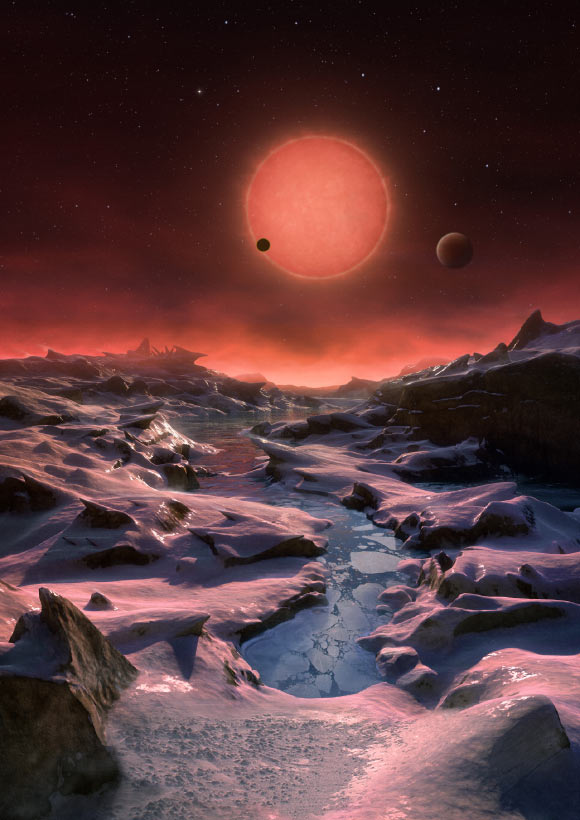
New Webb observations of two exoplanets TRAPPIST-1b and TRAPPIST-1c show blistering days and frozen nights, offering the first detailed climate maps of rocky exoplanets and dimming hopes for habitability. This artist’s impression shows an imagined view from the surface one of the three exoplanets orbiting the ultracool dwarf star TRAPPIST-1 38.8 light-years from Earth. These…

Read More

New Form of Matter May Lurk Deep Inside Uranus and Neptune

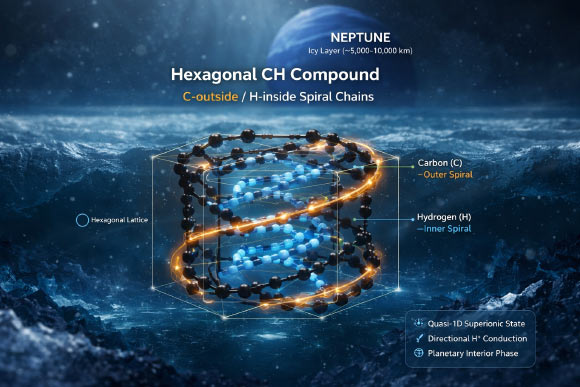
New computational simulations suggest ice-giant planets like Uranus and Neptune harbor a quasi-one-dimensional superionic state of carbon hydride that could reshape how scientists understand planetary interiors. Illustration of the predicted hexagonal carbon hydride compound under Neptune-like interior conditions. In this structure, carbon forms the outer spiral chains (yellow) and hydrogen forms the inner spiral chains…

Read More

Physicists Find First Experimental Evidence of Elusive Critical Point in Supercooled Water

By probing supercooled water with ultrafast lasers before it crystallizes, physicists at Stockholm University observed telltale signs of a long-theorized transition between two liquid states, including surging heat capacity and critical fluctuations. You et al. studied supercooled water at timescales before ice formation by heating high- and low-density amorphous ices using infrared ultrafast laser pulses,…

Read More