





Hubble Spots a Starry Spiral

Hubble Spots a Starry Spiral

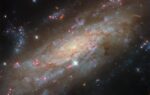
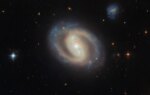
In this new picture from NASA’s Hubble Space Telescope, a spiral galaxy glittering with star clusters is the center of attention. NGC 3137 is located 53 million light-years away in the constellation Antlia (the Air Pump). As a nearby spiral galaxy, this target offers astronomers an excellent opportunity to study the cycle of stellar birth and death,…
Read More
A Gently Glowing Galaxy - NASA

A Gently Glowing Galaxy – NASA

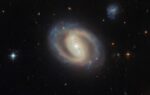
A luminous swirl set against the deep black of space, the barred spiral galaxy IC 486 glows with a soft, ethereal light in this NASA Hubble Space Telescope image from April 13, 2026. IC 486 lies right on the edge of the constellation Gemini (the Twins), around 380 million light-years from Earth. Classified as a barred spiral…

Read More
A Fresh Look at the Crab Nebula

A Fresh Look at the Crab Nebula

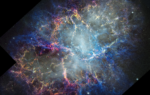
This observation from NASA’s Hubble Space Telescope, released on March 23, 2026, gives an unparalleled, detailed look at the aftermath of a supernova and how it has evolved over the telescope’s long lifetime. Hubble captured the nebula’s intricate filamentary structure, as well as the considerable outward movement of those filaments over 25 years, at a…

Read More
Hubble Spies an Active Spiral

Hubble Spies an Active Spiral

A luminous swirl set against the deep black of space, the barred spiral galaxy IC 486 glows with a soft, ethereal light in this new NASA Hubble Space Telescope image. IC 486 lies right on the edge of the constellation Gemini (the Twins), around 380 million light-years from Earth. Classified as a barred spiral galaxy,…

Read More
Hubble and NASA space telescopes track 'game-changing' gamma-ray burst back to neutron star collision in 'forbidden' region of the universe

Hubble and NASA space telescopes track ‘game-changing’ gamma-ray burst back to neutron star collision in ‘forbidden’ region of the universe

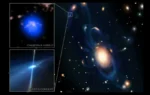
When you buy through links on our articles, Future and its syndication partners may earn a commission. Illustration shows the cosmic origin point of gamma-ray burst GRB 230906A tracked back to colliding neutron stars. | Credit: X-ray: NASA/CXC/Penn State Univ./S. Dichiara; IR: NASA/ESA/STScI; Illustration: ERC BHianca 2026 / Fortuna and Dichiara, CC BY-NC-SA 4.0; Image…

Read More