







By probing supercooled water with ultrafast lasers before it crystallizes, physicists at Stockholm University observed telltale signs of a long-theorized transition between two liquid states, including surging heat capacity and critical fluctuations.
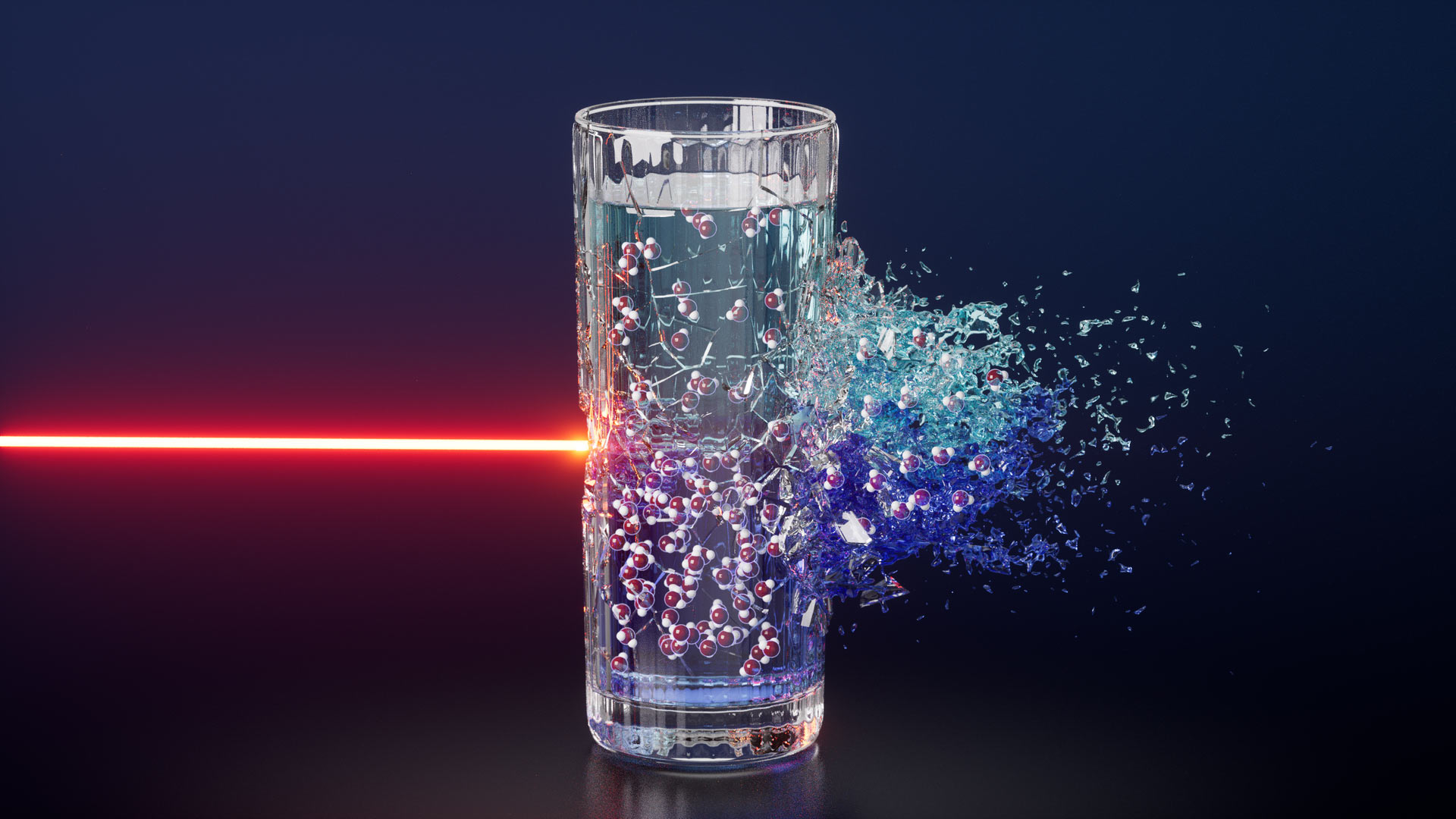
You et al. studied supercooled water at timescales before ice formation by heating high- and low-density amorphous ices using infrared ultrafast laser pulses, followed by X-ray scattering; they observed a rapid increase in the heat capacity indicating a critical divergence at 210 K coincident with enhanced density fluctuations. Image credit: POSTECH University.
“What was special was that we were able to X-ray unimaginably fast before the ice froze and could observe how the liquid-liquid transition vanishes and a new critical state emerges,” said Stockholm University’s Professor Anders Nilsson.
“For decades there has been speculations and different theories to explain these remarkable properties and one theory has been the existence of a critical point. Now we have found that such a point exists.”
Using X-ray lasers, Professor Nilsson and colleagues were able to determine the existence of a critical point in supercooled water at around 210 K (minus 63 degrees Celsius or minus 81 degrees Fahrenheit) and 1,000 atmospheres.
“Water is unique, as it can exist in two liquid macroscopic phases that have different ways of bonding the water molecules together at low temperature and high pressure,” they explained.
“When the temperature increases and pressure decreases there is a state where distinction between the two liquid phases vanishes and only one phase is present.”
“It is a point of large instability, causing fluctuations in a large temperature and pressure region all the way up to ambient conditions.”
“The water fluctuates between the two liquid states and mixtures of the two as if it can’t make up its mind. It is these fluctuations that give water its unusual properties.”
“The state beyond a critical point is called supercritical and ambient water is in that state.”
Another remarkable finding of the study is that that the dynamics of the system slows down as it enters the critical point.
“It looks almost that you cannot escape the critical point if you entered it, almost like a black hole,” said Stockholm University’s Dr. Robin Tyburski.
“It’s amazing how amorphous ices, such an extensively studied state of water, happened to become our entrance to the critical region,” said Dr. Aigerim Karina, a postdoctoral researcher at Stockholm University.
“It’s a great inspiration for my further studies and a reminder of the possibilities of making discoveries in much-studied topics such as water.”
“It was a dream come true to be able to measure water under such low temperature condition without freezing,” said Iason Andronis, a Ph.D. student at Stockholm University.
“Many have dreamt about finding this critical point but the means have not been available before the development of the X-ray lasers.”
“I find it very exciting that water is the only supercritical liquid at ambient conditions where life exists and we also know there is no life without water,” said Stockholm University’s Dr. Fivos Perakis.
“Is this a pure coincidence or is there some essential knowledge for us to gain in the future?”
“There has been an intense debate about the origin of the strange properties of water for over a century since the early work of Wolfgang Röntgen,” Professor Nilsson said.
“Researchers studying the physics of water can now settle on the model that water has a critical point in the supercooled regime.”
“The next stage is to find the implications of these findings on waters importance in physical, chemical, biological, geological and climate related processes. A big challenge in the next few years.”
The findings were published on March 26 in the journal Science.
_____
Seonju You et al. 2026. Experimental evidence of a liquid-liquid critical point in supercooled water. Science 391 (6792): 1387-1391; doi: 10.1126/science.aec0018
Source: Read Full Article