





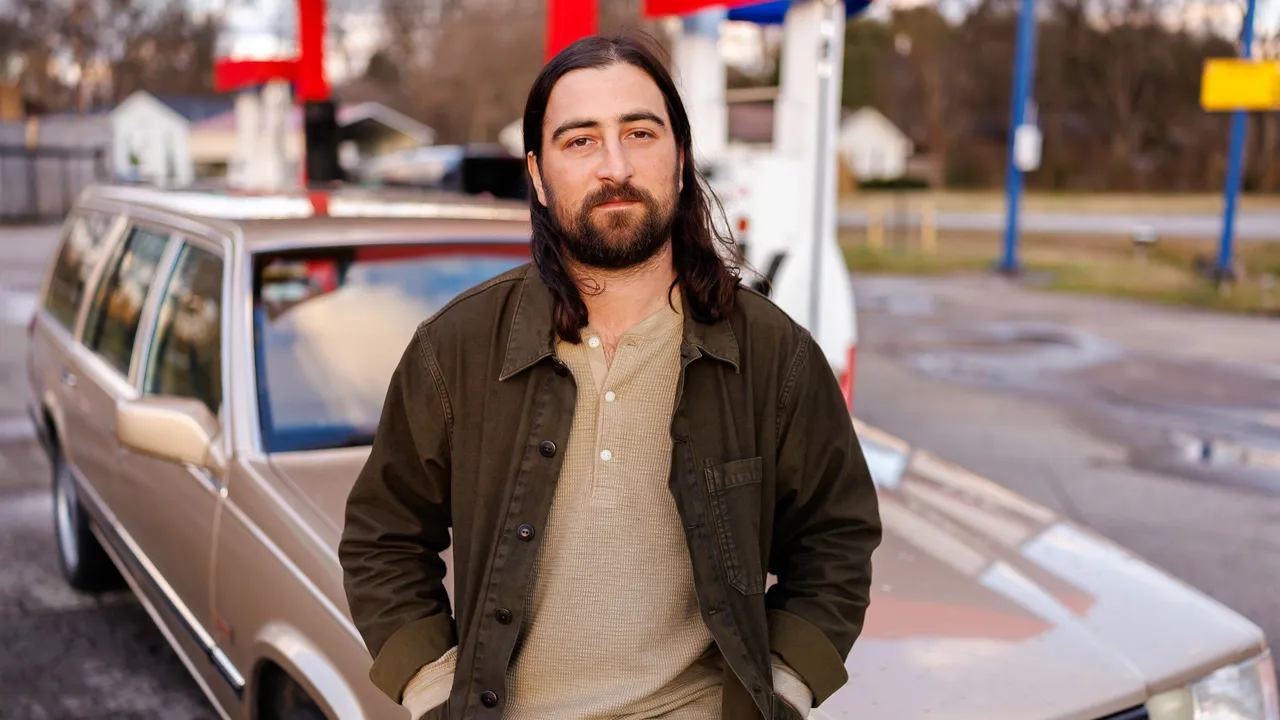
In 2023, Noah Kahan, a singer and songwriter from Strafford, Vermont, leapfrogged to superstardom following the release of “Stick Season,” a COVID-era LP full of claustrophobic, lovesick folk songs. Kahan has a soft, nasal voice—more Simon than Garfunkel—and he uses it to eulogize relationships that falter for reasons both intentional and incidental. If its instrumentation were just slightly more askew, “Stick Season” could have easily been released on the indie label Sub Pop in the mid-to-late two-thousands, wedged somewhere in between the Shins and the Head and the Heart—its sound is something like a peppier Fleet Foxes, if Robin Pecknold had been reared on Counting Crows instead of Vashti Bunyan. Instead, Kahan occupies a funny spot in the pop-music cosmos—music for people who own too much performance fleece to embrace the bombast of Taylor Swift but aren’t quite feral enough for the cacophony of Geese. It’s the kind of thing that sounds really nice in a Subaru, on your way to work, with an iced coffee nestled in the cup holder.
Yet Kahan’s voice is also an unusually good vessel for ache: “I ain’t proud of all the punches that I’ve thrown / In the name of someone I no longer know,” he sings on “Dial Drunk,” a song about clinging, somewhat frantically, to an expired emergency contact. “Now I know your name, but not who you are,” he laments on “All My Love,” a no-hard-feelings song about an ex. (“If you need me, dear, I’m the same as I was,” he adds on the chorus.) Lyrically, Kahan is preoccupied by the slowness of change, whether it’s the awkward, loping transition between seasons or the equally untidy stretch between a relationship ending and finding peace with what happened. Kahan’s fear of leaving is at least as strong as his fear of being left behind.
He also writes about his home in a way that feels anomalous for the current era, in which pop artists tend to be geographically nonspecific, untethered from place and centered online. Kahan is from the Upper Valley, a quaint and seasonally verdant region encompassing parts of eastern Vermont and western New Hampshire, and sliced through by the Connecticut River—a scenic haven for canoers and for anglers chasing trout. The Upper Valley is perhaps as Platonically New England as an area can get (peeling red barns, rickety covered bridges, green mountains, golden retrievers). “Noah Kahan: Out of Body,” a documentary débuting on Netflix today, explores Kahan’s feelings of belonging, or, more accurately, of misbelonging—to the Upper Valley, largely, but also on stage, within the context of his family, and in his own body.
The film opens just before Kahan plays two sold-out shows at Fenway Park in July of 2024. “I’m so afraid of losing this special thing, like, it might go away,” he says in a voice over. “After all this, what is my purpose? And who am I now?” Though Kahan signed to Republic Records in 2017, it wasn’t until the pandemic, when he started uploading funny, unfinished snippets of songs about Vermont to social media, that he became a phenomenon. Back then, it was still the Wild West days of TikTok, and fame came fast and hard. By all accounts, virality is violent for its subjects, and building a sustainable career from sudden celebrity is a formidable task; any sensible person would be wise to distrust such an instantaneous anointing. When I spoke to Kahan at the very start of 2024, he had recently performed on “S.N.L.,” and had been nominated for a Grammy for Best New Artist. I found him affable, self-effacing, and slightly terrified. “I feel like I’m kind of trying to keep my head above water,” he told me. “Everybody says this, but I truly never imagined in my wildest dreams the level of attention and, frankly, stress that I would be contending with because of this album. I haven’t done a great job of dealing with it,” he added. “I think I’m starting to get a hold of the habits I need to form to handle this. But I have been struggling. It’s just not easy.” The documentary features a scene of Kahan, wielding a golf club and whacking a piñata of himself to smithereens, a kind of not-so-metaphorical ego death: “One-hit-wonder motherfucker! Your music is mid!” he hollers. When Kahan is asked about making a follow-up to “Stick Season,” his voice goes limp with dread. “I’m scared, I’m sad for the next album,” he says. “I’m also acutely aware that nothing will ever be the same.”
Source: Read Full Article