







New computational simulations suggest ice-giant planets like Uranus and Neptune harbor a quasi-one-dimensional superionic state of carbon hydride that could reshape how scientists understand planetary interiors.
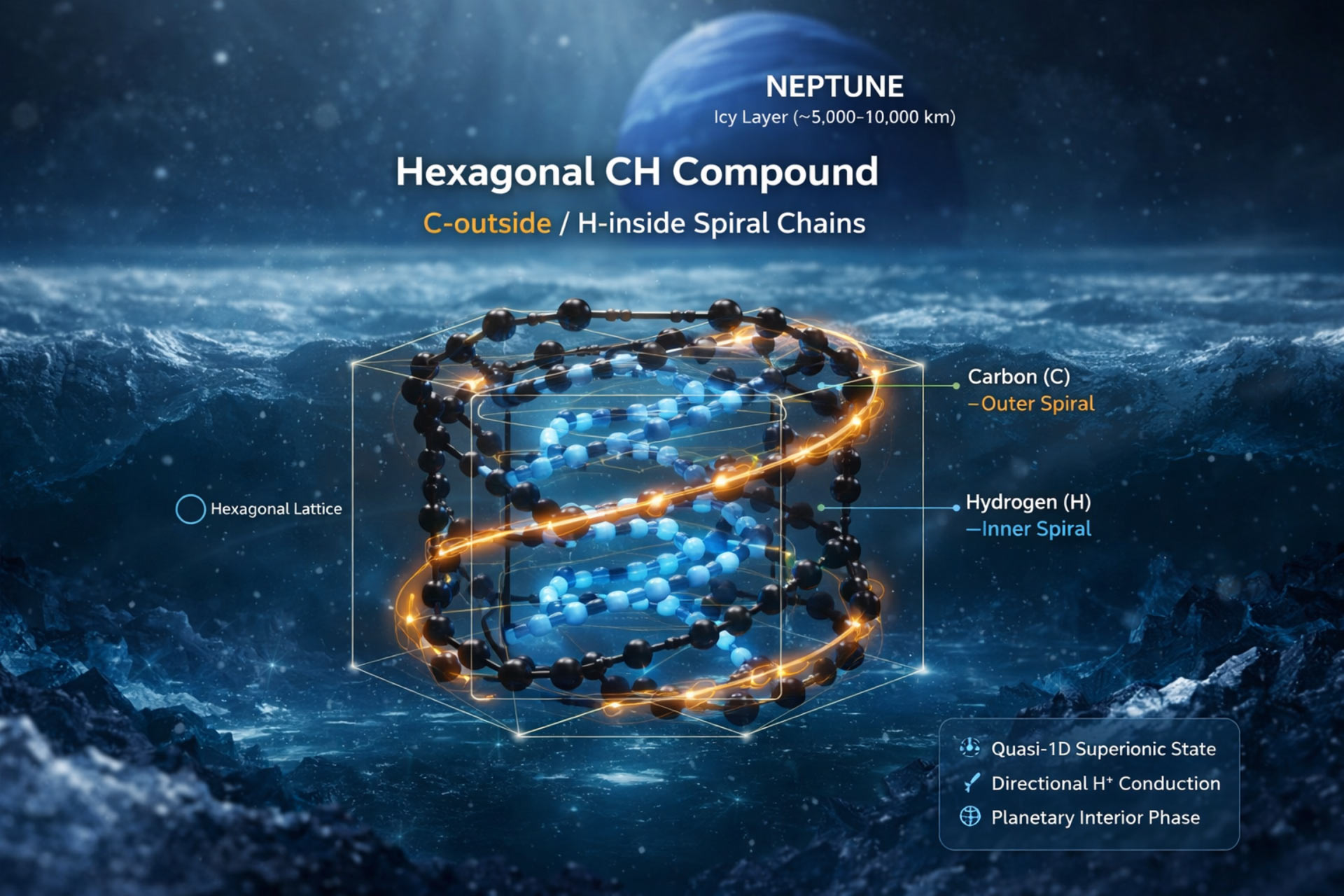
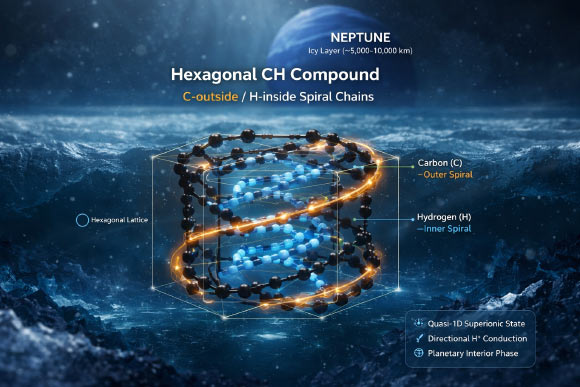
Illustration of the predicted hexagonal carbon hydride compound under Neptune-like interior conditions. In this structure, carbon forms the outer spiral chains (yellow) and hydrogen forms the inner spiral chains (blue), consistent with the quasi-one-dimensional superionic behavior identified in first-principles simulations. Image credit: Cong Liu.
Measurements of Uranus and Neptune’s densities indicate that the interiors of these giant planets contain intermediate layers of unconventional hot ices, which exist below their hydrogen and helium atmospheric envelopes and above their rocky cores.
These layers are believed to be composed of water, methane, and ammonia, but due to the extreme conditions, it is thought that exotic phases would emerge.
The physics in these high-pressure, high-temperature regions can give rise to unconventional states of matter, which is why theorists and experimentalists attempt to predict and recreate what would be found there.
Using high-performance computing and machine-learning, Dr. Cong Liu from the Carnegie Institution for Science and colleagues performed fundamental quantum physics simulations of carbon hydride under pressures ranging from nearly 5 million to nearly 30 million times atmospheric pressure (500 to 3,000 gigapascals) and at temperatures ranging from 4,000 to 6,000 K.
Their tools predicted the emergence of an ordered hexagonal framework in which hydrogen atoms move along spiral pathways, creating a quasi-one-dimensional superionic state.
Superionic materials occupy an unusual middle ground between solids and liquids — one type of atom remains arranged in a crystalline framework and another becomes mobile.
“This newly predicted carbon-hydrogen phase is particularly striking because the atomic motion is not fully three-dimensional,” said Dr. Ronald Cohen, also from the Carnegie Institution for Science.
“Instead, hydrogen moves preferentially along well-defined helical pathways embedded within an ordered carbon structure.”
This directionality of this movement has important implications for how heat and electricity move through planetary interiors.
Such behavior could influence interior energy redistribution, electrical conductivity, and possibly the interpretation of magnetic-field generation in ice giants.
The findings also expand our understanding of the behavior of simple compounds under extreme conditions, suggesting that even simple systems can organize into unexpectedly complex phases.
“Carbon and hydrogen are among the most abundant elements in planetary materials, yet their combined behavior at giant-planet conditions remains far from fully understood,” Dr. Liu said.
The results were published March 16 in the journal Nature Communications.
_____
C. Liu et al. Prediction of thermally driven quasi-1D superionic states in carbon hydride under giant planetary conditions. Nat Commun, published online March 16, 2026; doi: 10.1038/s41467-026-70603-z
Source: Read Full Article