










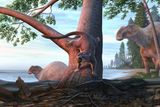
For mammals that roamed the Earth when an asteroid struck 66 million years ago, being small was a blessing. This was especially true for rodent-like mammals in the Cimolodon genus, which weathered the storm while non-avian dinosaurs were dying out.
Now, the latest Cimolodon species to be discovered, Cimolodon desosai, is shedding light on the traits that helped these mammals live to see another day after the catastrophic Cretaceous-Paleogene (K-Pg) extinction event.
A new study published in the Journal of Vertebrate Paleontology identified the hamster-sized creature from a 75-million-year-old fossil found in Baja California that came with a surprisingly robust assortment of pieces and parts.
“This new species, Cimolodon desosai, was ancestral to the species that survived the extinction event. It and its descendants were relatively small and omnivorous — two traits that were advantageous for surviving,” said study author Gregory Wilson Mantilla, a professor of biology at the University of Washington, in a statement.
Finding Fossils of this Hamster-Sized Mammal
The fossil that led to the classification of C. desosai, discovered in 2009 in Baja California, seemed to consist only of teeth when researchers first noticed it. But upon closer inspection, they found more components, including a skull, jaws, and limb bones like a femur and an ulna.
“It’s very hard to find fossils at this site compared to other areas,” Wilson Mantilla said. “At first, my field assistant found just a little tooth poking out. If he had just found that, I would have been over the moon. But then when we looked inside the crack of the rock, we could see there was more bone.”
Read More: First Fossilized Egg From a Mammal Ancestor Confirmed After 250 Million Years
All in the Teeth
The fossilized teeth were critical in teasing out the identity of this mammal; to confirm that it was a new species, the researchers took high-resolution images of the fossil and compared its teeth with those of other Cimolodon species.
“That far back in time everything is named based on their tooth characteristics,” Wilson Mantilla said in the release. “If you find a skeleton that’s missing teeth, sometimes it’s hard to attach it to a name.”
The researchers determined a few standout features of the teeth, including molar shape and relative length proportions of cheek teeth. The other fossil parts, in addition, helped them understand the animal’s size and shape.
With this knowledge, they established Cimolodon desosai as a new species — the name honors Michael de Sosa VI, the field assistant who first found the fossil, as he had passed away while the team was studying the fossil.
Survival of the Smallest
Species in the Cimolodon genus, like C. desosai, were multituberculates, which lived from around 170 million years ago to 35 million years ago, when they went extinct, according to the Luo Lab at the University of Chicago. Multituberculates were the most diverse group of Mesozoic mammals, as stated in a 2025 study in the Proceedings of the Geologists’ Association. They lived in a wide range of habitats (from forested areas to deserts) and filled many ecological niches that are performed today by modern rodents.
Research on multituberculates has begun to paint a better picture of how these mammals survived the K-Pg extinction event, which wiped out 75 percent of all life on Earth at the time.
The descendants of C. desosai likely had a better chance of surviving the extinction event because of their small stature (C. desosai itself was about the size of a golden hamster). Another survival advantage was the animals’ omnivorous diet of fruits and insects; animals with more limited diets, meanwhile, were left with a diminished food supply after the asteroid hit.
Although multituberculates survived past the K-Pg mass extinction, there are no living descendants of the order. Other mammals, however, similarly survived and diversified into the over 6,000 mammal species living today.
Read More: An Extinct Giant Echidna Roamed Ice Age Victoria, Filling a Huge Gap in its Australian Range
Article Sources
Our writers at Discovermagazine.com use peer-reviewed studies and high-quality sources for our articles, and our editors review for scientific accuracy and editorial standards. Review the sources used below for this article:
Source: Read Full Article