










Your Internet Service Provider (ISP) seems to be an entity that serves you based on the name, but in the end an ISP is a business trying to make a profit. This means it doesn’t always have your best interests at heart, unless it hurts the company’s bottom-line.
The truth is that when it comes to internet privacy, your ISP has more insight into your daily activities than you might know, and that doesn’t always have to a necessary evil.
Your browsing history isn’t as private as you think
They can see you enter the building
When you visit a website, your ISP can see which domain you’re connecting to. This doesn’t mean it can see what exact pages you visit. At least as long as the website uses HTTPS encryption, that is.
Even with HTTPS, the DNS request for the server address of that website also exposes you. Most people are using the default DNS servers provided by their ISPs after all.
This wouldn’t be such a big issue if it wasn’t for the fact that ISPs have the option to log this data. They know who you are and where you live, and can create records of exactly which web domains you were visiting at a specific time. So if someone with authority asks for those records, they can be used against you.
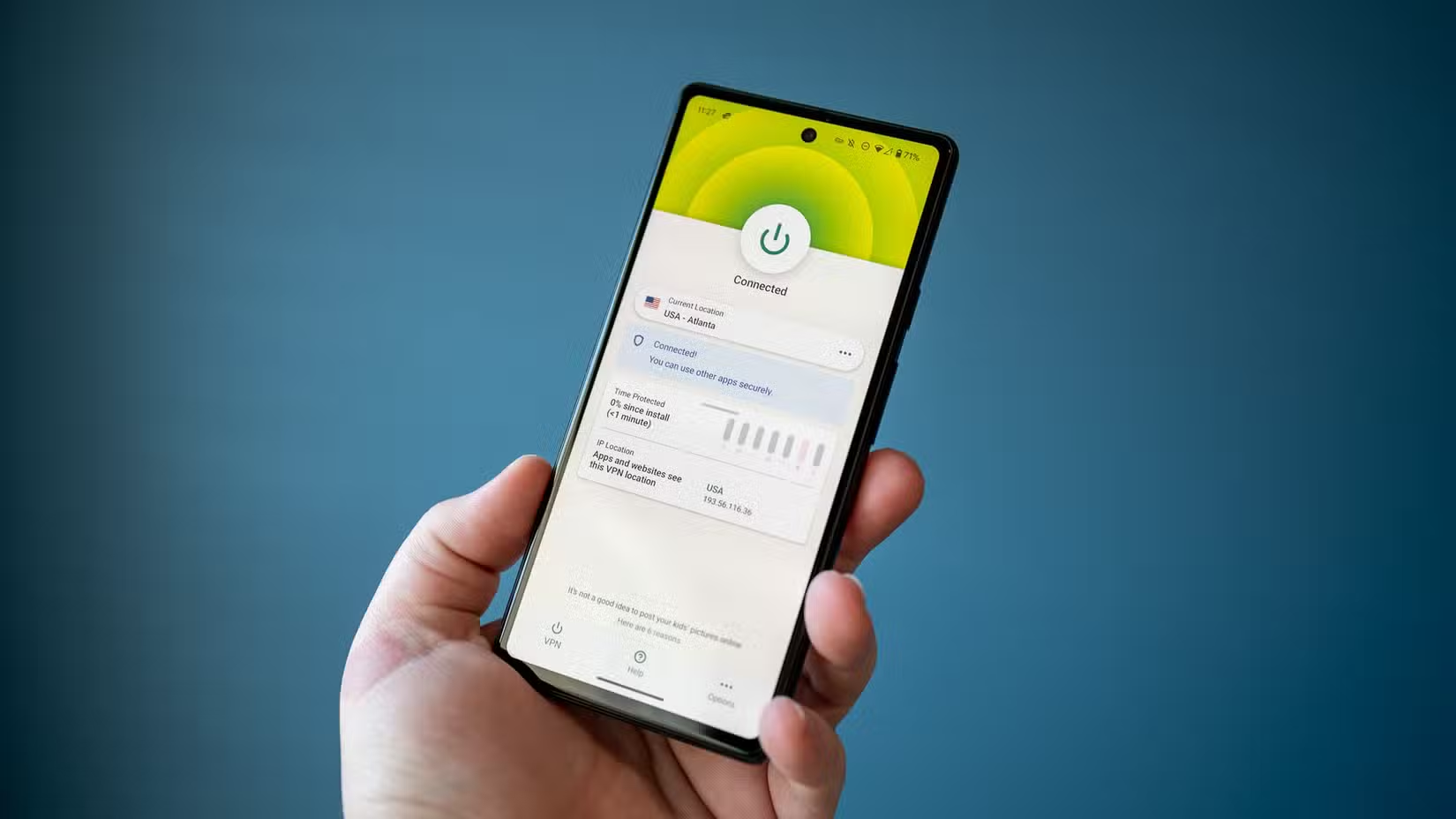
The most effective way to prevent this is by using encrypted DNS and, of course, using a VPN. To be clear, your ISP will know you are using a VPN, it just won’t know anything beyond that fact.
They track and monetize your data behind the scenes
One person’s trash is a corporation’s treasure

In some countries, ISPs are legally required to keep records on you for some period of time in case a judge or other government authority needs it, but that’s not all ISPs can do with that information. As per NBC News, in 2017, the US Senate voted to repeal FCC privacy rules that prohibited ISPs from selling data it gathered on its users to third parties.
This senate resolution, at least as far as my internet sleuthing goes, doesn’t seem like it was reversed by the subsequent administration. Either way, regardless of where you live in the world, there’s a real chance your ISP can make money selling your data, even if only in a big anonymous aggregate pile.
Your unencrypted traffic is fair game
The most open of open books

Remember when I said that while your ISP can see the domains you’re visiting, it can’t see what you do on that site since websites have HTTPS encryption. Well, not all sites have this encryption and if you happen to access one your ISP can pretty much inspect every data packet and see it all.
An ISP could even modify that data before it reaches you, injecting adverts, for example. Luckily, modern browsers will warn you if you’re trying to connect to a site without HTTPS. Apart from this, you can use the EFF’s HTTPS Everywhere browser extension. This automatically encrypts websites that don’t have it for some reason.
Again, using a VPN also prevents your ISP from spying on unencrypted streams, but the VPN can then see what’s in the unencrypted packets, so dealing with the root issue is more important here.
They can throttle or prioritize your traffic
Paying to be a second-class netizen
If you got a great deal on your internet connection, it might be because there are some hidden terms and conditions in the fine print. Some ISP sell connections that are subject to “shaping” where the ISP lets some types of traffic run at slower speeds.
So, for example, your browsing speed may be the full throttle experience that was advertised, but when you try to watch a streaming movie the quality is throttled or when you try to download a game from Steam, you only get some fraction of the line’s true potential.
This is possible because your ISP can tell what sort of service you’re accessing. It knows if you’re watching streaming video or downloading software, as opposed to just browsing. It uses this knowledge of your private browsing activities to manage bandwidth on its network.
If you use a VPN, you can get around this and see faster speeds. Except that ISPs can also simply put a blanket throttle on VPN traffic, and then everything running through the VPN tunnel will slow to a crawl.
You might also consider swapping out the internet router your ISP provided for one that you’ve bought privately. I’m not saying your ISP might have fiddled with the firmware, but I’m also not saying that this sort of thing isn’t possible!

9/10
- Brand
-
Unifi
- Range
-
1,750 square feet
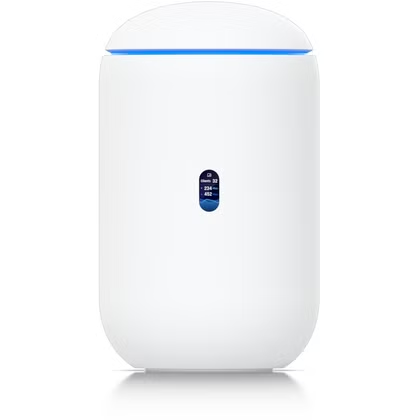
The Unifi Dream Router 7 is a full-fledged network appliance offering NVR capabilities, fully managed switching,a built-in firewall, VLANs, and more. With four 2.5G Ethernet ports (one with PoE+) and a 10G SFP+ port, the Unifi Dream Router 7 also features dual WAN capabilities should you have two ISP connections. It includes a 64GB microSD card for IP camera storage, but can be upgraded for more storage if needed. With Wi-Fi 7, you’ll be able to reach up to a theoretical 5.7 Gbps network speed when using the 10G SFP+ port, or 2.5 Gbps when using Ethernet.
Source: Read Full Article