








Key Takeaways of Kleptoparasitism
- Kleptoparasitism is a type of foraging where one animal steals food from another.
- There are three primary types of kleptoparasitism: overt aggression, competitive scramble, and stealth.
- Researchers are using new tracking technology to better understand kleptoparasitism.
The seagull with a French fry stolen from a sparrow. The monkey with a water bottle snatched from a tourist. The chihuahua with the dog biscuit that was clearly meant for her canine sister.
Animals routinely steal food from one another. Scientists have long observed how snatching can be a feeding strategy. But in recent years, advancements in tracking technology have helped researchers better understand kleptoparasitism and its surprising ecological impact.
What Is Kleptoparasitism?
Kleptoparasitism is a form of foraging in which one animal takes food from another. If this sounds like outright thievery, scientists have also been tempted to look at it as such, according to the book Social Foraging Theory. In the literature, kleptoparasitism has been referred to as robbing, piracy, and stealing.
One ornithologist, published in Wiley, colorfully described white-throated sparrows as using juncos similar to how a person employs a truffle-sniffing pig.
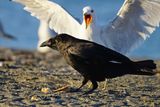
There are three primary types of kleptoparasitism: overt aggression, competitive scramble, and stealth. With overt aggression, one animal uses force to steal. (Think: A pigeon ripping a potato chip away from a sparrow.)
Competitive scrambles are when a food source becomes suddenly available, and animals rush in as if a piñata burst open. And stealth involves the stalk-and-snatch approach, in which kleptoparasites wait for the right moment to help themselves to a free sample.
How Common Is Kleptoparasitism?
Kleptoparasitism is “very common,” according to a study from the publisher Springer, and has been well documented in the scientific literature across birds, fish, insects, mammals, and spiders.
Some animals rely heavily on kleptoparasitism as a food strategy, according to a study in Animal Behavior. Hyenas, for example, track other predators and then attempt to steal kills without getting injured. Similarly, seabirds like Jaegers and skuas get most of their nourishment by nabbing it from gulls, kittiwakes, or terns.
Other animals do not rely exclusively on kleptoparasitism, but they don’t pass up opportunities. Chipmunks, for example, will raid empty burrows and help themselves to other chipmunks’ seed supplies.
But what does it mean for the victim of theft when their stash is stolen? New tracking technology has been helping scientists learn more.
How Kleptoparasitism Shifts What’s On The Menu
In Yellowstone National Park, cougars (Puma concolor) have been adjusting to the reintroduction of wolf populations (Canis lupus). Researchers began tagging the cougars in 2015 with GPS collars that transmit hourly information on their activities, according to a report in PNAS.
“We follow them that way to monitor predation, so we can get their diet, we can get their kill rates, how often they are killing deer, elk, and bison,” Wesley Binder, the lead author on the PNAS study and a Ph.D. candidate at Oregon State University in the department of fisheries, wildlife, and conservation sciences, told Discover.
They can also detect when a cougar is chased off by a pack of wolves. Yellowstone wolves can travel in 10-member packs, so cougars must get out of their way or risk harm. This has meant that wolves are kleptoparasites that steal cougars’ kills.
For the cougars, portion size has been part of the problem. A cougar may need several days to polish off a large elk.
“We’ve had a solitary female kill an elk. You’ve got an animal that is 400 pounds, they will be there for weeks,” Binder said.
A few weeks is plenty of time for wolves to take notice and take over. With its feeding interrupted, cougars have been forced to go on another hunt.
But in the last few years, scientists noted an interesting shift as elk populations diminished. The cougars began hunting deer, a smaller animal that they can consume in as little as two days. Shorter feeding times mean fewer cougar-wolf interactions, which is beneficial for cougars as they adapt to the reintroduction of wolves to Yellowstone.
Both wolves and cougars were hunted in the U.S. to the point of near extinction. Now that populations are rebuilding, scientists are learning what it means to have apex hunters competing for resources.
“We haven’t had time to really understand the impact on these large carnivores in our communities,” Binder told Discover.
Read More: 3 Apex Predators — Snow Leopards, Wolves, and Leopards — Coexist by Choosing Different Prey
Article Sources
Our writers at Discovermagazine.com use peer-reviewed studies and high-quality sources for our articles, and our editors review for scientific accuracy and editorial standards. Review the sources used below for this article:
Source: Read Full Article