









April 10, 2026

Watch live—NASA’s Artemis II crew returns to Earth
On Friday these four astronauts and their Orion spacecraft will splash down in the Pacific Ocean after a 10-day mission around the moon
NASA has launched four astronauts on a pioneering journey around the moon—the Artemis II mission. Follow our coverage here.
NASA’s historic 10-day mission around the moon comes to an end today. The Artemis II astronauts onboard the Orion spacecraft are closing in on Earth and getting ready to make their final descent into the Pacific Ocean tonight.
The crew—NASA’s Reid Wiseman, Christina Koch, and Victor Glover and Canadian Space Agency astronaut Jeremy Hansen—will splash down off the coast of San Diego, Calif., around 8:07 P.M. EDT.
On Friday morning, the astronauts awoke to the songs “Run to the Water,” by Live, and “Free,” by the Zac Brown Band. Just before 3 P.M. EDT, the spacecraft performed a last major burn to correct its trajectory that lasted about eight seconds. The crew will also replace their cabin seats and put on their respective space suits for the return trip. The weather at the splashdown site is “excellent,” with winds at 10 knots, wave heights less than four feet and “a few broken and scattered clouds,” said NASA public affairs officer Rob Navias on the agency’s Artemis II livestream on Friday.
On supporting science journalism
If you’re enjoying this article, consider supporting our award-winning journalism by subscribing. By purchasing a subscription you are helping to ensure the future of impactful stories about the discoveries and ideas shaping our world today.
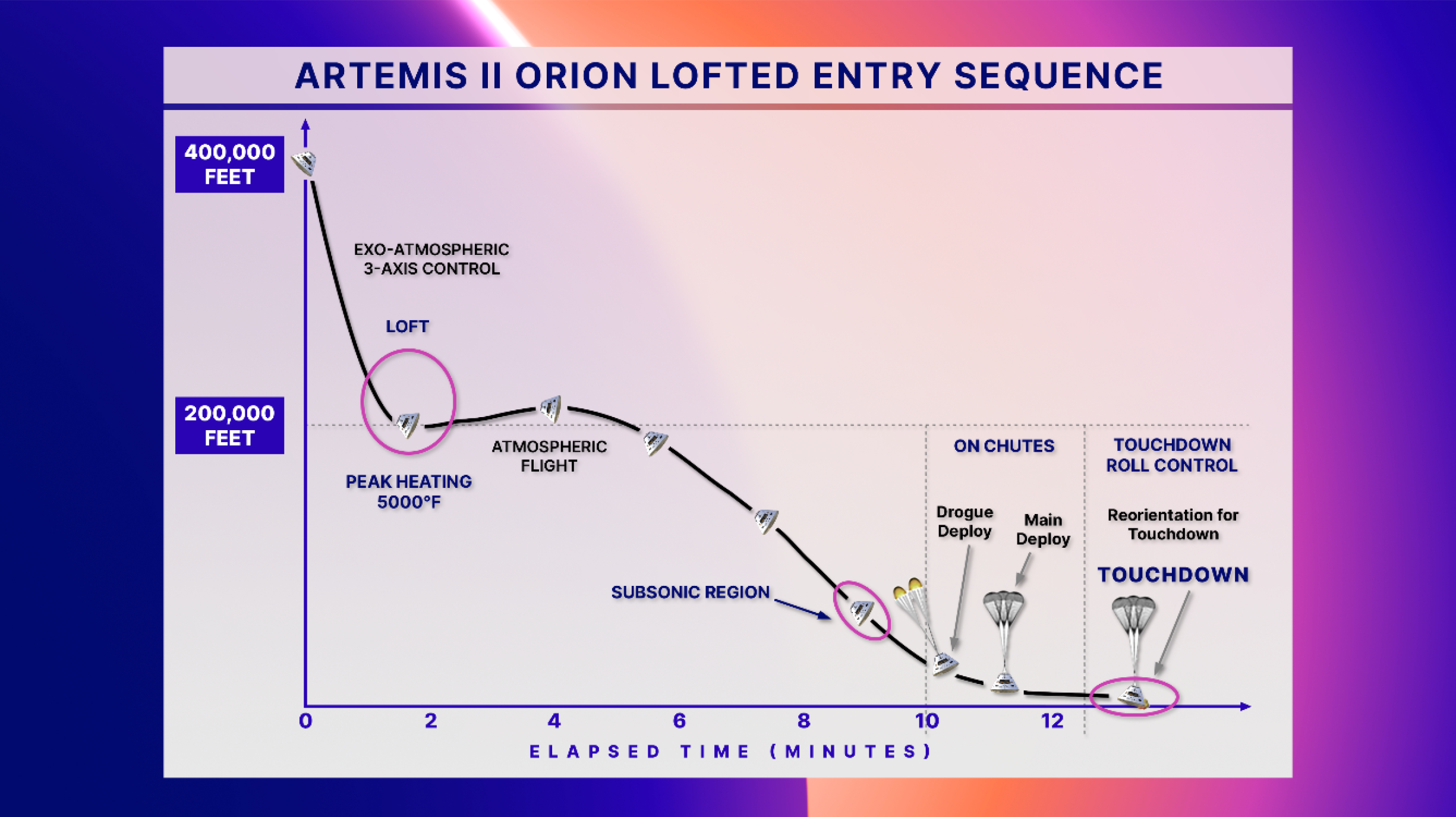
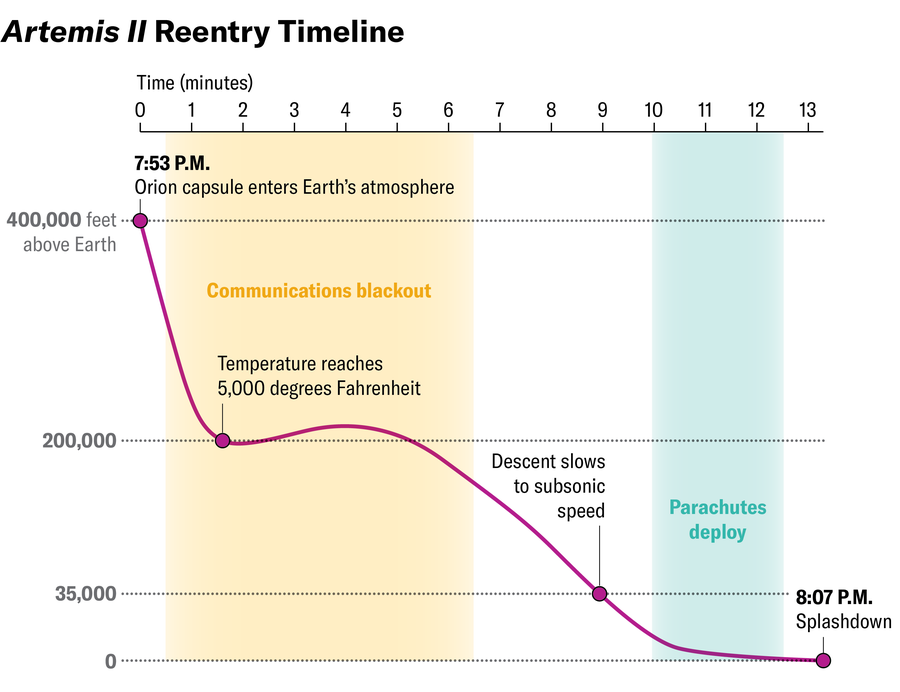
The Orion spacecraft, named Integrity by the crew, will reenter Earth’s atmosphere at nearly 24,000 miles per hour and is expected to withstand temperatures of up to about 5,000 degrees Fahrenheit (2,760 degrees Celsius) as it plummets to Earth.
The reentry timeline kicks off after the Orion crew’s capsule separates from the service module, which holds fuel in addition to oxygen and water for the crew. That will happen at around 7:33 P.M. EDT, according to NASA. Then the capsule will make a “raise burn” to refine its trajectory. Orion will officially enter Earth’s atmosphere at around 7:53 P.M. EDT, with splashdown projected about 13 minutes later.
“It’s 13 minutes of things that have to go right,” said Artemis II flight director Jeff Radigan at a press conference on Thursday.
Amanda Montañez; Source: NASA (reference)
During this period, superhot plasma will build up and engulf the spacecraft as it falls, causing mission control in Houston to lose contact with the crew for about six minutes.
Then, as it passes below 35,000 feet, the capsule will deploy a series of parachutes that will eventually slow the craft’s speed to less than 20 miles per hour. After landing in the water several hundred miles off the California coast, NASA and U.S. military officials will retrieve the astronauts by helicopter before taking them to a Navy ship called the USS John P. Murtha. Koch will emerge first from the spacecraft, followed by Glover, Hansen and then Wiseman, NASA’s Navias said on Thursday.
From San Diego, the crew is expected to fly to Houston’s Johnson Space Center, where they will reunite with their families.
Editor’s Note (4/10/26): This is a developing news story and will be updated.
It’s Time to Stand Up for Science
If you enjoyed this article, I’d like to ask for your support. Scientific American has served as an advocate for science and industry for 180 years, and right now may be the most critical moment in that two-century history.
I’ve been a Scientific American subscriber since I was 12 years old, and it helped shape the way I look at the world. SciAm always educates and delights me, and inspires a sense of awe for our vast, beautiful universe. I hope it does that for you, too.
If you subscribe to Scientific American, you help ensure that our coverage is centered on meaningful research and discovery; that we have the resources to report on the decisions that threaten labs across the U.S.; and that we support both budding and working scientists at a time when the value of science itself too often goes unrecognized.
In return, you get essential news, captivating podcasts, brilliant infographics, can’t-miss newsletters, must-watch videos, challenging games, and the science world’s best writing and reporting. You can even gift someone a subscription.
There has never been a more important time for us to stand up and show why science matters. I hope you’ll support us in that mission.
Source: Read Full Article