








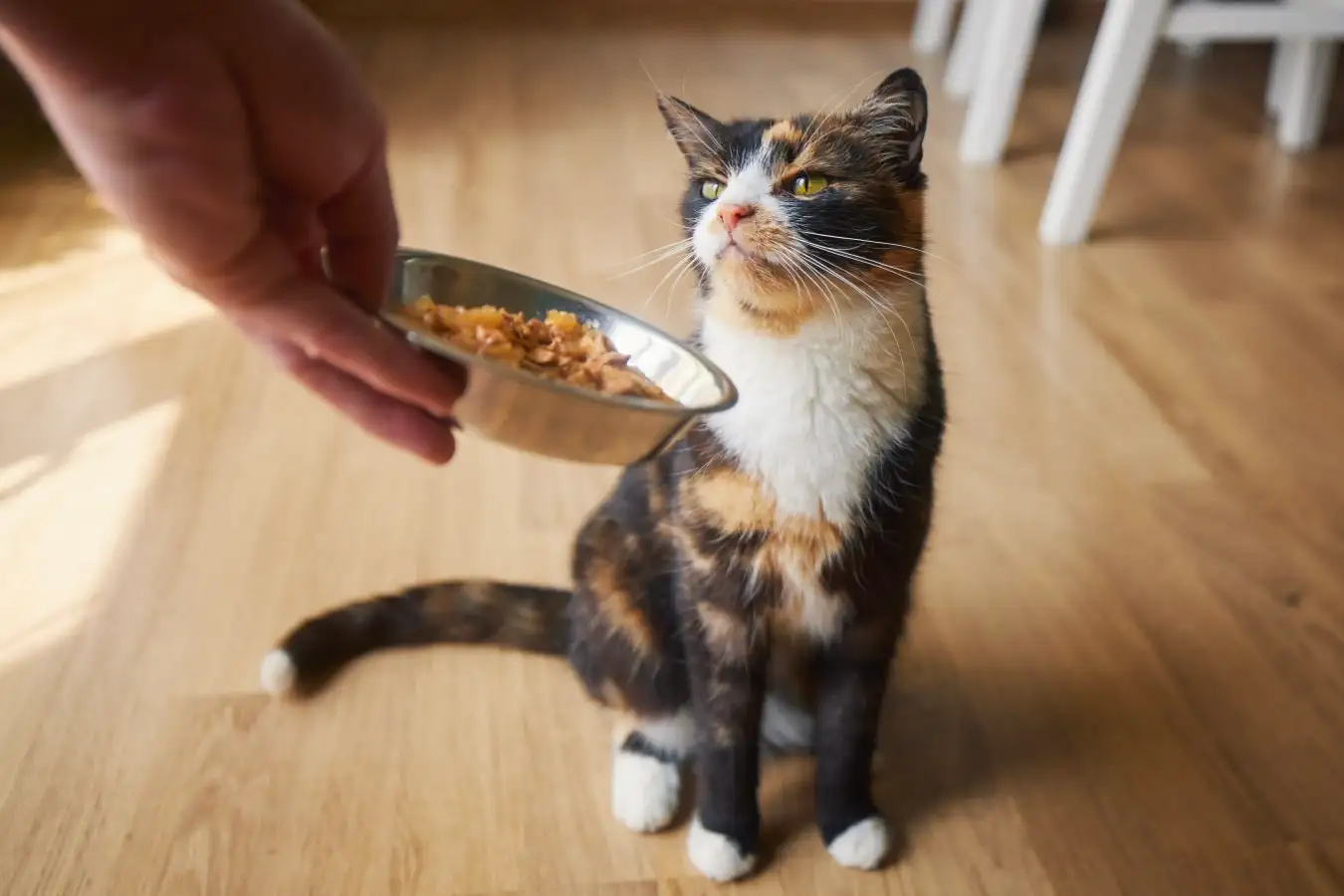
Cats may find food more appealing if it has a distinct odour
Jaromir/Getty Images
Cats that refuse their regular food might simply have become disenchanted by its odour – a discovery that suggests new strategies pet owners can explore to encourage their felines to eat.
Many owners have felt the frustration of feeding finicky cats – buying food that the animals seem to like, only to see them turn their noses up at it a few days later. While that can give cats a reputation for being demanding, it turns out that simply tweaking the way the food smells could accommodate the pets and make mealtimes more enjoyable, says Masao Miyazaki at Iwate University, Japan.
“This might include adding a topper, slightly varying the food or refreshing the feeding environment,” he says. “Cats may not be ‘picky’ in the human sense, but instead may lose interest when the smell becomes familiar.”
He and his colleagues ran a series of experiments with 12 cats – six males and six females, none of which had been sterilised. They offered each cat a variety of commercial dry cat food for 10 minutes and monitored how much was eaten. Then each cat had a 10-minute break, followed by a further 10-minute access to either the same food or a different variety of dry cat food. The researchers repeated this exercise six times in a row, meaning the experiment lasted 110 minutes. The cats ate less and less at each round – but that was especially true when the food was always the same. On average, switching to a new food each time led to about twice as much total consumption compared with always having the same food.
To find out how smell affected that intake, the researchers ran the experiment again, offering the same food in each of the six feeding sessions, but placing it in the upper part of a double-compartment bowl with a perforated divider. In the lower part of the bowl, the researchers placed additional cat food that the cats could smell but not touch. For the first five rounds, the food in the top and bottom compartments were the same – and intake declined as expected. But on the sixth round, the researchers switched the lower – inaccessible – food for a different kind with a distinct odour. That change of smell alone led to a considerable rebound in this final cycle, with cats eating roughly twice as much as they had in the previous round.
The findings suggest that smells have a strong effect on cats’ appetites, says Miyazaki.
“This phenomenon certainly accounts for the many, many cans of cat food in the supermarket,” says Katherine Houpt at Cornell University in New York state. “And it makes me wonder: do cats switch from mice to birds after eating a mouse or two?”
“I have both professional and personal experience of just how finicky eaters cats can be,” says Scott McGrane at the Waltham Petcare Science Institute, UK. “This paper provides interesting insights into the role food aroma plays on eating behaviour. Feeding different wet food flavours and also a mixed wet and dry food feeding regime can help to provide flavour variety and maintain food intake for cats.”
For David Thomas at Massey University in New Zealand, though, the findings may hint at a source of obesity in pet felines. “This also partly explains why modern feeding strategies with greater variety of flavours – like variety packs of pouches – may result in weight gain in cats,” he says.
Still, Mikel Delgado, an independent cat behaviour expert in Sacramento, California, notes that pet owners can aim to keep cats enjoying their meals – by offering a multitude of smells and flavours, and even choices at each mealtime – while managing daily food intake and overall health to maintain healthy weight.
Importantly, people should remember to wash their cats’ bowls to eliminate odours from previous meals, says Delgado. And she adds that if cats continue to be finicky even if pet owners take such measures, they may have underlying health issues that need investigation.
Topics:
Source: Read Full Article