










You download a file from the internet only to discover that it isn’t in the format you need. Your editing programs don’t like it, the thumbnail isn’t displaying properly, and what is a WebP anyway? Thanks to an open-source project, you can now instantly convert most common media files by simply right-clicking them.
There are so many file formats I never want
Does anyone mean to download a WebP?
If you spend any amount of time collecting files from the internet, you’ll quickly run into the situation where you have a huge mix of files, and as often as not, they’re not in the format you want.
In my experience, WebP tends to be the worst offender. It is a lightweight image format that is great for websites, but a surprising number of applications can’t use it. You need to convert it into another format, like PNG or JPG, first.
I also frequently find myself converting some media formats, like OGG, into more common media formats, like MP3. OGG is fine from a technical perspective, but it doesn’t have the near-universal compatibility of MP3.
When this happens a dozen times per day—or more, when I’m exploring a new project—it gets tiring quickly.
That is exactly the issue that File Converter solves.
File Converter is an open-source project that lets you convert anything, instantly
All you need to do is right-click
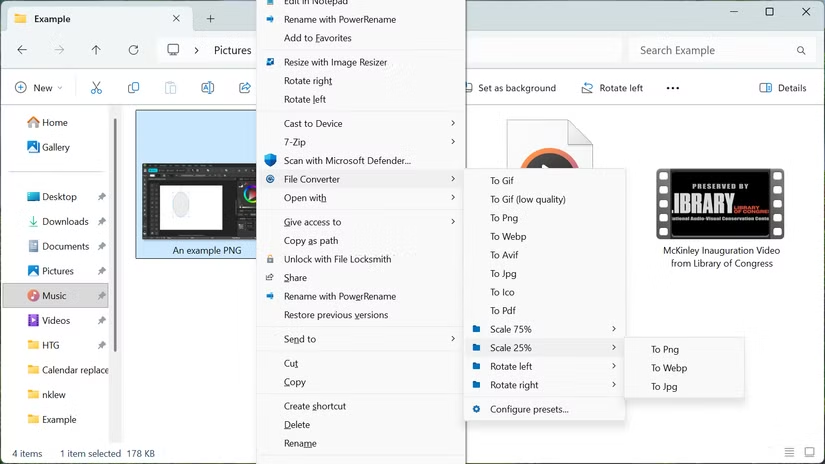
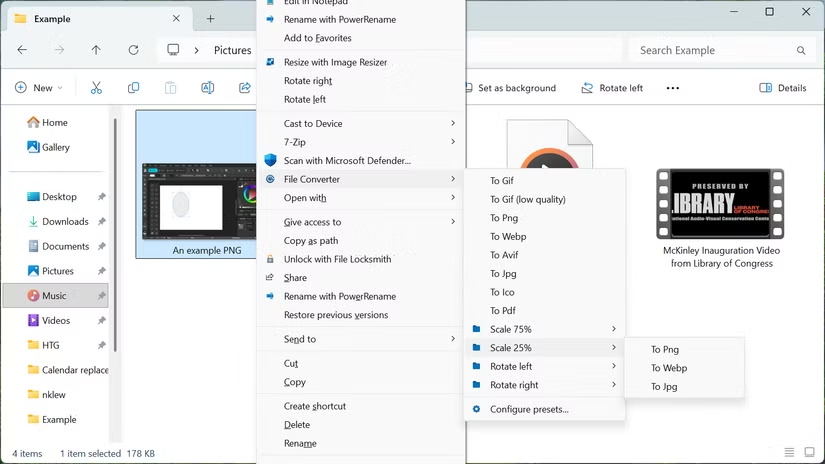
File Converter is an open-source project that gives you access to conversion tools in the full right-click context menu; any time you click a media file, you’ll see the options available for a media file of that type.
Under the hood, File Converter leans on several other open source projects to handle file conversion, including:
What can File Converter convert?
File Converter supports a huge range of files, primarily determined by FFmpeg and ImageMagick.
|
Image |
Video |
Audio |
|---|---|---|
|
JPG |
MKV |
MP3 |
|
PNG |
MP4 |
AAC |
|
GIF |
WEBM |
WAV |
|
BMP |
OGV |
OGG |
|
AVIF |
AVI |
|
|
WEBP |
GIF |
|
|
ICO |
It also supports a handful of other conversions that you might find useful. For example, you can convert image files into PDFs, which can occasionally be handy if you need to upload an image somewhere that doesn’t support typical image file formats.
Installing and using File Converter
Watch out for unofficial versions
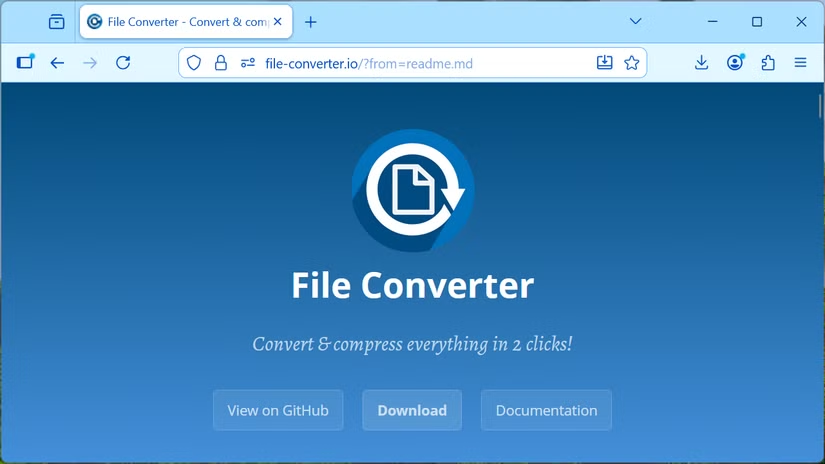
File Converter is available from one place: the official website. Even the GitHub links back to the official website.
If you see File Converter listed elsewhere, you should be extremely careful. I stumbled across one piece of malware that was pretending to be the real File Converter.
The legitimate download comes as an MSI file.
Using File Converter
Once File Converter has been installed, all you need to do is Shift+Right-Click the relevant file, select File Converter, and then select the new file format you want.
File Converter, by default, will not overwrite your existing file. Instead, it creates a duplicate to ensure that you don’t lose anything important.
Above and beyond converting files, it also has basic manipulation tools available, too. For example, if you have an image file, you can resize it automatically to 75% or 25% of the original resolution. You can also rotate it.
If you have an audio or video file, you can adjust the playback speed or the pitch of the audio.
Customizing File Convert’s options
File Converter’s options are great to have, but I don’t make use of some of the options at all, and I wanted to remove them to reduce the amount of clutter in the user interface.
The right-click menu is already extremely crowded, and cleaning it up is surprisingly difficult.
To adjust the options available in File Converter, Shift+Right-click any image, audio, or video file, then select Configure presets at the bottom of the list.
Once in the Settings, you can select a conversion option and then disable that option for specific file types. As an example, I’ll never use the 25% or 75% scale feature for photos, the 720p scale option for videos, or the option to adjust the pitch of audio files.
So, I went through and disabled those options for every single file type by clicking the first option under Input Formats on the right. If you just want to disable them for specific file types, you could also do that.
A convenience program, not a full editor
File Converter doesn’t take the place of a fully-fledged image, video, or audio editor. For those, I’d recommend Affinity for images, DaVinci Resolve for video, and Audacity for basic audio editing.
Source: Read Full Article