






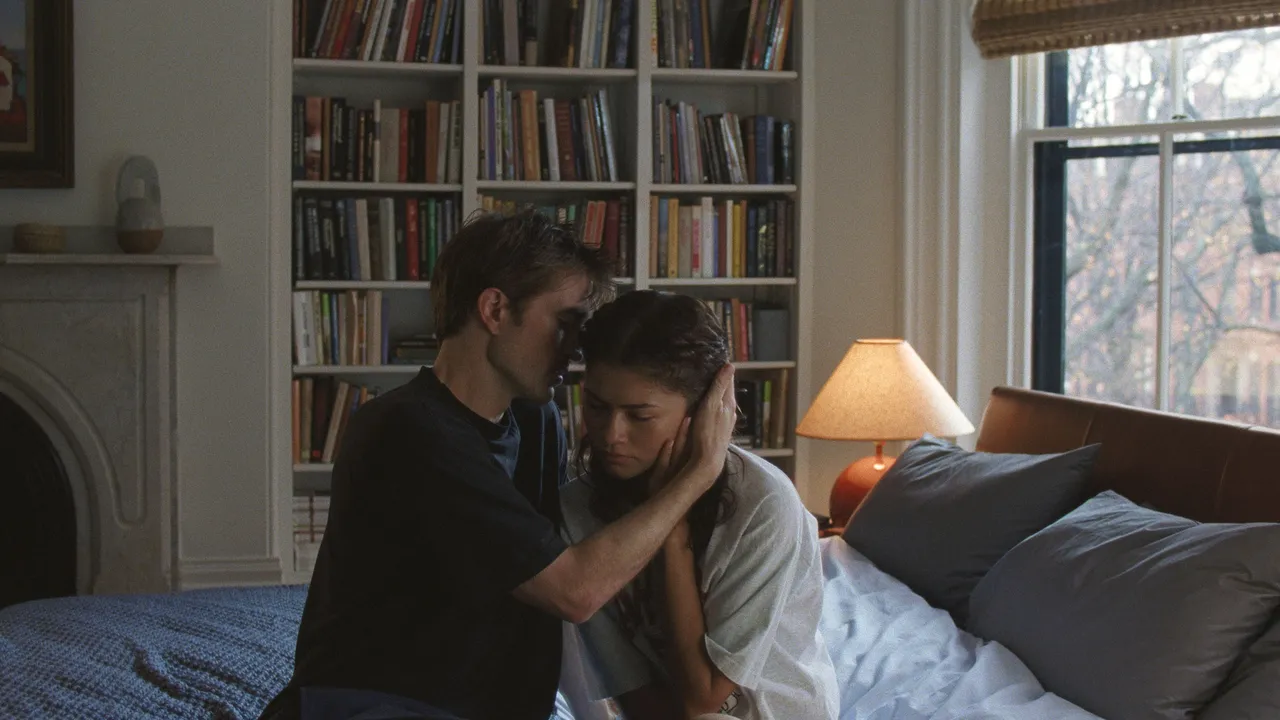
Does the movie itself know who she is? I’m not so sure. Emma is a literary editor, though the specifics are awfully vague—a late subplot involving challenges on the job feels particularly superficial—and her love for literature seems to begin and end with that novel in the café. Zendaya more than fulfills the central requirement of a romantic lead—when she’s onscreen, you can’t imagine looking at anyone else—but her striking presence alone can’t provide the psychological illumination that the film needs as a portrait of repressed, and ultimately redeemed, violence. “The Drama” has a juicy, combustible premise that it struggles to justify, not because there’s anything inherently distasteful about broaching the subject of real-world gun violence in the context of a sexy, tempestuous Hollywood melodrama but, rather, because Emma’s deep, dark secret simply doesn’t ring true.
Some might contend that this seeming implausibility is very much to the film’s point, insofar as many shooters’ identities have taken their communities by surprise. (One scene acknowledges the relative rarity of shootings committed by women, mainly so that it can then conveniently bat that statistic away.) But Borgli undermines his premise—ironically, by attempting to substantiate it. He repeatedly flashes back more than a decade to the high-school-age Emma, played by Jordyn Curet, who bears little physical or emotional resemblance to her Zendaya counterpart. Is that also the film’s point—that people can, in fact, transform themselves dramatically—or is it plain bad casting? Would it have made more sense for Zendaya, although several years older than when she first starred as a teen-age drug addict on the HBO series “Euphoria,” to embody Emma’s younger self as well? In any event, Curet’s Emma is a case study and a cipher. She’s lonely, isolated, and bullied; she wears nerd-coded glasses one minute and disreputable eye makeup the next. She has ready access to her father’s military rifle, which she drags around her family’s pointedly empty house as if it were her closest companion. Emma is turned on by the aesthetics of sociopathic rage and enjoys making online videos in which she spews hatred and poses with the rifle. But she is most heavily influenced, the film suggests, by the sheer ubiquity of school shootings and gun culture, which has contaminated America at large with a free-floating psychic residue of mass violence.
Borgli, a co-editor on the film, cuts jaggedly between past and present, and sometimes between reality and hallucination. Watching the young Emma, we can never be entirely sure if we are seeing an accurate representation of a distant time, a distorted memory of Emma’s, or a paranoid imagining of Charlie’s. In a way, the filmmaker is accessing the slippery terrain of his previous work, “Dream Scenario” (2023), an ominous black comedy that starred Nicolas Cage as a kind of flop-sweaty Freddy Krueger figure—a nebbishy professor who invaded the dreams of everyone around him. It was, like “The Drama,” a story about the dangerous power of suggestion, the repeated blows to our collective psyche, and the ease of villainizing someone for things that they didn’t actually do.
“Dream Scenario” was darkly amusing for a while, before it ultimately crapped out, unable to sustain either its funny-scary genre mechanics or its moribund cancel-culture subtext. “The Drama,” for all its miscalculations, is better at holding your interest. It was richly shot, on film, by Arseni Khachaturan, who brings out a lustrous golden-afternoon warmth in the film’s Boston locations, and it has an intensely jangly horror-film score, by Daniel Pemberton, that keeps your nerves suitably off-balance. Mostly, though, it holds you for a structurally built-in reason, the kind that keeps wedding movies in business. It isn’t just Emma but Charlie and Emma’s very beautiful and expensive nuptials that are in danger of being cancelled.
What’s the worst thing you’ve ever done? Forced to play the game himself, Borgli might not supply what many would deem the obvious answer: a relationship that he had in his twenties with a teen-age girl from Oslo. She was ten years his junior and not yet of voting age (eighteen) but over the age of consent (sixteen). Borgli wrote defensively about his “May-December romance” in an essay that was published by a Norwegian magazine in 2012; an English translation recently resurfaced in The Hollywood Reporter during the publicity campaign for “The Drama,” which is being released in theatres this week by A24. In short, the toxic cloud of judgment that Borgli seeks to interrogate has settled around and polluted the reception to the movie itself, forming a kind of life-versus-art ouroboros that, in the eyes of the most cynical marketeers, might seem less a blow than an opportunity.
Source: Read Full Article